Clear Sky Science · en
New insights from the bias-corrected simulations of CMIP6 in Northern Hemisphere’s snow drought
Why Less Snow Should Worry Us All
Across much of the Northern Hemisphere, winter snow is more than a pretty backdrop—it is a vast, natural water reservoir. Snow that falls in winter and melts in spring feeds rivers, fills reservoirs, sustains crops, powers dams, and supports winter tourism. This study asks a pressing question: as the climate warms, how will future "snow droughts"—winters with unusually low snowpack—change, and what does that mean for water security and communities that depend on reliable snow?
Making Climate Models Match the Real World
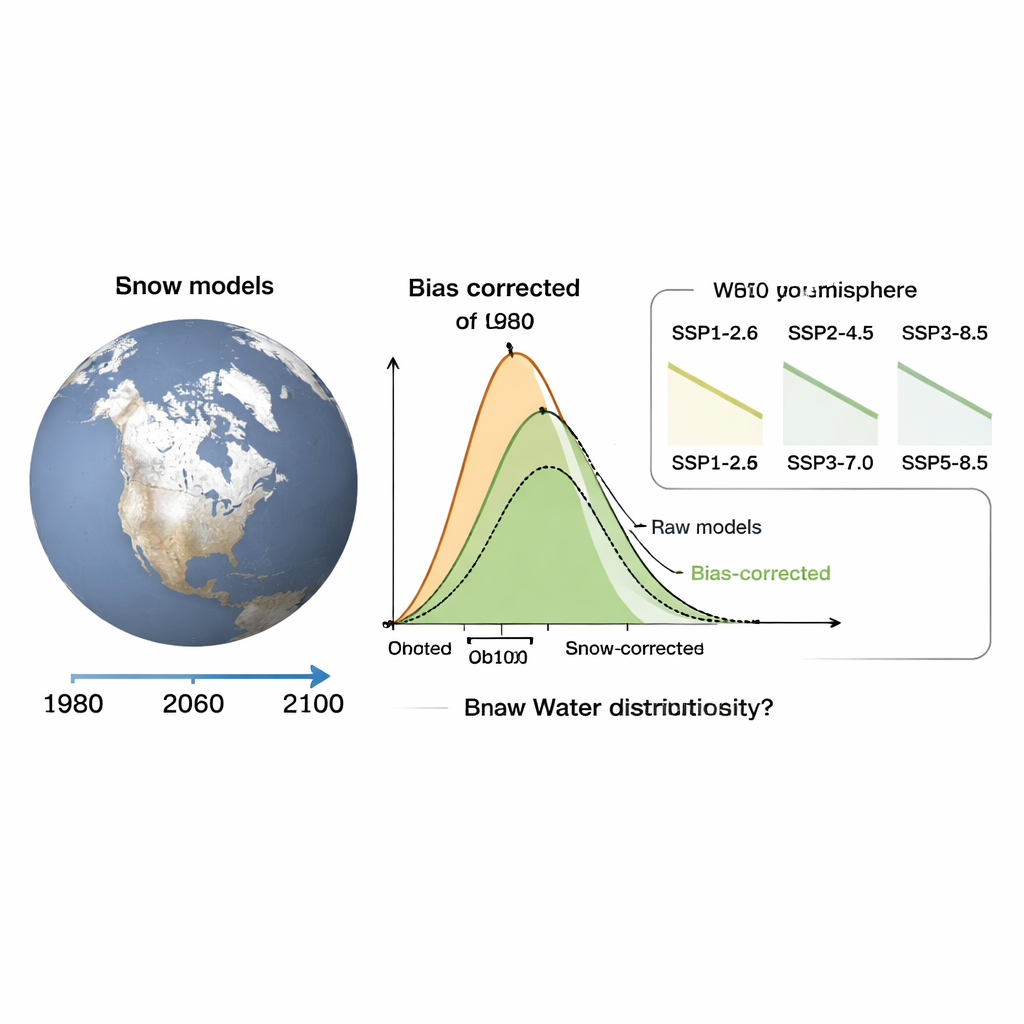
Climate models are our main tool for looking into the future, but they often misjudge how much snow actually piles up on the ground. Many of the latest CMIP6 models simulate far too much snow over regions like northern North America and Eurasia. If those biased simulations are used directly, they make future snow shortages look less serious than they really will be. To fix this, the authors used a statistical method called CDF-t bias correction, which carefully adjusts model output so that its full range—including rare extremes—matches decades of observed snow data over 1982–2014.
Sharpening the Picture of Future Snow
After bias correction, the models’ estimates of snow water equivalent—the amount of water stored in snow—line up much more closely with observations, both in time and across the map. The team then used this improved data from 29 climate models to calculate a Snow Water Equivalent Index, a standardized measure that tracks when snowpack is unusually low. Looking out to 2100 under four different greenhouse-gas pathways, they found that snow droughts have already been getting worse in recent decades and are projected to intensify further, especially under higher-emission scenarios. The higher the emissions, the faster the decline in this snow-based index.
Fewer Mild Winters, More Dangerous Ones
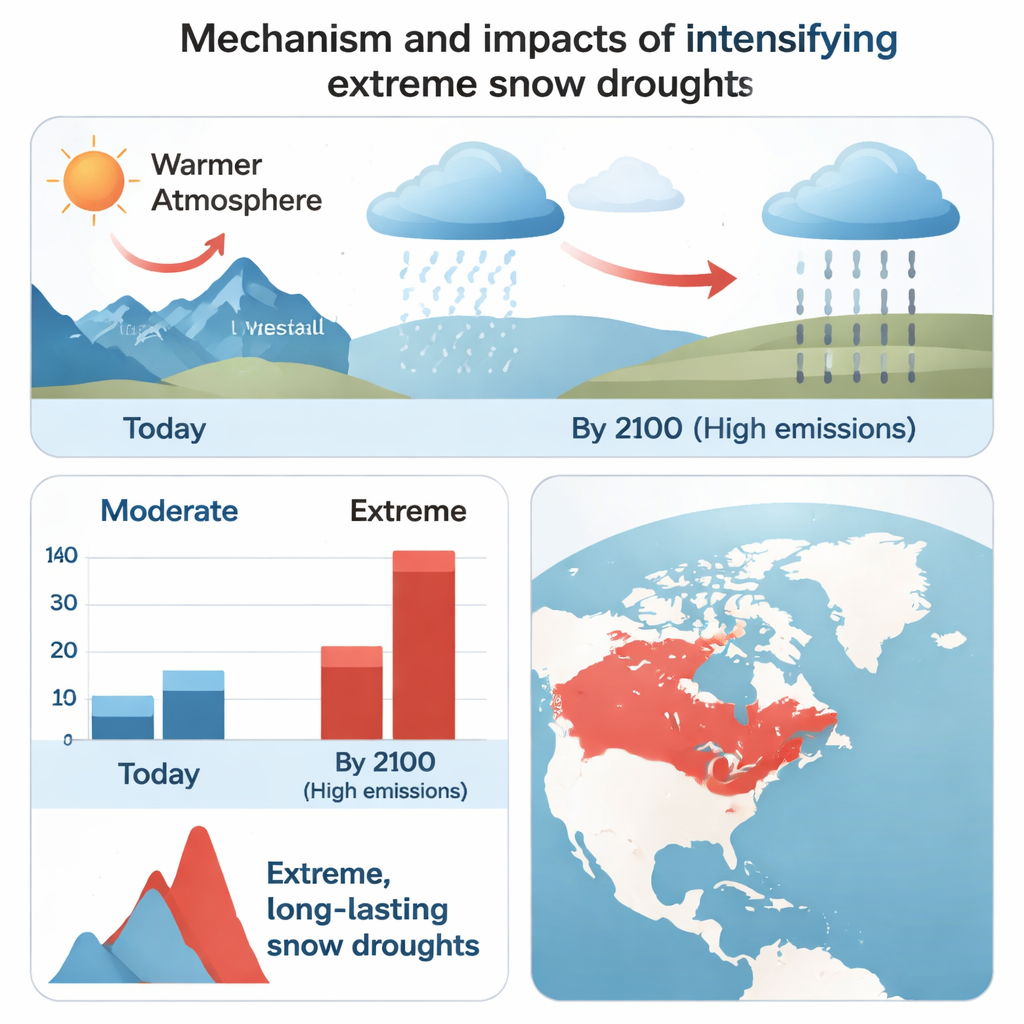
The study shows a striking shift in the character of snow droughts. In the future, milder droughts—years that are only slightly drier than normal—may become less common or shorter, particularly under strong warming. But this is not good news. At the same time, the most extreme snow droughts become much more frequent, more intense, and longer lasting. Under the high-emission SSP5-8.5 pathway, the harshest category of snow droughts is projected to last about half again as long as in recent decades and to occur far more often. Europe, western Asia, and central North America stand out as hotspots where these severe events cluster, posing serious risks for rivers, reservoirs, ecosystems, and economies.
What Is Driving the Change
By examining the underlying physics, the authors find that the main culprit is a decline in snowfall itself. As temperatures rise, more winter precipitation falls as rain instead of snow, and the number of snowy days drops steadily, especially under high emissions. With less snow arriving in the first place, the seasonal "snow bank" shrinks, leaving less water to melt in spring. While warmer conditions can also speed up snowmelt, this effect is limited simply because there is less snow to melt. In some regions, such as eastern Siberia, increased moisture transport actually boosts snowfall and snowpack, but these are rare exceptions in an otherwise widespread pattern of shrinking winter snow.
What This Means for People and Policy
For non-specialists, the message is clear: a warming climate is pushing us toward a world with fewer gentle snow shortfalls and many more extreme, long-lasting winters with dangerously low snow. Because snow is a delayed water source for downstream communities, this shift threatens water supplies for farming, hydropower, and cities, and undermines winter recreation industries. The study also shows that using uncorrected climate models understates these risks, especially for the most severe events. Under a low-emission, more sustainable pathway, the decline in snowpack slows and even partially reverses late in the century, demonstrating that rapid cuts in greenhouse gases can still help preserve winter snow and reduce the odds of the worst snow droughts.
Citation: Hu, Y., Yang, X., He, Z. et al. New insights from the bias-corrected simulations of CMIP6 in Northern Hemisphere’s snow drought. Commun Earth Environ 7, 165 (2026). https://doi.org/10.1038/s43247-026-03187-7
Keywords: snow drought, climate change, water resources, snowpack, Northern Hemisphere