Clear Sky Science · en
Cumulative hydrodynamic impacts of offshore wind farms on North Sea currents and surface temperatures
Why ocean changes from wind power matter
Offshore wind farms are becoming one of Europe’s main power sources, especially in the North Sea. But thousands of turbines don’t just pull energy from the wind; they also nudge the ocean itself. This study asks a basic but far-reaching question: as we pack more turbines into the North Sea, will we quietly reshape currents, water mixing, and even sea surface temperatures in ways that matter for marine life and climate?
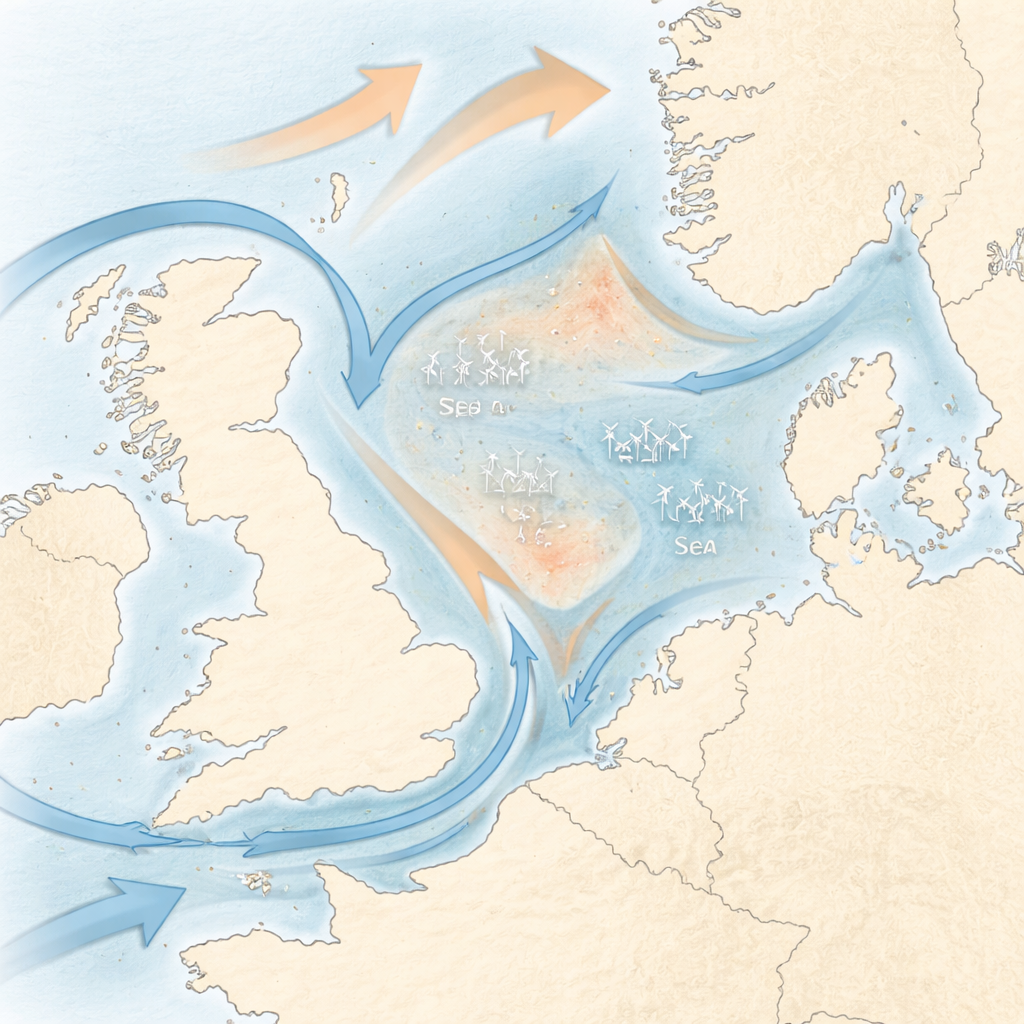
Slowing the sea’s natural traffic
The researchers used a sophisticated computer model of the central and southern North Sea, run over a decade, to compare a world with and without offshore wind farms. They tested today’s layout (about 4,700 turbines in 2023) and a future scenario that matches political goals for 2050, with more than 10,000 turbines. The model shows that wind farms collectively slow near-surface currents: today’s farms already reduce average surface speeds by around 10 percent where they are densest, and under the 2050 build-out, currents at some sites—especially in the German Bight—could weaken by more than 20 percent. At the same time, water speeds increase slightly in the gaps between large turbine clusters, as flow is deflected around these new “obstacles” in the sea.
Two kinds of wakes, two different footprints
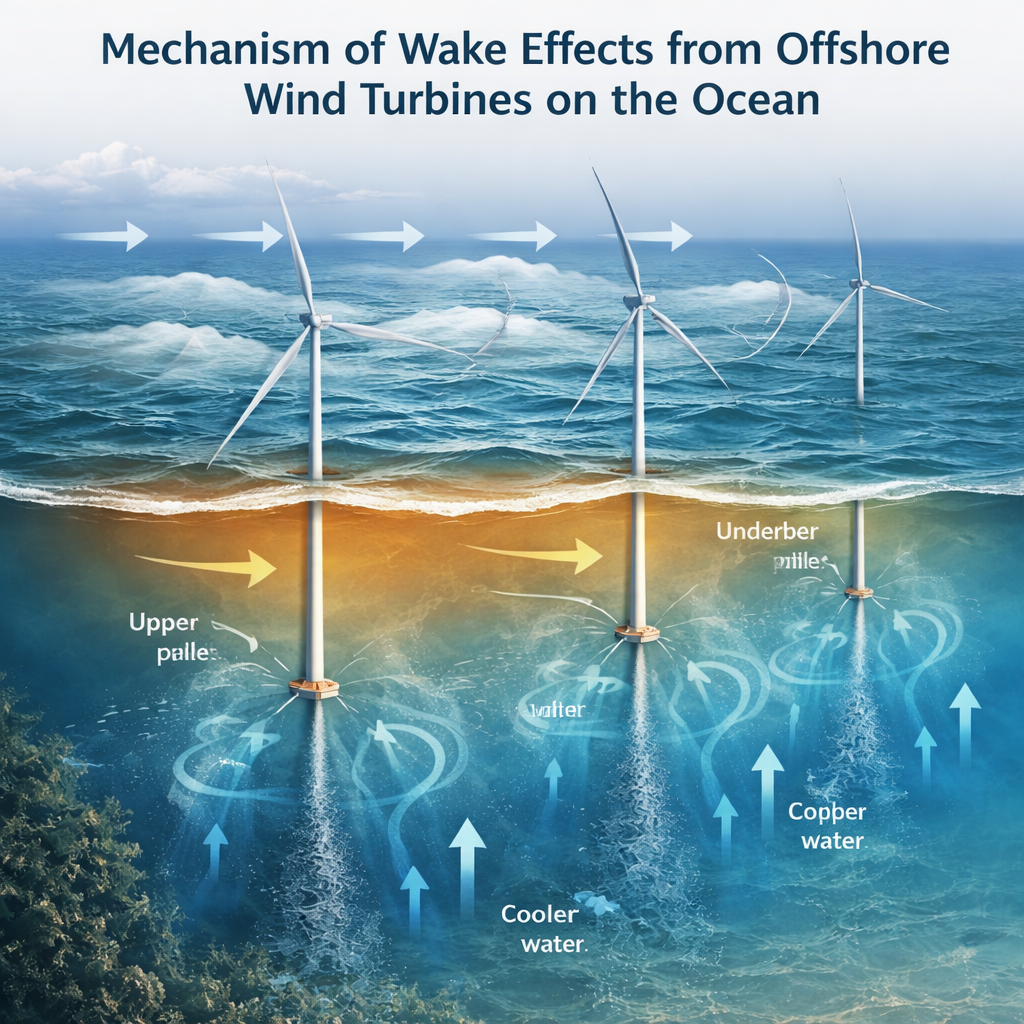
Each turbine creates two main types of wake. Above the surface, blades rob energy from the wind, leaving a long trail of slower, more turbulent air stretching tens of kilometers downwind. This weaker wind stress reduces the push on the sea surface and calms turbulent motion in the upper few meters. Below the surface, the turbine’s foundation acts like a post in a river, adding drag and spawning swirling, energetic currents in its immediate wake. The simulations show that these underwater wakes can boost local turbulence by more than 30 percent—sometimes exceeding natural levels—within a few hundred meters to kilometers of each structure. Together, these effects create a patchwork of quieted surface waters surrounding narrow “hotspots” of intense mixing.
Mixing, layers, and a subtle warming trend
This tug-of-war between calmer surfaces and stirred-up bottoms changes how the water column mixes. In areas with dense turbine spacing, like parts of the German Bight, the extra turbulence from foundations increases vertical mixing by 50 to over 100 percent at times, pulling colder, deeper water upward during summer. That can locally cool the surface by as much as about half a degree Celsius and weaken seasonal layering. Elsewhere, especially in more open, seasonally stratified regions such as east of Dogger Bank, the dominant signal is the opposite: weaker surface mixing and reduced air–sea exchange linked to slower winds. There, the surface warms by up to about 0.2 °C, and the boundary between warm surface and cooler deep water becomes shallower and sharper.
Shifting energy, sediment, and nutrients
Because currents slow near many wind farms, the overall kinetic energy of the system—its moving-water “budget”—drops by a few percent in the future scenario. Less vigorous bottom currents translate into weaker seabed shear stress over wide shallow areas, which can change how easily sediments are stirred up. Previous work suggests that such changes can alter how much organic material ends up buried in the seafloor versus kept in suspension, with knock-on effects for water clarity and primary production. The study also finds that the main tide in the region loses some energy while certain higher-frequency tidal components strengthen, showing that wind farms subtly retune the rhythm and shape of the tides themselves.
What this means for climate and marine life
On average, the model suggests that offshore wind expansion could nudge North Sea surface temperatures upward by roughly a tenth of a degree—small compared with year-to-year swings, but about 10 percent of the long-term warming expected from climate change alone. In stratified zones, stronger layering may make it harder for oxygen-rich surface water to reach the bottom, raising concerns for regions already prone to low oxygen. In mixed, tide-dominated areas, changes in wind-driven heat loss may matter more than mixing, pointing to complex feedbacks between wind farms, the ocean, and the atmosphere. The authors argue that as offshore wind grows from single projects to a basin-scale network, its physical footprint must be treated like any other major human driver in the sea—something planners and policymakers need to factor into future wind farm design, turbine spacing, and marine ecosystem management.
Citation: Christiansen, N., Daewel, U. & Schrum, C. Cumulative hydrodynamic impacts of offshore wind farms on North Sea currents and surface temperatures. Commun Earth Environ 7, 164 (2026). https://doi.org/10.1038/s43247-026-03186-8
Keywords: offshore wind farms, North Sea currents, ocean mixing, sea surface temperature, marine ecosystems