Clear Sky Science · en
Historical diurnal temperature range trends constrain future climate projections
Why today’s day–night temperature swing matters
Most of us notice when afternoons feel hotter or nights no longer cool down the way they used to. That daily swing between daytime highs and nighttime lows—the diurnal temperature range, or DTR—affects our health, crop yields, energy use, and ecosystems. This study shows that the way DTR has changed over recent decades can be used to sharpen our forecasts of how regional climates will respond to ongoing global warming, providing more reliable guidance for local planning.
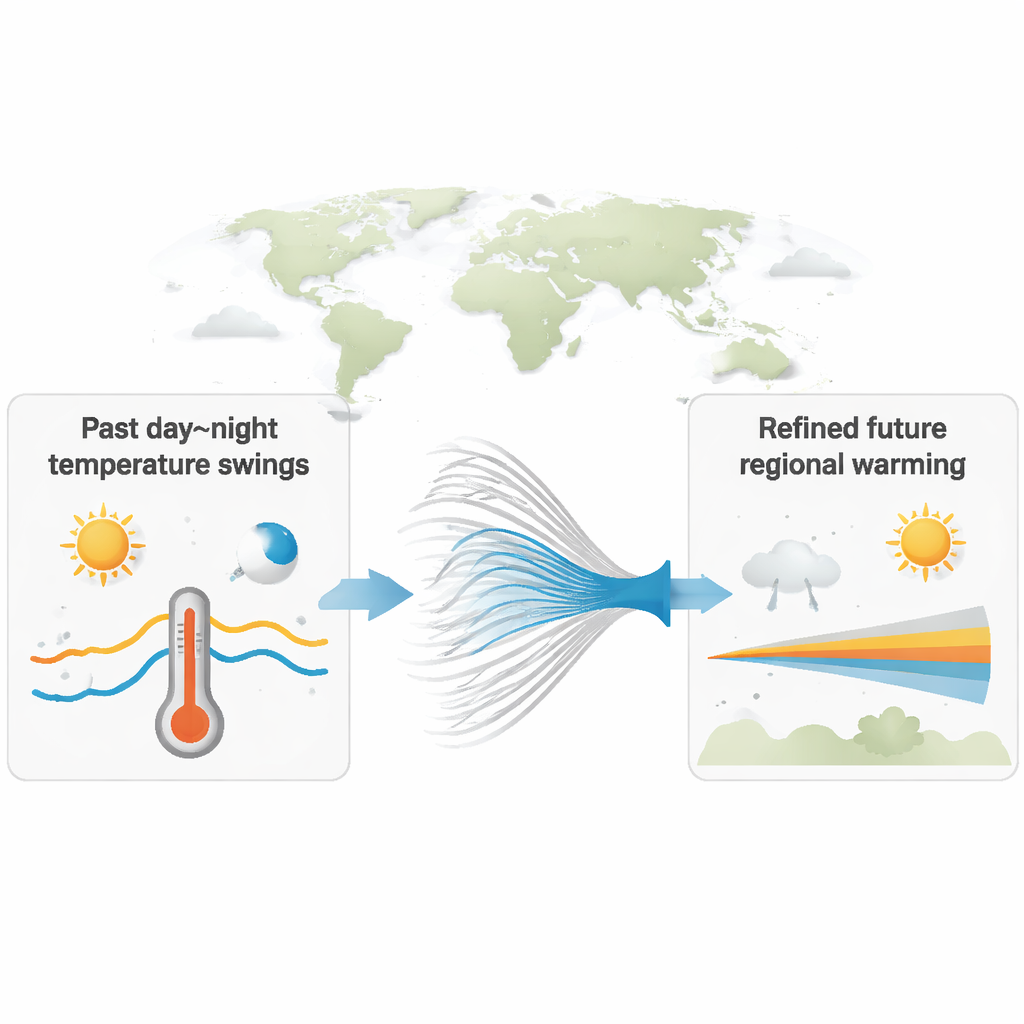
From daily highs and lows to future climate clues
DTR is simply the difference between a day’s maximum and minimum temperature, but it captures how heat and moisture move through the atmosphere and land. Earlier in the late twentieth century, nights warmed faster than days in many places, shrinking the DTR and giving rise to the idea of “nighttime warming.” More recently, in some regions the pattern has flipped: daytime highs are now rising faster than nighttime lows, widening the daily temperature swing. These shifts are closely tied to changes in clouds, soil moisture, and incoming sunlight, which also play major roles in shaping climate extremes such as heatwaves and cold snaps.
Finding a stable pattern across many climate models
Climate models disagree strongly about how DTR will change over land by late this century. Some project a narrower day–night range, others a wider one, even within the same region. The authors examined 26 state-of-the-art climate models and looked for an “emergent” pattern: a consistent link between each model’s simulated trend in DTR from 1981 to 2014 and its projection of future DTR change under continued greenhouse gas emissions. They found a clear relationship over most land areas: models that simulated a more positive (or less negative) historical DTR trend also tended to project a smaller future reduction—or even an increase—in DTR. This link held across different emissions scenarios and even when the historical period was extended to 2024, suggesting it is a robust feature rather than a coincidence.
Sharpening regional forecasts with real-world data
Because this relationship is strong in many regions, the researchers used observed DTR trends from a global temperature dataset to “nudge” the model projections toward reality. In practice, this means using the observed past trend to correct each model’s future estimate, then combining those corrected estimates. They applied this method to the 44 reference regions used in recent IPCC reports and found that in 27 of them—covering about two-thirds of global land—the correction was statistically reliable. In these regions, the constrained projections show that DTR will generally decrease with warming, especially in high-latitude areas such as the Russian Arctic, while some places like the Mediterranean, parts of South America, and sections of Africa and Asia are likely to see a stable or even larger day–night temperature swing. Importantly, this approach cuts model uncertainty by roughly 15% to 68% in those 27 regions, giving a much tighter range of possible futures.
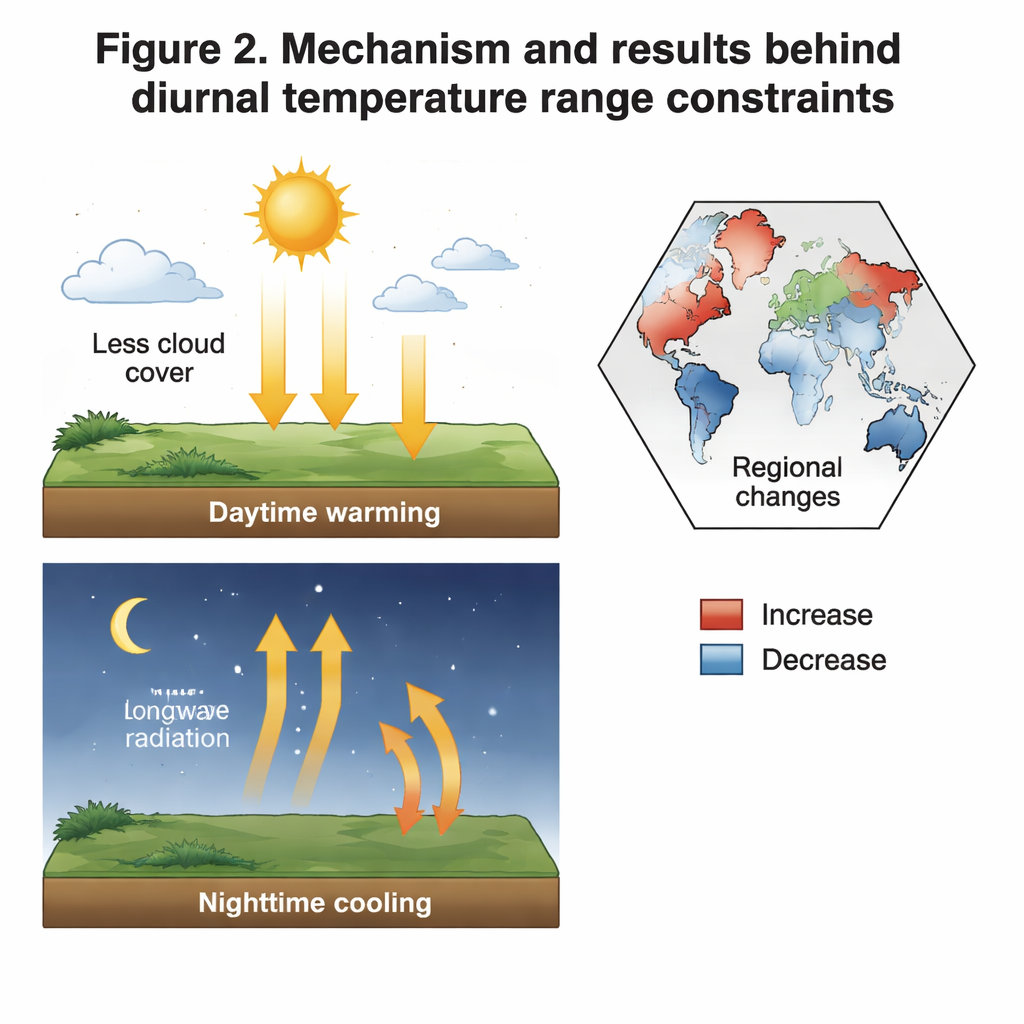
How clouds, sunlight, and soil moisture drive the changes
The study also explores why the historical and future changes in DTR line up so well. A key player is cloud cover. Fewer clouds allow more sunlight to heat the surface during the day, boosting daytime highs, while at night they alter the balance of infrared radiation that escapes back to space. The authors show that reductions in cloud cover are closely tied to increases in DTR, both in the past and in projections, and that this effect strengthens as greenhouse gases rise. Other factors matter too: soil moisture and the way heat and water move between land and air influence how strongly daytime temperatures spike and how much nights cool. Regions that dry out—because of less rain or higher evaporation—tend to see larger DTR shifts, especially in certain seasons.
What this means for people and planning
By demonstrating that past changes in day–night temperature swings can reliably constrain future projections, this work offers a new way to reduce uncertainty in regional climate outlooks. For decision-makers concerned with heat stress, crop yields, disease risks, or energy demand, knowing not just how much average temperatures will rise but also how the daily highs and lows will stretch or compress is crucial. The study finds that external factors—especially greenhouse gas emissions and cloud-related changes—have left a lasting imprint on DTR that will continue into the future. Using that imprint to refine model projections brings us closer to the level of detail needed for informed local climate adaptation and policy.
Citation: Liu, A., Xue, D., Yang, B. et al. Historical diurnal temperature range trends constrain future climate projections. Commun Earth Environ 7, 163 (2026). https://doi.org/10.1038/s43247-026-03185-9
Keywords: diurnal temperature range, regional climate projections, cloud cover, greenhouse gases, climate extremes