Clear Sky Science · en
Climate change and ocean acidification pose a risk to underwater cultural heritage
Hidden Museums Beneath the Waves
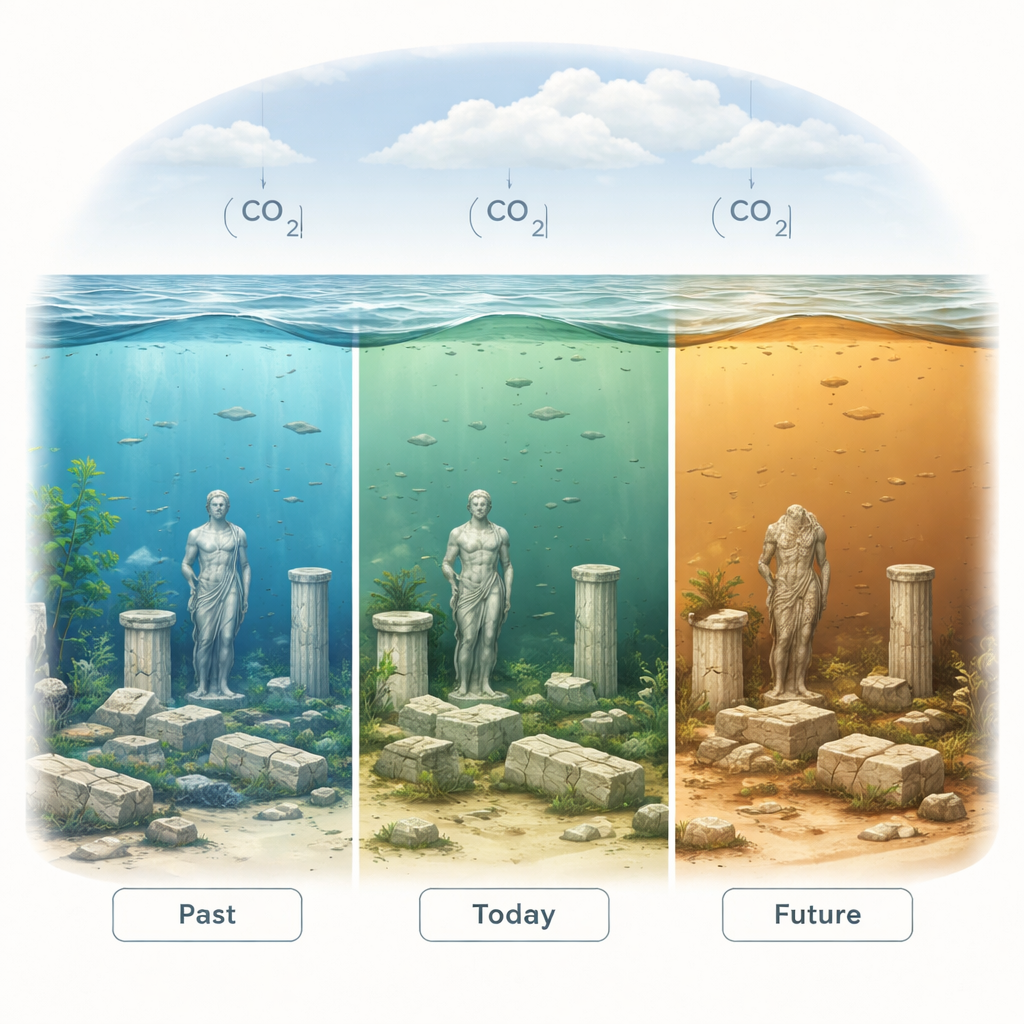
All over the world, traces of past civilizations lie quietly on the seafloor—sunken cities, harbors, shipwrecks, and carved stone statues. We usually think of climate change as a threat to polar bears or coral reefs, but this research reveals that it also endangers these underwater time capsules. As oceans take up more carbon dioxide from the air and become more acidic, the very stones that preserve our history begin to dissolve, slowly erasing details that have survived for thousands of years.
Why Sea Water Is Turning Against Stone
The oceans act as giant climate regulators, absorbing heat and a large share of the carbon dioxide produced by human activities. This service comes at a cost: when carbon dioxide dissolves in seawater, it forms a weak acid that lowers pH. Since the pre‑industrial era, average ocean acidity has already risen by about 30%, and it is projected to increase much further if greenhouse gas emissions remain high. While scientists have long studied how this harms marine life—especially shell‑forming organisms—little attention has been paid to what it means for underwater cultural heritage made from carbonate rocks such as marble and limestone.
Testing Ancient Stones in Future Oceans
To fill this gap, the authors designed an experiment that mimics past, present, and possible future oceans. They focused on four common historical building stones: Carrara marble, Roman travertine, a dense limestone known as Istria stone, and a more fragile porous limestone. Some samples were placed for a year at natural carbon‑dioxide vents off the island of Ischia in Italy, where volcanic gas bubbles create patches of seawater with different acidity levels. Others went into a custom laboratory tank that carefully controlled temperature, pressure, and pH. By repeatedly scanning the stone surfaces in three dimensions, the team measured how much material was lost and how the texture changed under each set of conditions.
From Slow Weathering to Runaway Erosion
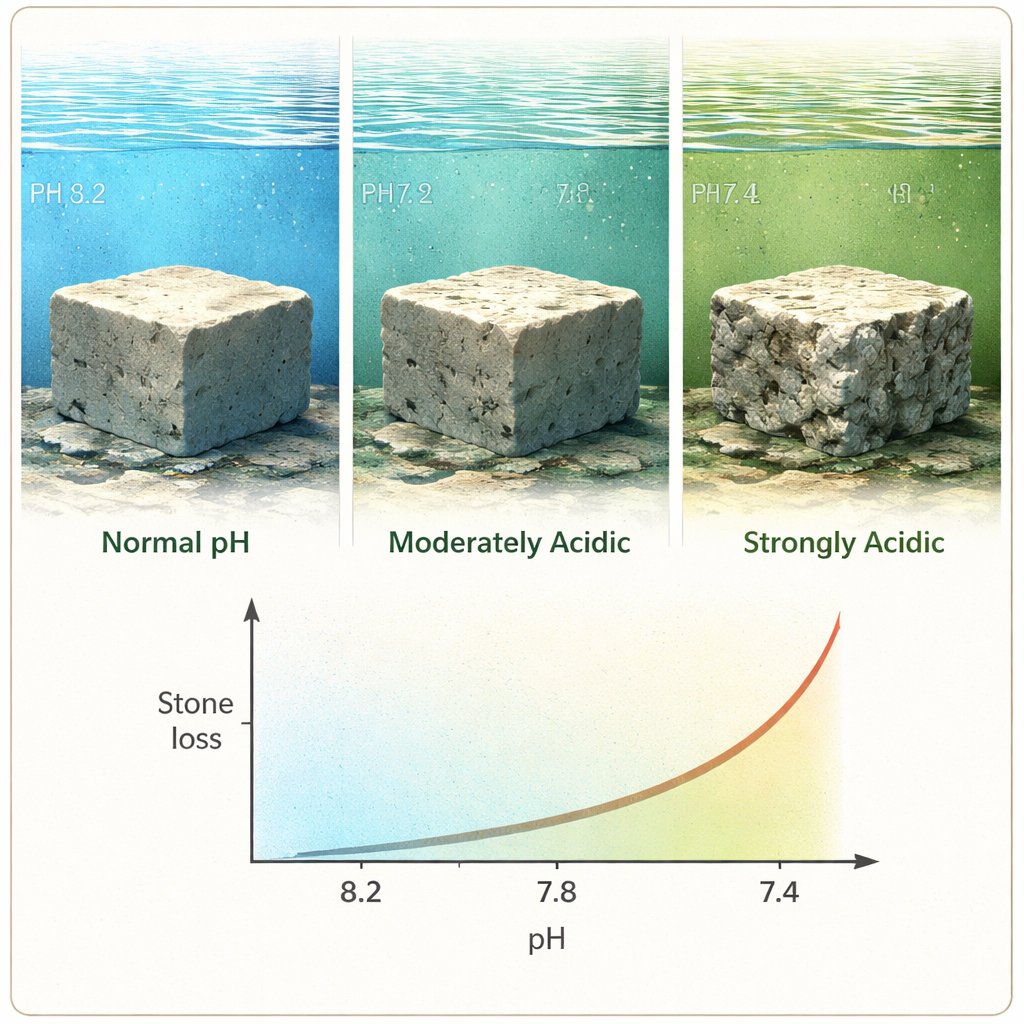
The results show that today’s and past ocean conditions cause only tiny amounts of wear on most of these stones—often less than a millionth of a meter per year for marble and dense limestone, and somewhat more for the porous variety. But as pH drops to values expected later this century under high emissions, the pace of loss increases sharply, and at even lower pH it accelerates dramatically. At a pH of 7.0, for example, porous limestone can lose hundreds of micrometers of surface each year, more than ten times its loss at modern pH levels. The relationship is exponential: a modest additional drop in pH can mean several times more erosion, especially for weaker, more porous stones.
Life on Stone: Friend and Foe
The study also tracked how marine organisms colonize the stones, because biology can either shield or attack the surface. In waters close to modern pH, hard‑shelled animals such as barnacles and tube‑building worms, along with crusty red algae, form thick encrusting layers. These rough, uneven growths dramatically change the stone’s texture and can etch into it, but they also act as a sort of armor that partially protects the rock beneath. As the water becomes more acidic, overall biodiversity drops: barnacles and many bryozoans vanish, leaving mainly soft algae or no substantial growth at all under the most extreme conditions. Without these encrusting layers, the bare stone is more directly exposed to chemical attack.
A Glimpse of the Future Seafloor Gallery
By combining their experimental data with climate model projections of future ocean pH, the authors built timelines and global maps of risk. Under a strong effort to cut emissions, stone erosion would stay close to pre‑industrial levels through this century. Under a high‑emissions path, however, decay of underwater stone heritage could become four to six times faster than in the past, with especially rapid damage in cold, high‑latitude seas that absorb more carbon dioxide. Digital simulations suggest that a marble statue left underwater for 500 years in such a future ocean could lose fine facial features and surface details; more delicate stones might lose centimeters of material in only a century—damage that would once have taken millennia.
Saving History Before It Dissolves
For non‑specialists, the message is straightforward: the same processes that threaten corals and shellfish are also quietly eroding underwater records of human history. Ocean acidification, driven by our carbon emissions, turns once‑durable stone into a slowly shrinking shell of its former self. Keeping emissions low keeps ocean pH closer to its historical range, buying time for these submerged sites. At the same time, heritage managers will need new strategies—from careful documentation and 3D scanning to selective recovery and novel protective coatings—to ensure that the stories carved into underwater stone are not lost to a more corrosive sea.
Citation: Germinario, L., Munari, M., Moro, I. et al. Climate change and ocean acidification pose a risk to underwater cultural heritage. Commun Earth Environ 7, 157 (2026). https://doi.org/10.1038/s43247-026-03184-w
Keywords: ocean acidification, underwater archaeology, cultural heritage, climate change, stone erosion