Clear Sky Science · en
Dust and smoke layers over the Atlantic Ocean weaken the underlying low-level cloud-top radiative cooling through different pathways
Why distant dust and smoke matter to our weather
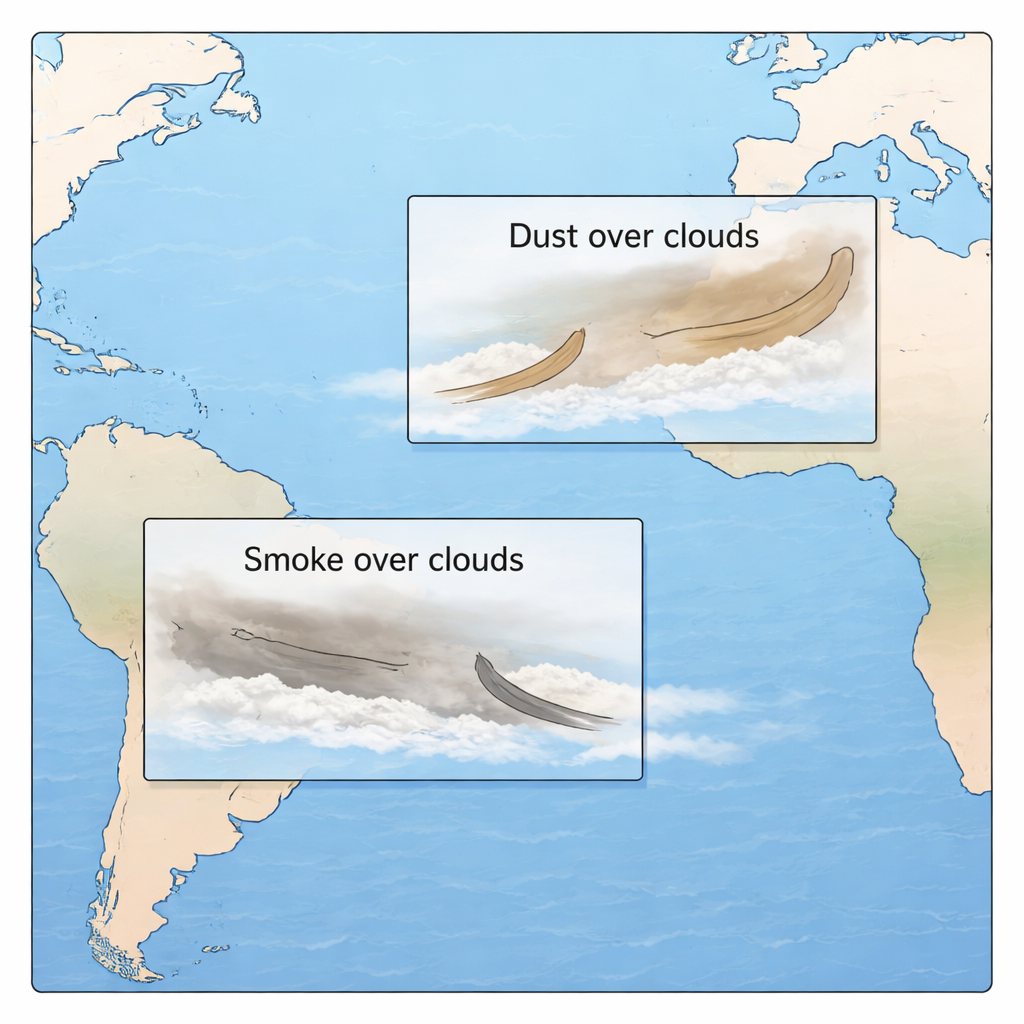
Far from land, the Atlantic Ocean is blanketed by vast sheets of bright, low clouds that help cool the planet by reflecting sunlight back to space. High above these clouds, plumes of dust from the Sahara and smoke from fires in southern Africa regularly drift out over the water. This study asks a deceptively simple question with big climate implications: when these dark, heat-absorbing particles sit above clouds, do they change how strongly the clouds cool the air—and therefore how much cloud cover we get?
Great ocean clouds as planetary sunshades
Low marine clouds, especially blanket-like stratocumulus decks, act like giant mirrors. Covering about 40% of the world’s skies, they reflect huge amounts of sunlight and are crucial in keeping Earth from overheating. Their formation and persistence depend strongly on how fast they can cool at their tops. Cooling there stirs the air below, helping to draw moist air upward from the ocean surface to feed the cloud layer. Anything that weakens this cloud-top cooling can calm that circulation, thin the clouds, and let more sunlight reach the ocean.
Dust and smoke: the sky’s heat-absorbing layers
Two types of tiny airborne particles dominate the sun-absorbing haze above Atlantic clouds. Mineral dust from North Africa contains relatively large grains that interact not only with sunlight but also with the Earth’s own infrared, or “longwave,” heat radiation. Smoke from burning vegetation over southern Africa, by contrast, is made of much finer particles that mainly absorb sunlight. Using 10 years of satellite data from laser and radar instruments, plus detailed computer simulations of how radiation moves through the atmosphere, the authors tracked how these overlying layers of dust and smoke change the heating and cooling of the air from the ocean surface up through the clouds.
How high hazes quietly weaken cloud cooling
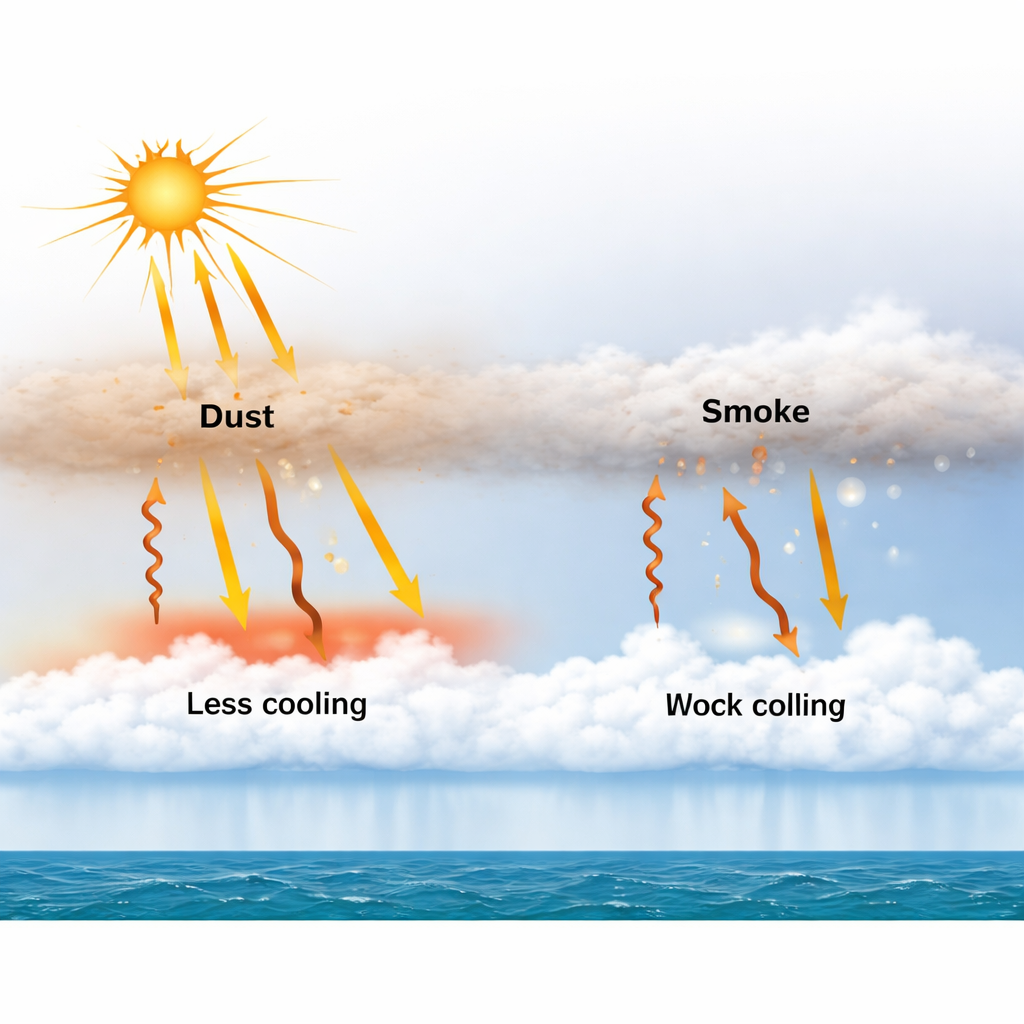
The team found that both dust and smoke layers above low clouds reduce the usual strong cooling at cloud top, but for different reasons and by very different amounts. Dust is the heavyweight player: its coarse particles absorb and emit longwave radiation efficiently, sending extra downward heat toward the cloud top. This longwave “glow” from the dust layer can cut cloud-top cooling locally by about 10–16%, enough to noticeably weaken the churning that maintains the clouds. Smoke behaves differently. Its own properties tend to strengthen cooling slightly, but the smoke plumes often contain extra water vapor. That moisture also radiates longwave energy downward, partly cancelling the cooling and leaving only a small net effect. As a result, dust above the northeast Atlantic alters cloud-top cooling roughly ten times more strongly than smoke above the southeast Atlantic.
Layer thickness, height, and load: which details matter most?
Not all hazy layers are equal. The study shows that cloud-top cooling becomes weaker when the overlying dust or smoke layer is thicker, closer to the cloud, or more “optically dense” (meaning it blocks and absorbs more light and heat). Among these factors, the total aerosol load—captured by optical depth—is the dominant driver. For typical changes seen in the data, increasing dust loading warms the cloud top by over half a degree Celsius per day, whereas a similar increase in smoke loading warms it by only a few hundredths of a degree. The background temperature and humidity structure of the atmosphere further shape this response: for dust, the particle properties themselves lead the effect, while for smoke, the added humidity in the layer often pushes the response in the opposite direction of what the smoke alone would do.
What this means for future cloudiness and climate
When cloud-top cooling weakens, low-level cloud cover tends to shrink. The authors find that typical dust events reduce low cloudiness by a bit more than 1%, while comparable smoke events cut it by only about a quarter of a percent. That might sound small, but spread over entire ocean basins and many months, such reductions can noticeably change how much sunlight the ocean absorbs. The results suggest that earlier studies, which often emphasized only sunlight absorption and ignored dust’s longwave heating or smoke’s extra moisture, may have overestimated the cooling effect of these aerosol–cloud interactions. By showing how dust’s infrared influence and smoke-layer humidity can erode low cloud cover, this work highlights a subtle way in which airborne particles may tilt cloud feedbacks—and therefore climate warming—more toward heating than previously thought.
Citation: Pandey, S.K., Adebiyi, A.A. Dust and smoke layers over the Atlantic Ocean weaken the underlying low-level cloud-top radiative cooling through different pathways. Commun Earth Environ 7, 160 (2026). https://doi.org/10.1038/s43247-026-03183-x
Keywords: aerosols, clouds, Sahara dust, biomass burning smoke, Atlantic climate