Clear Sky Science · en
Fiber-optic observations capture wind wave evolution in Lake Ontario
Listening to Waves with Light
Storm waves on big lakes can threaten ships, lakeshore communities, and future offshore energy projects. Yet it’s surprisingly hard to watch these waves form and evolve, especially in winter when traditional buoys are pulled from the water. In this study, researchers turned an ordinary fiber-optic internet cable on the bottom of Lake Ontario into a giant underwater “ear,” allowing them to listen to how wind-driven waves grow, organize, and fade over time.
A Lake That Behaves Like a Small Sea
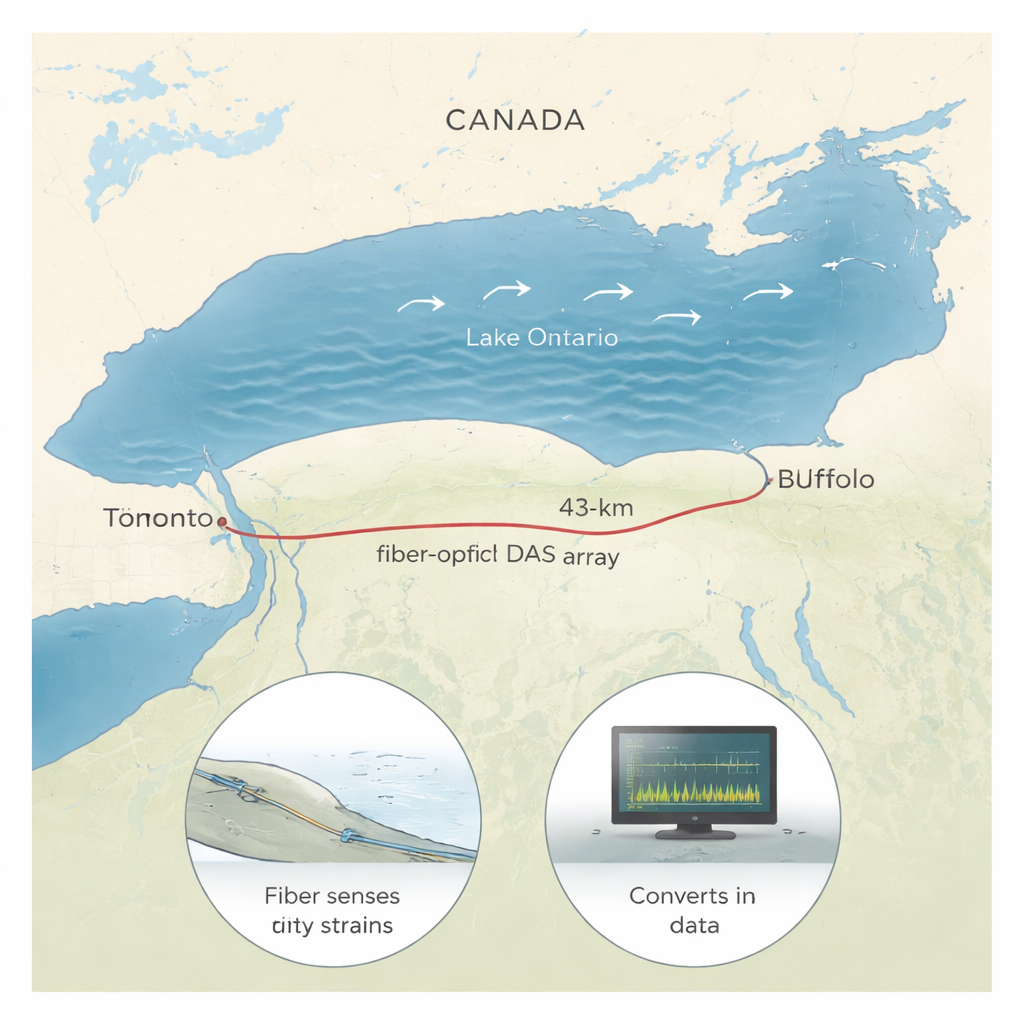
Lake Ontario is one of the world’s largest lakes, with depths similar to coastal oceans. That means winds blowing across it can build sizeable waves, especially during winter storms. The team tapped into a 50-kilometer telecom cable between Toronto and the U.S. shore, using a technique called distributed acoustic sensing (DAS). Pulses of laser light sent through the fiber bounce back in tiny ways when the cable stretches or contracts. By measuring these minuscule strains every few meters along the cable, the scientists effectively created thousands of virtual sensors on the lake floor, all listening to how waves shake the ground beneath them.
From Chaotic Ripples to Rolling Swells
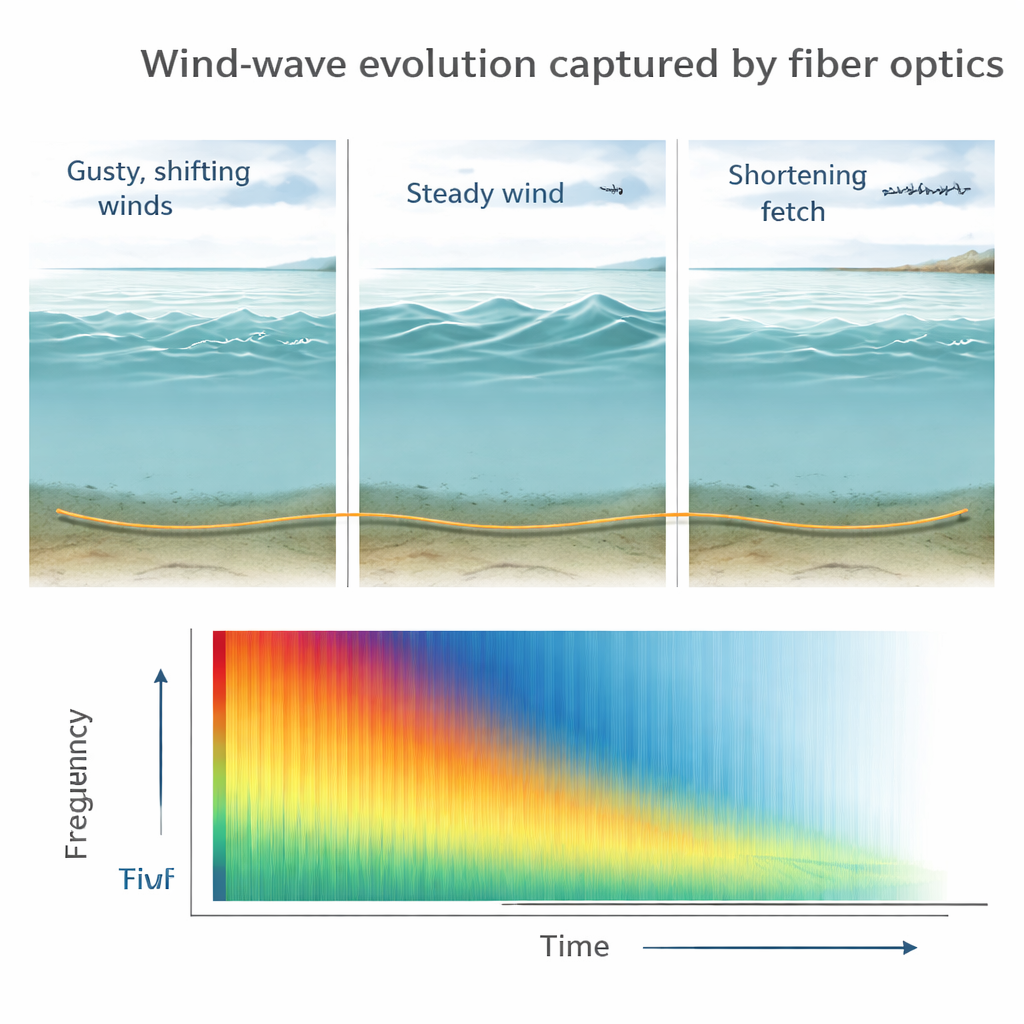
As wind blows over water, it first raises short, choppy ripples that constantly break and collide. Under steady winds and enough distance over water (called “fetch”), these chaotic ripples can grow into smoother, longer gravity waves—what we recognize as organized wind waves or swells. The study shows that this transformation leaves a clear fingerprint in tiny vibrations called microseisms, which are low-level seismic waves generated when surface waves push on the lake bottom. High-frequency microseisms (faster vibrations) appear when the surface is dominated by messy, breaking waves. As winds stay strong and aligned, the dominant wave period lengthens, and energy shifts into lower-frequency microseisms that track the growth of large, organized waves.
Storm Winds, Wave Paths, and Hidden Patterns
The researchers analyzed two 36-hour periods: one with moderate winds, and one with a strong winter storm. They found that the most energetic high-frequency signals tended to follow zones where wind speed and direction were changing quickly—regions filled with crossing, breaking waves. These patches moved across the lake at a few meters per second, similar to wind-driven surface motion, and were especially strong over the deeper middle of the lake, away from shore. The low-frequency signals, by contrast, reflected how far and how long the wind had been pushing the water in one direction. When winds blew steadily along the long axis of the lake, the “listened-to” frequency dropped, signifying slower, longer waves. When wind direction shifted or the effective fetch shrank, those waves weakened and the frequency climbed again.
Why Distance Matters More Than Just Wind Speed
Using well-known wave models, the team linked the measured microseism frequencies to a simple “wave growth factor” that combines wind speed with fetch length. Comparing this factor with weather and wave simulations, they found that the size and period of the dominant waves depend strongly on how far the wind can blow unobstructed across the lake, not just how hard it blows. In Lake Ontario, easterly winds can build long-period waves because they travel over more than 200 kilometers of water, while similarly strong westerly winds are limited by a much shorter path. This fetch control explains why the lake’s microseisms occur at higher frequencies than those in the open ocean, where waves can grow over much larger distances.
A New Way to Watch Dangerous Waves
By treating a buried telecom cable as a continuous wave sensor, the study tracks the full life cycle of wind waves—from noisy ripples to powerful swells and then to fading remnants—as storms move across Lake Ontario. For non-specialists, the key takeaway is that we can now monitor hazardous lake and coastal wave conditions using existing underwater internet cables, even in seasons and storms when traditional instruments are absent or at risk. This approach could improve real-time lake-state forecasts, support better planning for coastal hazards and ecosystems, and guide the design of future wave-energy systems that depend on understanding how wind waves grow and decay.
Citation: Yang, CF., Spica, Z., Fujisaki-Manome, A. et al. Fiber-optic observations capture wind wave evolution in Lake Ontario. Commun Earth Environ 7, 159 (2026). https://doi.org/10.1038/s43247-026-03182-y
Keywords: Lake Ontario waves, fiber optic sensing, wind-driven waves, microseisms, coastal hazards