Clear Sky Science · en
Photoacclimation contributes to Arctic primary production under sea ice and around the subsurface chlorophyll maximum
Hidden Gardens Beneath the Arctic Ice
Far from being a frozen desert, the Arctic Ocean hosts thriving communities of microscopic plants that fuel its entire food web. Much of this plant growth happens not at the surface, but under sea ice and in darker layers below the waves where satellites cannot see. This study explores how these tiny plants, called phytoplankton, adjust to low light and help sustain Arctic life even in places that appear barren from above.
How Tiny Plants Make the Most of Weak Light
Phytoplankton survive by capturing sunlight with chlorophyll, much like leaves on land plants. In the dim Arctic, especially under sea ice or at depth, light is scarce but nutrients can be plentiful. The authors focus on a process called photoacclimation: when light is limited, each phytoplankton cell packs in more chlorophyll per unit of its own carbon, turning itself into a more efficient light-collecting device. Laboratory and field measurements have shown that this chlorophyll content can change more than tenfold depending on light and nutrients. The study asks how this built-in flexibility shapes where and how much plant growth occurs across the Arctic Ocean.
A Global Model of a Very Local World
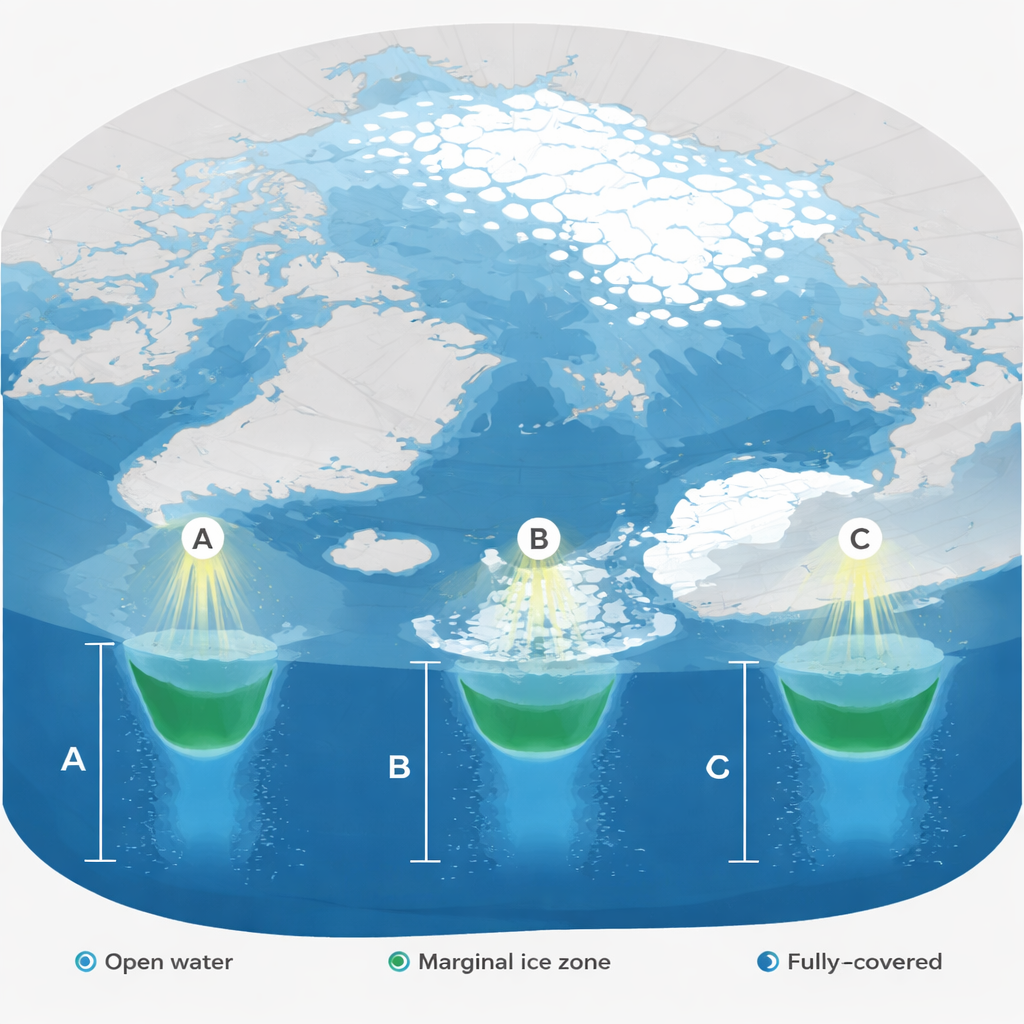
To answer this, the researchers used a global ocean ecosystem model that explicitly lets phytoplankton reallocate their internal resources between light capture and nutrient uptake. When light is weak but nutrients are abundant, the model allows cells to invest more in chlorophyll; when nutrients are scarce, they shift resources toward gathering nutrients instead. This approach, grounded in theories of optimal resource use and tested against lab experiments, was run together with a realistic physical model of ocean circulation and sea ice. The team then examined simulated Arctic conditions from 1998 to 2004, focusing on how vertical layers rich in chlorophyll, known as subsurface chlorophyll maxima, form in open water, marginal ice zones, and heavily ice-covered regions.
Different Ice Conditions, Different Underwater Landscapes
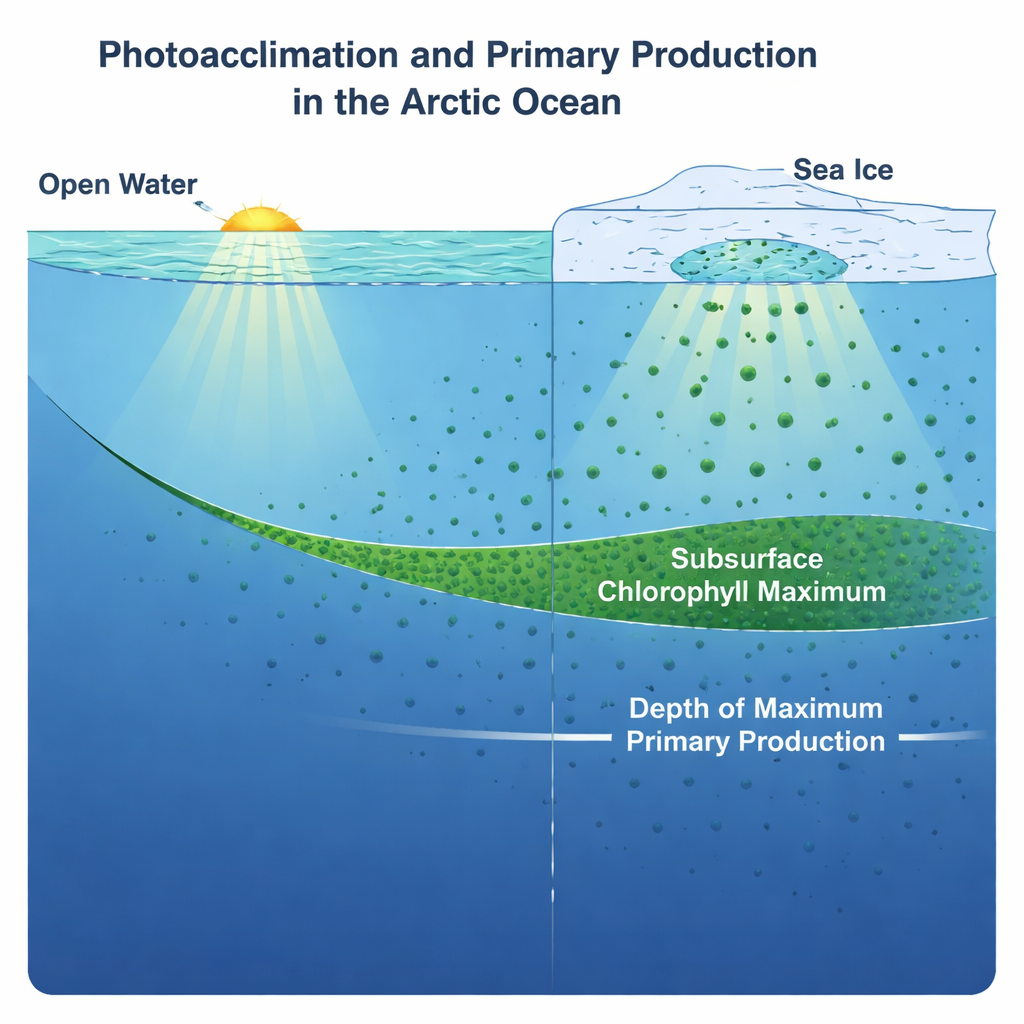
The model reveals that the same chlorophyll-rich layer can arise for different reasons depending on the local ice and water structure. In open water, chlorophyll increases with depth even as the total amount of phytoplankton does not, because individual cells simply load up on more pigment as light fades. This creates a deep chlorophyll maximum that does not coincide with the depth of greatest plant biomass or growth. In marginal ice zones, where fresher surface waters and sharp density layers trap nutrients, the chlorophyll maximum sits closer to the true peak in phytoplankton mass. Under thick sea ice, however, surface waters are so dim yet nutrient-rich that cells at or near the top of the water column already carry very high chlorophyll levels. As a result, the chlorophyll maximum sits much shallower, only a few meters below the ice.
Production Follows Biomass, Not Just Green Color
An important outcome of the model is that actual primary production—the rate at which phytoplankton turn carbon dioxide into organic matter—tracks the amount of phytoplankton carbon more closely than it tracks chlorophyll concentration. Where chlorophyll peaks purely because each cell has more pigment, production does not necessarily peak at the same depth. Comparisons with ship-based measurements in the Chukchi and Beaufort seas show that observed maxima in production tend to sit above the chlorophyll maximum, in line with the model’s prediction that photoacclimation shifts the visible green layer deeper than the true growth hotspot. This distinction matters because satellite estimates of production usually assume a fixed link between chlorophyll and biomass.
Half of Arctic Plant Growth Happens Where We Cannot See
Because satellites struggle to measure chlorophyll when ice covers more than 10 percent of a region, much of the Arctic’s hidden productivity has been easy to miss. The model suggests that over the study period, about 54 percent of total Arctic primary production occurred in areas with more than 10 percent ice cover—roughly half of all plant growth taking place in regions that satellites largely ignore. In heavily ice-covered areas, production is lower than at the ice edge or in open water because thick ice blocks light, pushing growth into a thin, shallow layer. Still, phytoplankton’s ability to raise their chlorophyll content allows them to keep growing at rates comparable to surface populations in ice-free seas, even under dim ice-filtered light.
What This Means for a Warming Arctic
As sea ice continues to thin and retreat, the balance between open water and under-ice habitats will shift, and with it the depth and location of the Arctic’s hidden plant factories. This study shows that correctly representing photoacclimation is essential for predicting how primary production will respond to climate change. Without accounting for how phytoplankton adjust their chlorophyll content, models can misplace the chlorophyll maximum, misjudge under-ice production, and misinterpret satellite data. By capturing these adjustments, the work provides a clearer picture of how much life the Arctic Ocean can support today, and how that life may move deeper and change as the region warms.
Citation: Masuda, Y., Aita, M.N., Smith, S.L. et al. Photoacclimation contributes to Arctic primary production under sea ice and around the subsurface chlorophyll maximum. Commun Earth Environ 7, 158 (2026). https://doi.org/10.1038/s43247-026-03181-z
Keywords: Arctic phytoplankton, under-ice primary production, photoacclimation, subsurface chlorophyll maximum, sea ice change