Clear Sky Science · en
Anthropogenic climate change leads to a pronounced reorganisation of wintertime North Atlantic atmospheric circulation regimes
Why winter winds over the Atlantic matter to you
The winter weather that shapes everyday life across eastern North America and Europe is steered by vast wind patterns high above the North Atlantic. These patterns decide whether a season is stormy or calm, wet or dry, mild or bitterly cold. This study asks a pressing question: as humans warm the planet, are we also reshaping these large-scale winter patterns themselves—not just raising temperatures, but altering how the atmosphere behaves over the North Atlantic?
Big climate patterns behind familiar weather
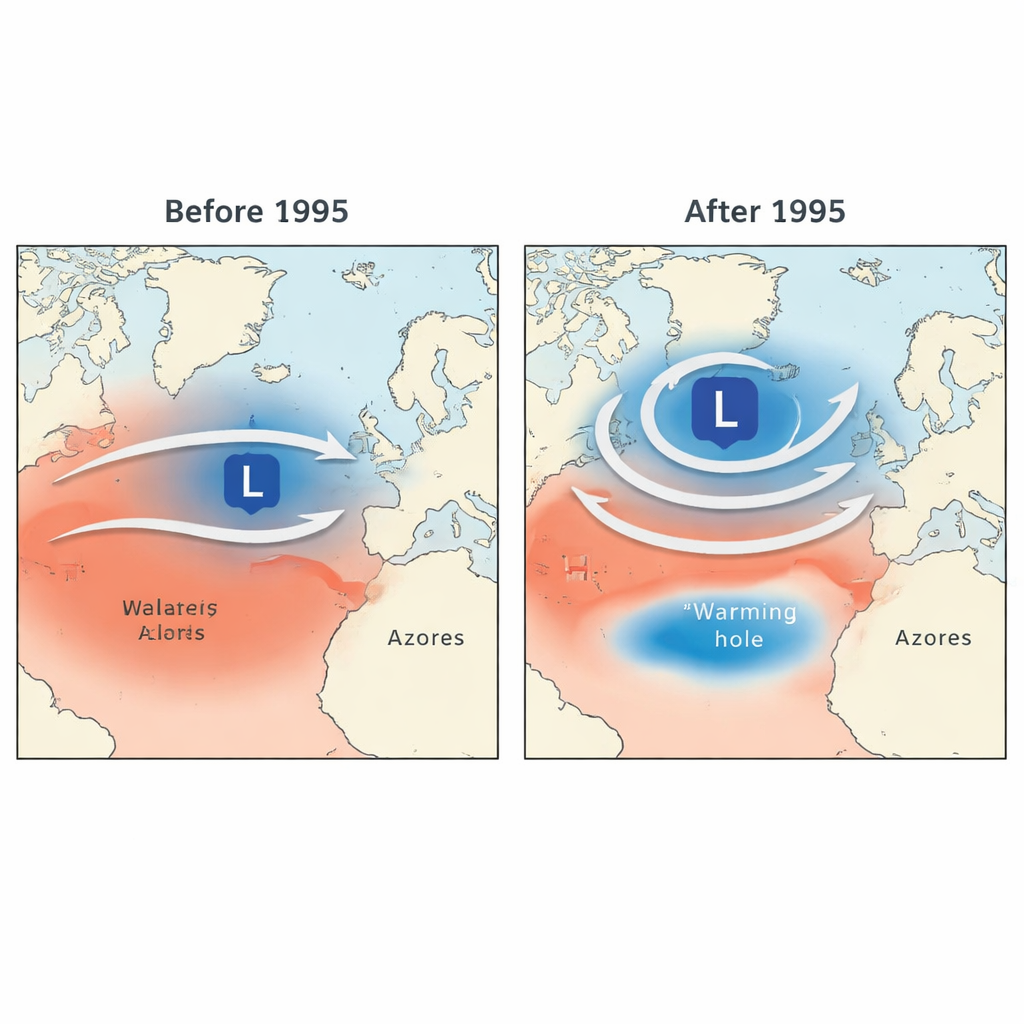
Winter climate in the North Atlantic is organized into a handful of recurring “regimes,” or preferred circulation patterns in the atmosphere. One of the most important is the North Atlantic Oscillation (NAO), which describes the pressure difference between a low-pressure area near Iceland and a high-pressure area near the Azores. When this difference is strong (a positive NAO phase), westerly winds intensify and shift northward, often bringing mild, wet winters to northern Europe and drier conditions to parts of southern Europe and the Mediterranean. When the difference is weak or reversed (a negative NAO phase), the jet stream slackens or shifts, favoring colder European winters and other regional shifts. Understanding whether global warming is changing how often these regimes occur—and how strong they are—has direct consequences for floods, droughts, wind energy, and agriculture across the Atlantic region.
Simulating centuries of winter skies
To separate natural ups and downs from human-driven change, the authors used 100 simulations from a state-of-the-art climate model that span 1850 to 2100 under a high-emissions scenario. Because each simulation experiences the same external forcing but starts from slightly different initial conditions, their average describes the climate’s forced response to greenhouse gases and other drivers, while the spread among them represents internal variability. The team focused on winter (December to February) and examined circulation about 5 kilometers above the surface, where the mid-latitude jet stream flows, together with surface temperatures. They used statistical tools to find the leading patterns that link upper-air circulation and surface warming, then identified distinct atmospheric regimes by clustering the model’s output before and after a key turning point around 1995, when a clear human influence on North Atlantic circulation becomes detectable.
Same number of regimes, but their character shifts
The analysis shows that, when external forcing is included, the North Atlantic continues to exhibit four main winter circulation regimes both before and after 1995. Yet their spatial patterns are reorganized under global warming. The centers of low and high pressure shift northward, and the most common regime after 1995 looks more like a positive NAO pattern, with a better-defined Icelandic low and Azores high. At the same time, the internally generated part of the circulation—what the atmosphere would do without changing external conditions—loses one of its regimes after 1995 and becomes dominated by a single, weaker pattern. This suggests that human-driven warming is not just adding a background trend, but is actively suppressing some natural circulation states and making others more persistent.
NAO tilts positive, then softens later in the century
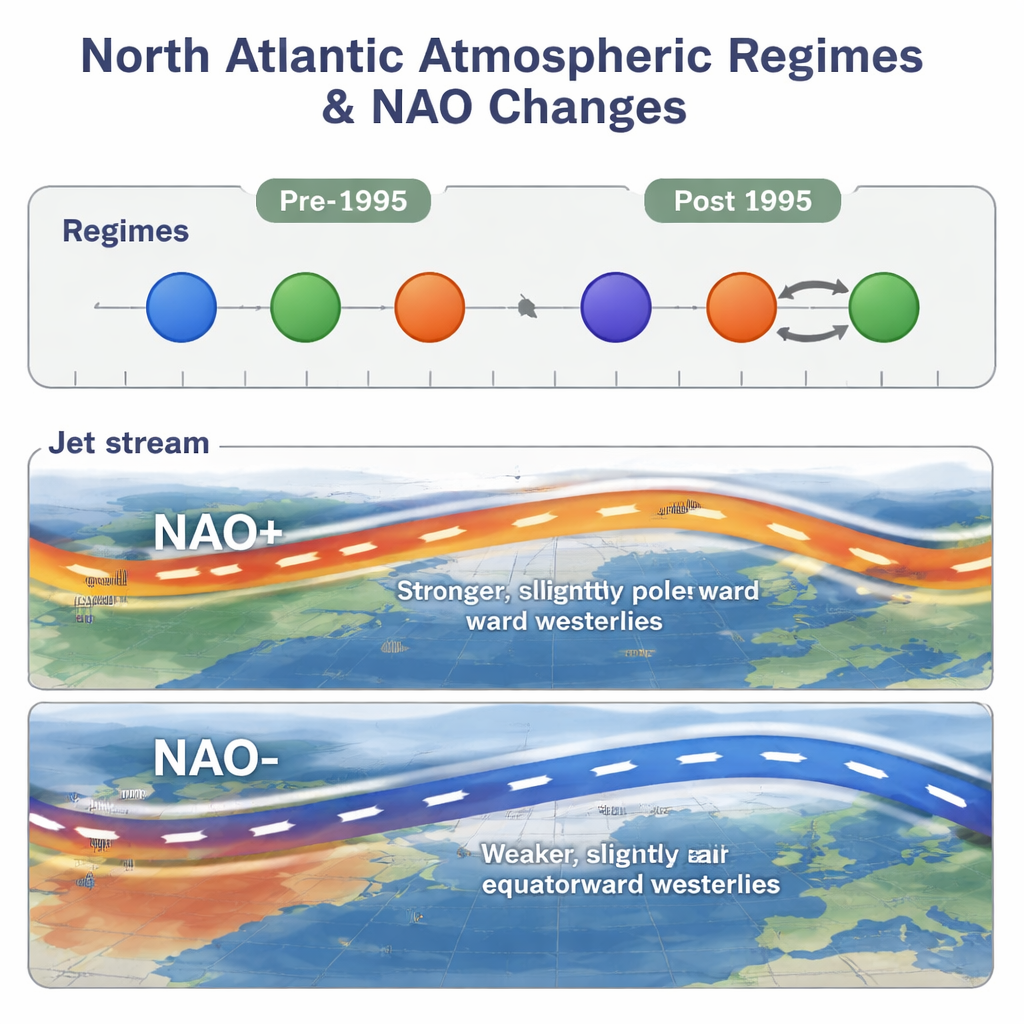
Turning to the NAO specifically, the model reproduces its familiar dipole structure and historical behavior. When the forced response is included, the average NAO index trends toward more positive values through most of the 21st century, meaning winters with a strong pressure contrast between Iceland and the Azores become more common. At the same time, the overall variability of the NAO declines: swings between positive and negative phases become less pronounced. Intriguingly, toward the end of the century there is a modest rebound in low-intensity negative NAO events, which contributes to a slight easing of the positive tendency. Physically, these changes are linked to shifts in the mid-tropospheric jet stream: NAO-positive regimes develop stronger, slightly more poleward westerly winds, while NAO-negative regimes see weaker, slightly equatorward jets.
What this means for future winters
For a general reader, the key message is that human-caused climate change is reorganizing the “traffic lanes” of the winter atmosphere over the North Atlantic. The broad set of circulation patterns does not disappear, but some become more frequent and persistent, while others fade. The climate system’s natural variability is muted in certain respects, particularly for the NAO, even as extreme negative events can still occur. This evolving balance helps explain why future winters may bring more consistent patterns of storm tracks, rainfall, and temperature across Europe and eastern North America, superimposed on overall warming. It also highlights that planning for the future climate must consider not only rising temperatures, but also how the underlying atmospheric regimes that drive day-to-day weather are being reshaped.
Citation: Satpathy, S.S., Franzke, C.L.E., Verjans, V. et al. Anthropogenic climate change leads to a pronounced reorganisation of wintertime North Atlantic atmospheric circulation regimes. Commun Earth Environ 7, 155 (2026). https://doi.org/10.1038/s43247-026-03180-0
Keywords: North Atlantic Oscillation, atmospheric circulation, climate change, winter weather, jet stream