Clear Sky Science · en
The observed September 2023 temperature jump was nearly impossible under standard anthropogenic forcing
When the World Suddenly Got Hotter
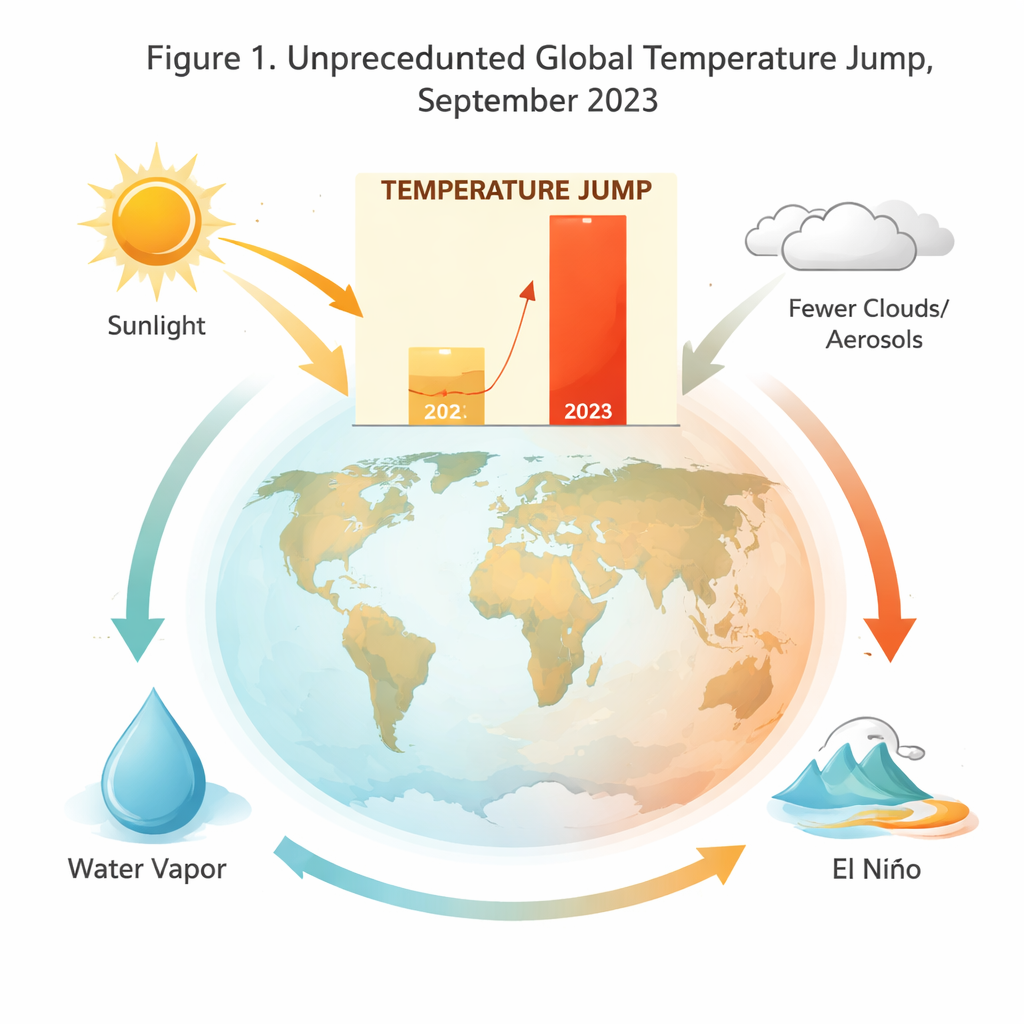
In late 2023, Earth’s average temperature didn’t just set another record—it lurched upward in a way scientists had almost never seen before. September 2023 was about 0.6 degrees Celsius hotter than September 2022, a jump so large and sudden that it raised an unsettling question: was this just a freak fluctuation, or a warning sign that our climate system is entering new territory?
A Record Month That Models Didn’t See Coming
Using more than 140 years of observations together with modern climate models, the authors show that the September 2023 temperature jump is extraordinarily rare under current levels of human-caused warming. Statistical tools normally used to describe extreme events assign it an almost vanishing probability—far below one-in-a-thousand in most model simulations. Climate models participating in the latest international comparison project (CMIP6), which together span roughly 40,000 simulated years, almost never produce a September jump as large as that seen between 2022 and 2023 at today’s global warming level.
Heat Focused on Land, Especially Outside the Tropics
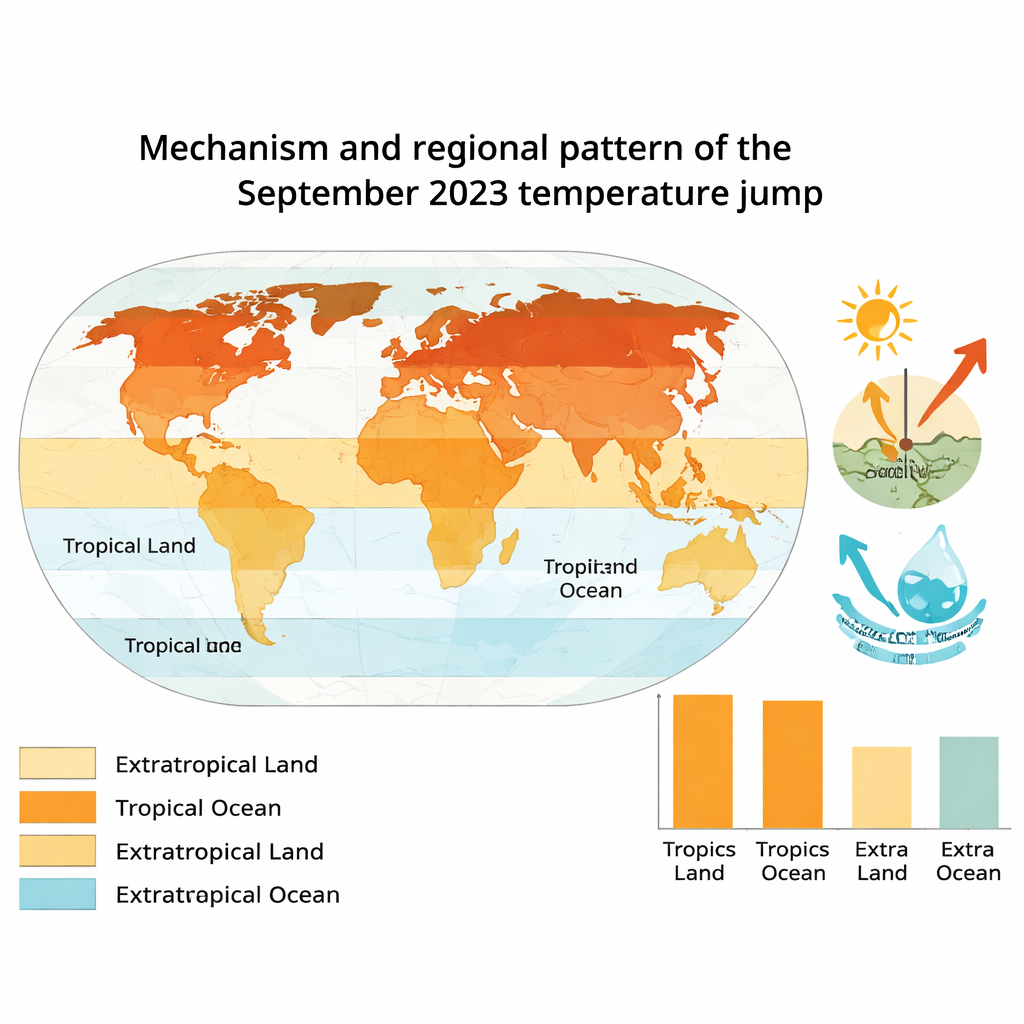
The study then asks where this sudden heat came from geographically. Although land covers only about one-third of Earth’s surface, it supplied more than half of the global temperature jump. Land outside the tropics—the regions where most of the world’s population lives—stood out as especially unusual in both observations and models. Oceans, including those affected by the strong El Niño, looked less extreme by comparison. This suggests that what made September 2023 remarkable was not just hot spots in one ocean basin, but the broad, land-heavy spread of warmth across the planet.
Many Small Pushes, Not One Single Cause
To understand what physically drove the jump, the authors examined several key ingredients of Earth’s energy balance: incoming sunlight at the surface, the amount of water vapor in the atmosphere, soil moisture over land, and the strength of El Niño. In the months leading up to September 2023, all four shifted in a direction that favors warmth—more sunlight reaching the surface, moister air, drying soils in many regions, and the transition from a three-year La Niña to El Niño. A statistical model that links short-term changes in these factors to local temperature was able to reproduce most of the observed warming pattern, showing that the jump emerged from their combined effect rather than from a single dominant driver.
Extra Sunlight and Hidden External Nudges
When the authors compared the roles of these drivers in observations with their behavior in climate models, one factor stood out: downwelling shortwave radiation, essentially the sunlight that actually reaches Earth’s surface. In 2023, this extra sunlight was stronger—especially over mid- and high-latitude oceans—than models typically generate for similarly large temperature jumps. Part of this may stem from recent declines in air pollution from ships and industry, which reduce reflective particles and low clouds, letting more sunlight in. By mathematically “dialing back” this excess sunlight to match model behavior, the authors estimate that about 0.07 degrees Celsius of the September jump can be linked to unusually high shortwave forcing. With that adjustment, the event’s probability rises to about one in a thousand—not common, but no longer virtually impossible.
What This Means for Our Future Climate
Looking ahead, the study finds that as the planet continues to warm, jumps like September 2023 will gradually become more likely, even without additional external pushes beyond greenhouse gases. By late century under a high-emissions pathway, climate models suggest such events could occur with probabilities on the order of one in a thousand or higher, driven mainly by stronger internal ups and downs superimposed on a hotter background climate. Yet even then, a jump as large as 2023 remains at the extreme edge of what models expect from natural fluctuations alone. For now, the authors conclude that September 2023 was an exceptionally unlikely event that likely combined a powerful burst of natural variability with a smaller but important boost from external factors that increased the amount of sunlight reaching Earth’s surface.
Citation: Seeber, S., Schumacher, D.L., Gudmundsson, L. et al. The observed September 2023 temperature jump was nearly impossible under standard anthropogenic forcing. Commun Earth Environ 7, 156 (2026). https://doi.org/10.1038/s43247-026-03178-8
Keywords: global warming, climate extremes, El Niño, aerosols, temperature variability