Clear Sky Science · en
Tidewater glacier fronts are an important foraging ground for an Arctic marine predator
A Hidden Banquet at the Ice Edge
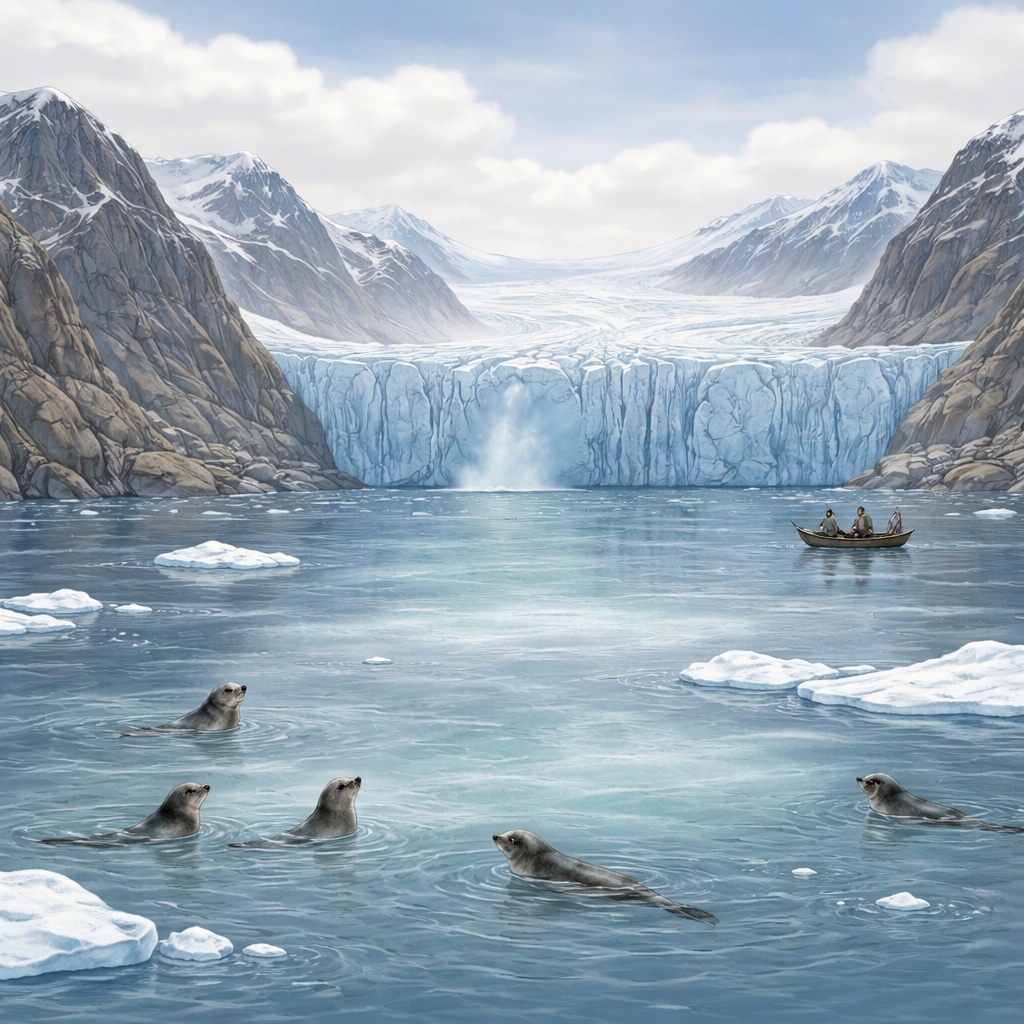
In the far north of Greenland, where glaciers crumble into the sea, ringed seals are quietly revealing how climate change may reshape Arctic life. This study asked a deceptively simple question: are the fronts of tidewater glaciers—where ice meets ocean—really feeding hotspots for marine predators, or just dramatic scenery? By teaming up with Inuit hunters and examining what seals had eaten just hours before they were caught, the researchers were able to look directly into the animals’ recent meals and link them to precise locations in the fjord.
Why Glacier Fronts Matter for Wildlife
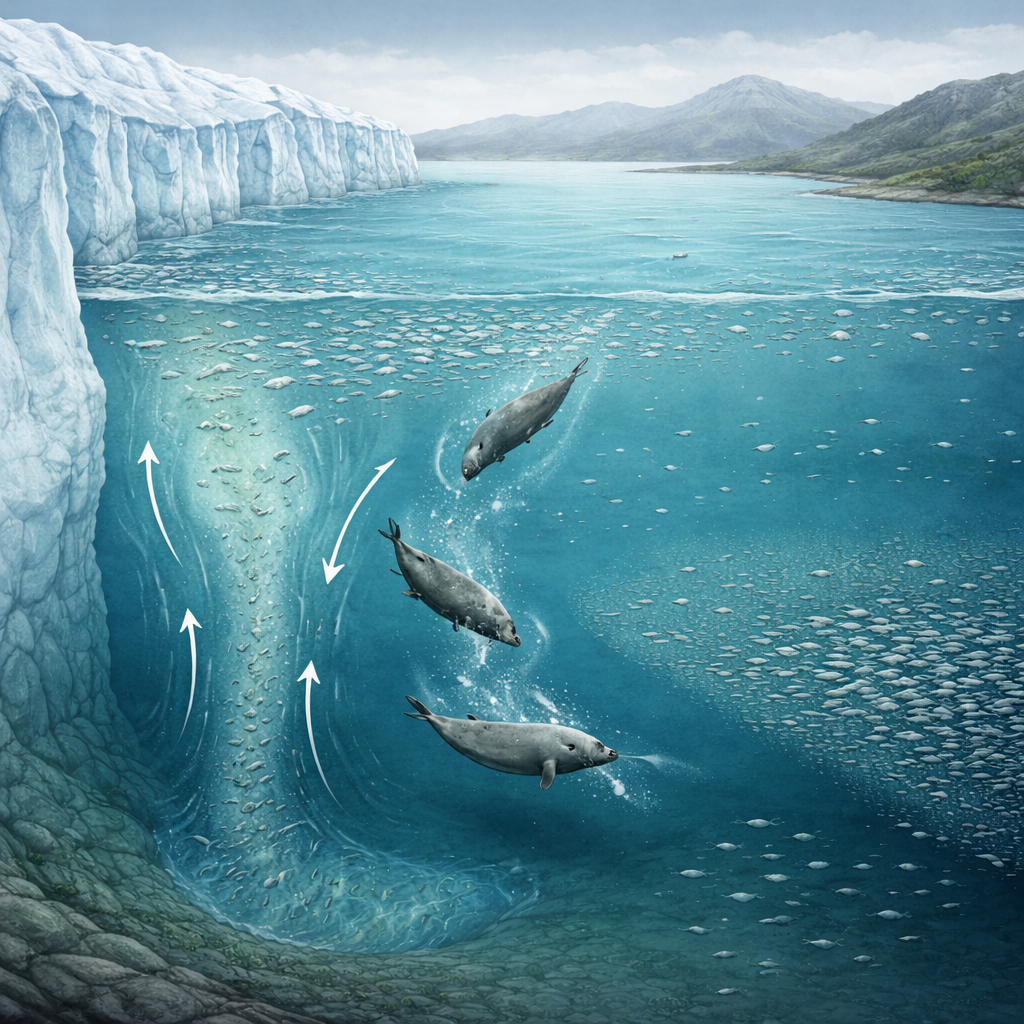
Tidewater glaciers do more than shed icebergs. As meltwater gushes out from beneath the ice and rises toward the surface, it drags up nutrients, plankton, and sometimes small fish from deep water. This creates cloudy, light-blue patches in the sea that can be rich in life. Seabirds, whales, and seals are often seen gathering at these spots, hinting that they may be important feeding grounds. Yet most evidence so far has come from tracking devices that show animals diving near glaciers—not from direct proof of what they eat there. The new study set out to close this gap, focusing on ringed seals, a key Arctic species that both feeds on fish and invertebrates and in turn feeds polar bears, while also supporting Inuit food and culture.
Using Seals’ Stomachs as Time-Stamps
Ringed seals digest their food quickly: within about four hours, their stomachs are empty. This rapid turnover can be a problem for scientists who want to know an animal’s long-term diet, but here it became an advantage. Inuit hunters in three communities around the fjord Inglefield Bredning recorded exactly where and when they caught each seal and provided the intact stomachs to researchers. Because the stomach contents represent only the last few hours of feeding, the team could closely match what each seal had eaten to its position in the fjord and its distance from the nearest glacier front.
More Food—and Different Food—Near the Ice
From 42 seals collected over two summers, 30 had identifiable prey in their stomachs. The scientists found 15 types of prey overall, but one fish dominated: polar cod. By biomass, this small Arctic fish made up more than four-fifths of everything the seals ate. Crucially, seals that had recently fed were, on average, caught much closer to glacier fronts than those with empty stomachs. When the samples were split into two groups—seals taken within four kilometers of a tidewater glacier and those taken farther away—the ones near the glaciers had noticeably heavier stomachs. In other words, the closer the seals were to the ice front, the more they had managed to eat in the hours before capture.
Targeting Polar Cod Where It Gathers
The pattern became even clearer when the team looked specifically at polar cod. Seals that had eaten polar cod were typically taken within roughly two kilometers of a glacier, while those without any polar cod in their stomachs tended to be captured much farther out in the fjord. The more distant the seal was from a glacier, the less polar cod it had eaten. At the same time, seals farther from the ice showed a greater variety of prey, including zooplankton such as shrimp-like crustaceans. Hydroacoustic surveys—using sound waves to detect layers of animals in the water—confirmed that dense schools of polar cod appeared only near the inner parts of the fjord close to tidewater glaciers, while zooplankton were spread more patchily and did not track glacier distance in the same way.
What Glacier Retreat Could Mean for Seals
These findings suggest that ringed seals are not simply wandering through the fjord; they are concentrating their efforts at glacier fronts where polar cod gather, allowing them to gain a lot of energy for relatively little effort. As climate warming causes more glaciers to shrink back onto land, their meltwater will no longer rise from deep below the surface to stir up nutrients and prey. The study warns that as tidewater glaciers retreat, seals may lose some of their most profitable feeding grounds, forcing them to alter where they travel, what they eat, and how they use their habitat. Because ringed seals are crucial prey for polar bears and central to Inuit livelihoods, changes at the ice edge could ripple through both the Arctic food web and Arctic communities.
Citation: Ogawa, M., Jansen, T., Rosing-Asvid, A. et al. Tidewater glacier fronts are an important foraging ground for an Arctic marine predator. Commun Earth Environ 7, 167 (2026). https://doi.org/10.1038/s43247-025-03174-4
Keywords: Arctic ecosystems, ringed seals, tidewater glaciers, polar cod, climate-driven glacier retreat