Clear Sky Science · en
High profits from soybean-corn agriculture are associated with increased land prices and deforestation rates in Mato Grosso’s Amazon forests
Why booming farms can threaten vital forests
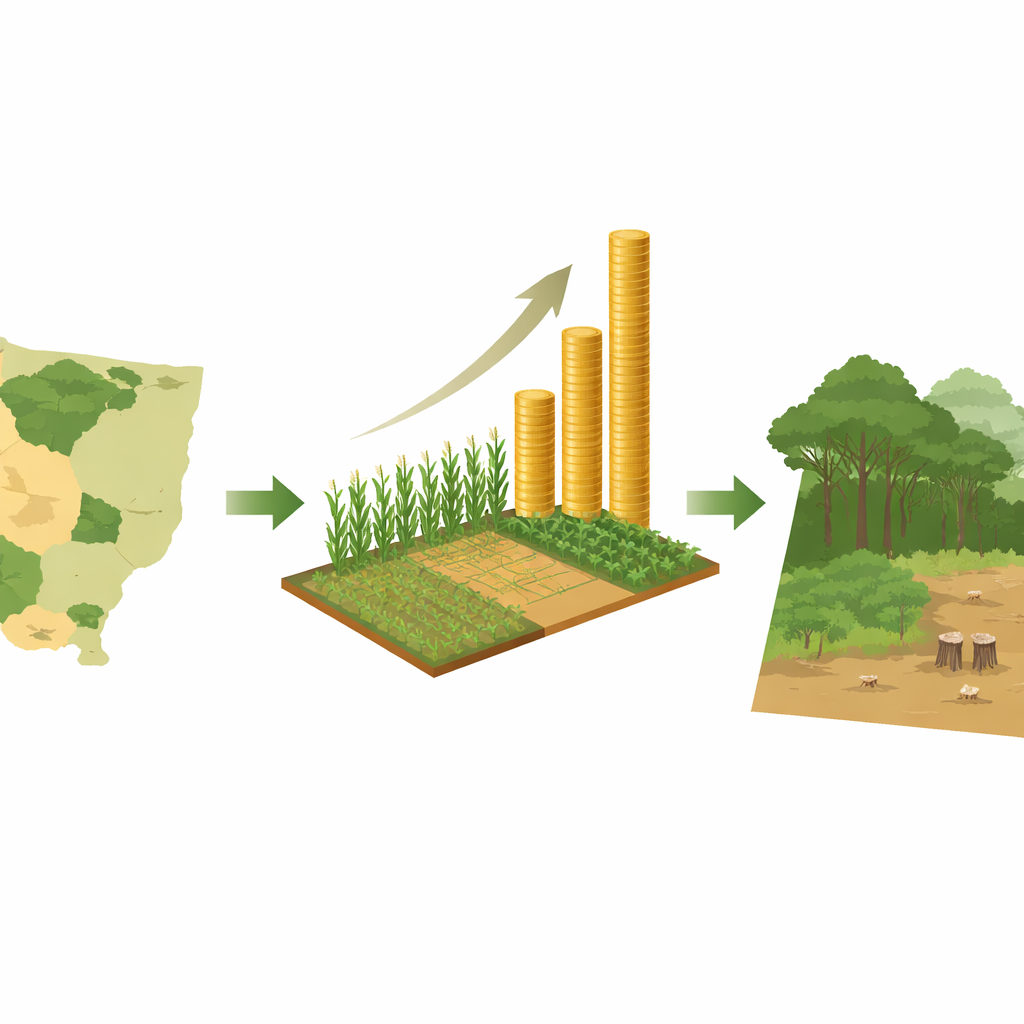
In Brazil’s vast interior, farmers have learned to grow soybeans and a second crop of corn on the same fields each year. This double harvest has turned parts of the state of Mato Grosso into one of the most productive farm regions on Earth. But the same profits that delight farmers and fuel biofuel production may also be quietly pushing up land prices and encouraging the cutting of Amazon forest. This study looks closely at how money made from these crops is linked to land markets and deforestation, revealing a hidden chain between ethanol, farmland wealth, and forest loss.
How two harvests grow on one field
In Mato Grosso, farmers plant soybeans at the start of the rainy season, harvest them early in the year, and then quickly plant a “safrinha” or second-season corn crop on the same land before the rains end. This system takes advantage of months of warmth and moisture that are also ideal for tropical forests. For years, the corn crop was a side business, often grown with little investment and modest yields. Since about 2010, however, better seeds, fertilizers, and management have steadily boosted corn yields. Today, safrinha corn in Mato Grosso produces close to 7 tons per hectare, and its profits approach 80 percent of those from soybeans, accounting for roughly 40–45 percent of total income from the two-crop cycle.
From local ethanol plants to rising land wealth
At the same time, corn-based ethanol has taken off in Brazil. Mato Grosso now produces most of the country’s corn ethanol, turning a large share of its corn harvest into fuel at nearby refineries. Local plants give farmers a steady, year-round buyer, especially important in this landlocked region far from seaports. Although the exact impact on corn prices is hard to pin down, past work from the United States suggests that ethanol demand tends to raise corn prices. As corn and soybean profits rose together, the total income flowing into the farm sector of Mato Grosso surged. The authors show that this wave of earnings matches sharp increases in the price of cropland and pasture, as investors anticipate higher future returns from farming.
Following the money from fields to forest edges
The study breaks profits into two parts: how much money is made per hectare of cropland, and how much total profit the region’s farm sector generates in a year. The first captures how attractive each hectare is to farm, while the second reflects the pool of capital farmers and investors can reinvest in land. Using time-series models, the authors find that both types of profit are linked to higher land prices and more forest clearing, but the total profit pool—the investment effect—is far more important. A one percent rise in sector-wide profits is tied to almost a one and a half percent increase in forest loss in Mato Grosso’s Amazon portion, and these effects unfold over several years after a profitable season.
How much forest loss is tied to the second crop?
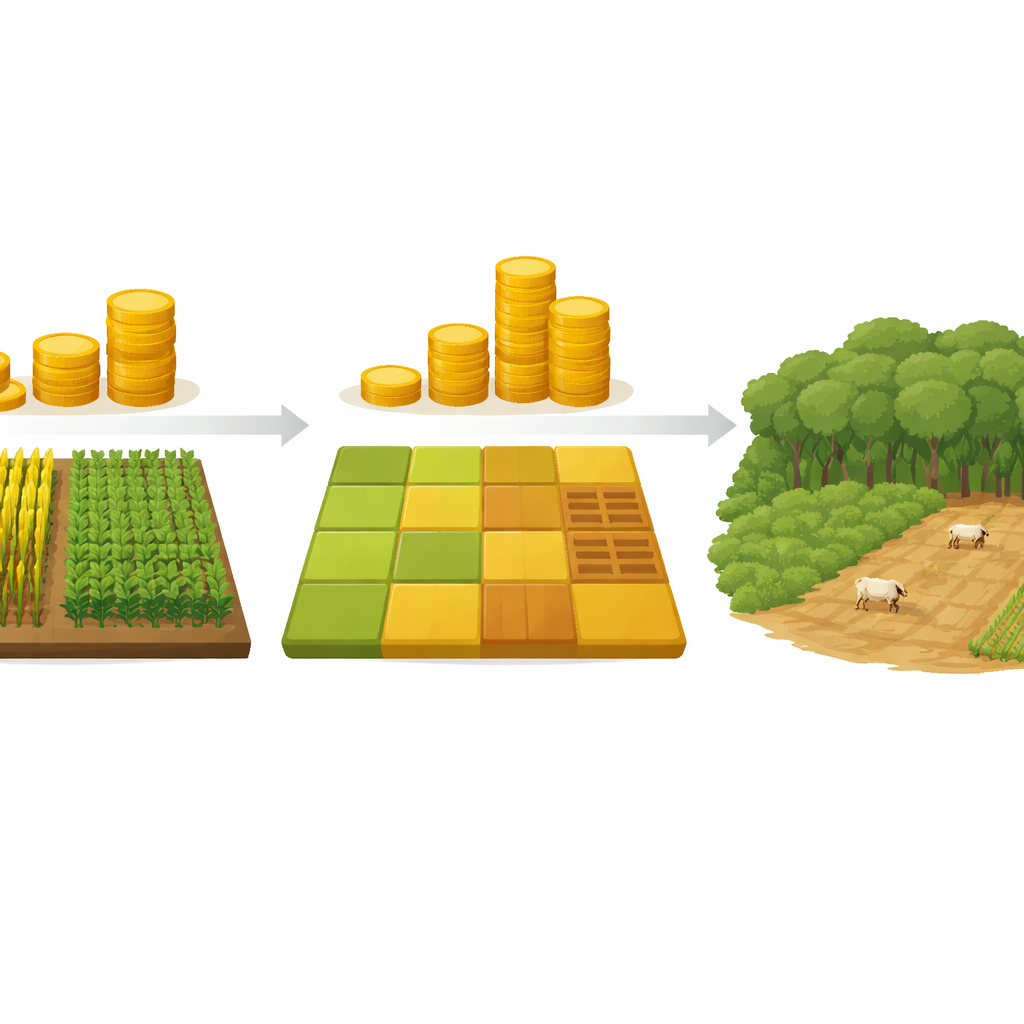
To see the specific role of safrinha corn, the authors compare actual deforestation with a “what if” scenario in which only soybean profits changed while corn profits stayed flat. The difference between these two cases is attributed to the extra money earned from corn. Between 2010 and 2024, they estimate that added profits from safrinha corn helped drive roughly 343–390 square kilometers of Amazon forest loss in Mato Grosso, about 1.5 percent of all clearing in that period. During the highly profitable 2020 and 2021 harvests alone, safrinha corn profits may have contributed to 320–340 square kilometers of forest loss—around eight percent of the clearing seen in those two years.
What this means for cleaner fuels and rainforest protection
The findings highlight a troubling paradox. Biofuels such as corn ethanol are promoted as climate-friendly because they can replace fossil fuels, but when grown next to tropical forests, the profits they generate can fuel land speculation and deforestation, releasing large amounts of stored carbon. In regions like Mato Grosso, increasing yields and adding a second crop do not automatically spare forest; without strong protections on remaining native vegetation, intensification can instead make clearing more attractive. As global demand for biofuels and new products like sustainable aviation fuel climbs, the authors argue that any push to expand these markets near vulnerable forests must be paired with firm safeguards for forest cover. Only then can the climate benefits of biofuels outweigh the hidden costs of losing the Amazon.
Citation: Peter, R., Arima, E. High profits from soybean-corn agriculture are associated with increased land prices and deforestation rates in Mato Grosso’s Amazon forests. Commun Earth Environ 7, 222 (2026). https://doi.org/10.1038/s43247-025-03172-6
Keywords: biofuels, deforestation, soybean corn double cropping, Amazon rainforest, land markets