Clear Sky Science · en
Harnessing converted phases for rapid magnitude estimation and early warning with distributed acoustic sensing offshore Chile
Listening to Earthquakes with Undersea Cables
Earthquakes that begin far offshore can still send powerful shaking toward coastal cities, yet traditional warning systems rely mostly on instruments located on land. This study explores a new way to gain precious seconds of warning by turning existing seafloor fiber-optic cables into giant earthquake sensors. The researchers show how subtle early signals on these cables can reveal how big an offshore earthquake is likely to become, fast enough to help protect people and infrastructure on land.
Turning Internet Cables into Giant Ears
Modern fiber-optic cables do more than move data; they can also act as dense chains of vibration sensors through a technique called distributed acoustic sensing. A laser is sent down the cable and tiny changes in the returning light reveal how much each short segment is stretching or squeezing. Offshore Chile, three such systems monitor about 400 kilometers of seafloor cable, continuously recording how the ground moves during earthquakes of many sizes, from modest tremors to major events larger than magnitude 7. 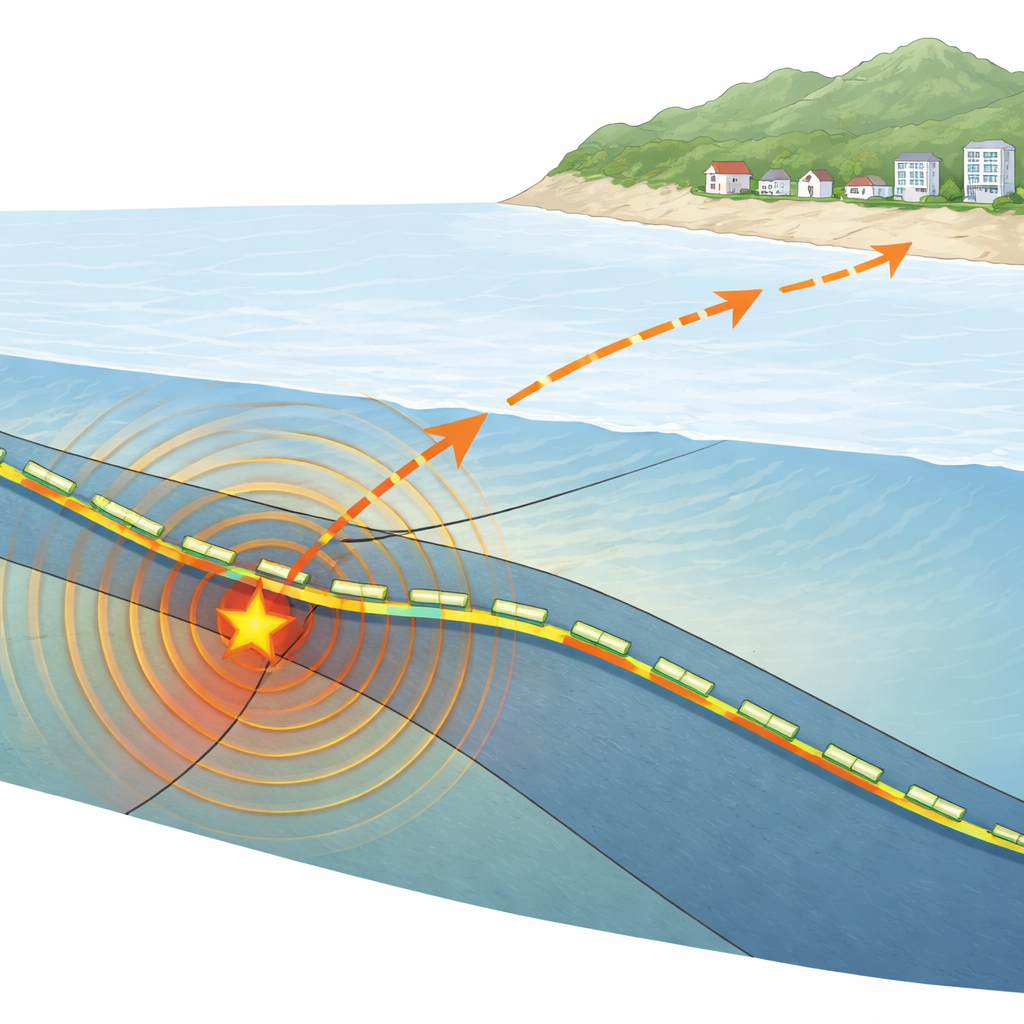
Why the First Shaking Is Hard to Read
Conventional early warning often focuses on the very first arriving vibrations, known as P waves, to estimate how large an earthquake might become. But along soft seafloor sediments, those early P waves are weak and quickly overwhelmed by more complex wave patterns. In the Chilean data, the researchers found that P-wave measurements along the cables were highly scattered, especially for moderate to large earthquakes. Nearby sediments convert part of the energy into different wave types within fractions of a second, shortening the clean P-wave window and making it difficult to tell a truly large event from a smaller one based on P waves alone.
Letting Converted Waves Tell the Story
Instead of fighting this complexity, the team decided to use it. When P waves hit the boundary between soft sediments and harder rock, they generate new waves that move more slowly but carry strong shaking, similar to the later S waves that cause most damage on land. These converted "Ps" waves arrive only a fraction of a second after the first signal, yet the researchers showed that their peak motion scales very clearly with earthquake size, much like the strong S waves that come later. After correcting for distance and local site effects along the cables, the peak displacements of the converted waves formed nearly straight lines when plotted against earthquake magnitude, across events from about magnitude 2.5 up to 7.4.
Reading Magnitude in Just a Few Seconds
To test whether this behaviour is useful for real-time warning, the authors measured the largest motion of the converted waves in fixed time windows of only two to six seconds after the first arrivals. Even in these very early slices of data, the converted-wave amplitudes increased in a predictable way with earthquake size. Using these relationships, they simulated how an actual warning system would perform and replayed a magnitude 6.4 offshore event that was not part of their original tuning data. Within about five seconds of the first signal reaching the cables, the magnitude estimate stabilized near the true value, while still staying below the levels where the instruments begin to saturate during very strong shaking. 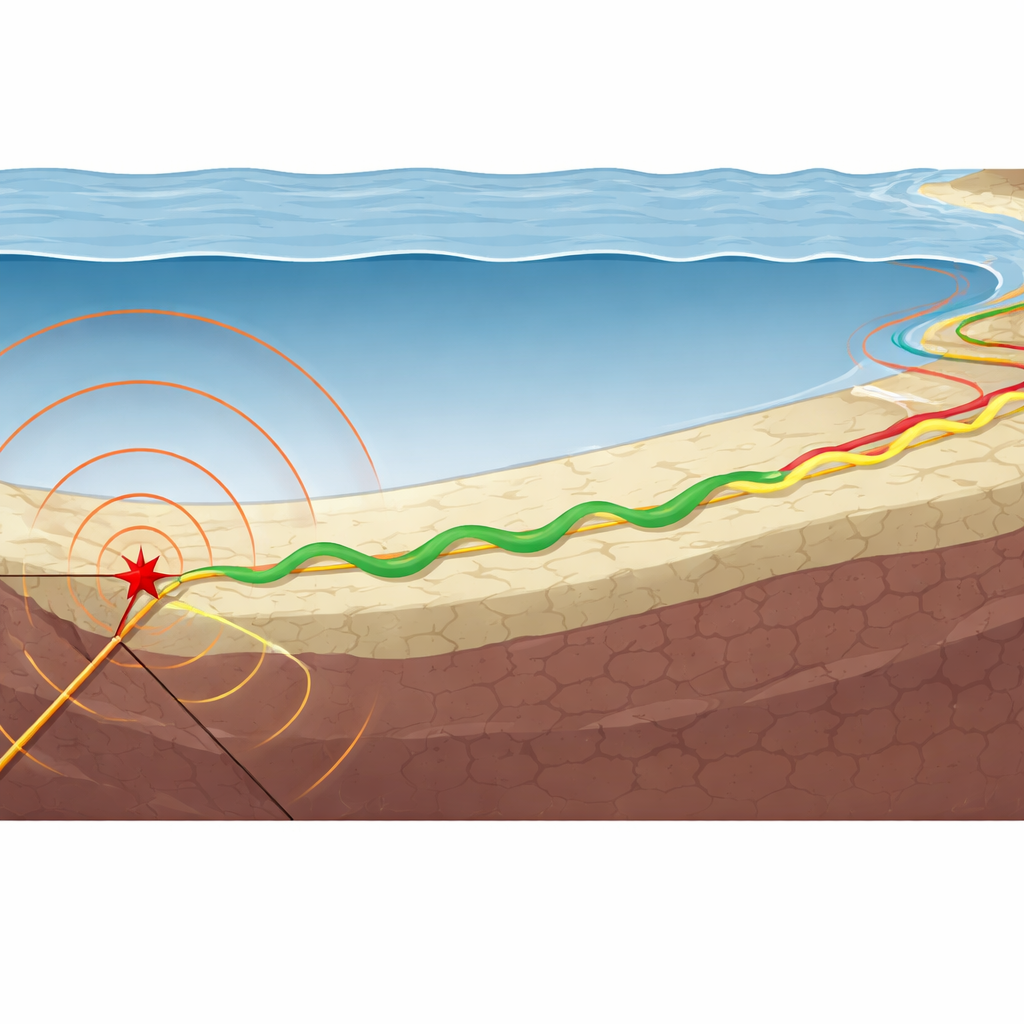
Taking a Step Toward Faster Coastal Warnings
The study demonstrates that early converted waves recorded on undersea fiber-optic cables can provide a rapid and reliable readout of earthquake size, even in complex sedimentary environments that normally confuse standard methods. By focusing on displacement-like measures derived from the cable data, and by embracing the naturally strong converted waves rather than ignoring them, a warning system can estimate magnitudes of earthquakes up to about magnitude 6 within tens of kilometres of the coast before the strongest shaking arrives on land. This approach suggests that existing offshore cables could be turned into powerful new tools for earthquake early warning, buying valuable extra seconds for people and automated systems to react.
Citation: Strumia, C., Trabattoni, A., Scala, A. et al. Harnessing converted phases for rapid magnitude estimation and early warning with distributed acoustic sensing offshore Chile. Commun Earth Environ 7, 212 (2026). https://doi.org/10.1038/s43247-025-03167-3
Keywords: earthquake early warning, distributed acoustic sensing, offshore Chile, fiber-optic seismology, seafloor earthquakes