Clear Sky Science · en
Time irreversibility as an indicator of approaching tipping points in Earth subsystems
Why hidden warning signs in Earth’s rhythms matter
Many parts of Earth’s climate system, from ocean currents to polar ice, may be close to sudden and possibly irreversible shifts known as tipping points. Traditional warning methods look for systems that become sluggish as they weaken, but these signals can be fooled by noisy, changing conditions. This study proposes a different way to listen for trouble: instead of asking whether the system is getting slower, it asks whether time itself has stopped looking reversible in the data, revealing a deeper loss of balance that can precede a climate tipping event.

Climate switches that don’t flip back easily
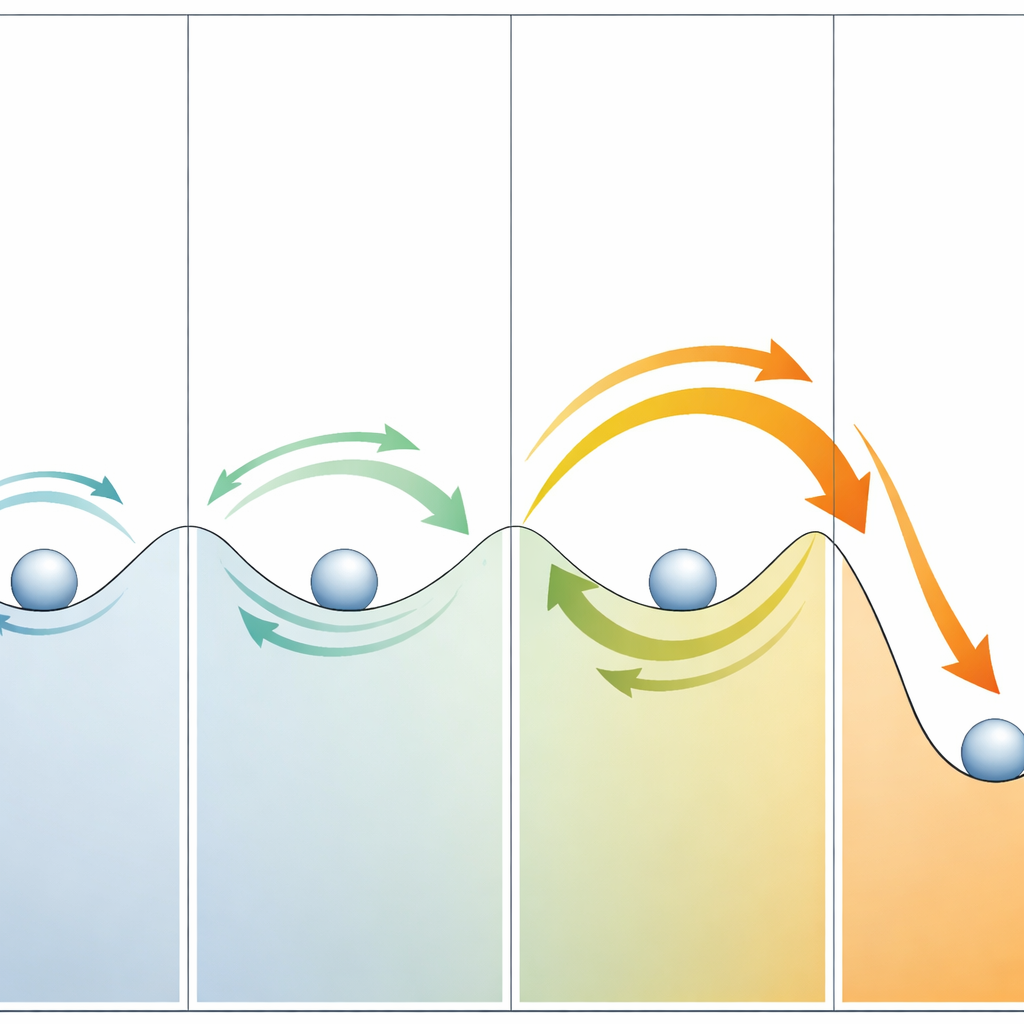
Tipping points are thresholds where gradual change can trigger a step-like shift into a very different state, such as a collapse of the Atlantic Meridional Overturning Circulation (a major current system in the Atlantic) or the abrupt loss of Arctic sea ice. Once crossed, these shifts can be hard or impossible to reverse and may cascade into further changes elsewhere in the climate system. Policymakers and scientists therefore need early warning signals that can be trusted, even when observations are short, noisy, and incomplete. The best-known class of such signals is based on “critical slowing down,” where the system recovers more and more slowly from disturbances as it nears a tipping point, leading to rising variance and stronger correlation over time in observed data.
When usual warning lights give false readings
In the real world, climate subsystems are buffeted by fluctuations whose strength and memory change over time. Under these conditions, the usual slowing-down indicators can be misleading: they may suggest rising risk where none exists, or hide genuine loss of stability. The authors explore this problem using idealized models of two high-latitude tipping elements: a simplified representation of Atlantic overturning, and a one-dimensional climate model that captures abrupt loss of polar sea ice. They also include a realistic type of “red” noise whose variance and persistence evolve in time, mimicking the influence of other changing climate components. In these tests, the standard indicators sometimes report spurious warnings or, worse, suggest increasing stability just when the system is actually moving toward a critical transition.
A new way to see time running forward
Instead of focusing on how fast the system bounces back, the new method measures how strongly the system’s behavior breaks time-reversal symmetry. In a perfectly balanced steady state, seeing a movie of the system run backward would look statistically similar to the movie run forward. But in driven, dissipative systems like Earth’s climate, there are net flows—of heat, salt, or probability—that make the forward direction special. The authors quantify this “arrow of time” using subtle asymmetries in how different parts of the system co-vary at different time lags, and in three-point correlations along a single time series. These indicators do not require an explicit model of the system and can work with partial observations. In their experiments, as the Atlantic circulation and sea-ice models approach tipping points, these time-asymmetry measures grow steadily and then sharply, even when the system does not hop back and forth between states and even when external conditions are changing.
Robust signals in a noisy, many-layered world
The study shows that these nonequilibrium indicators, which the authors call NEWS, are much less sensitive than standard methods to confounding effects from nonstationary noise. When the background noise is deliberately tuned to mask or fake the usual slowing-down signals, the NEWS measures still track the real distance to the tipping point in the ocean-circulation model. In the higher-dimensional sea-ice model, the authors also examine how the choice of what to observe matters. They find that, like standard indicators, the NEWS signals are strongest when built from variables aligned with the directions in which the system is most likely to shift, such as temperatures near the ice edge, underscoring the need for careful selection of climate observables.
What this means for watching Earth’s future
For non-specialists, the key message is that there is more than one way to spot an approaching climate tipping point, and these different approaches need not rely on the same physical signal. While traditional methods watch for systems becoming sluggish, the new framework watches for the hidden arrow of time to strengthen in the data. Because these time-irreversibility measures respond directly to the breakdown of balance in a driven system, and are less easily fooled by shifting background noise, they could become a powerful complement to existing tools. Together, such independent lines of evidence may improve our ability to assess when critical parts of Earth’s climate are nearing dangerous and possibly irreversible thresholds.
Citation: Kooloth, P., Lu, J., Rupe, A. et al. Time irreversibility as an indicator of approaching tipping points in Earth subsystems. Commun Earth Environ 7, 250 (2026). https://doi.org/10.1038/s43247-025-03165-5
Keywords: climate tipping points, early warning signals, Atlantic overturning circulation, Arctic sea ice, time irreversibility