Clear Sky Science · en
Quantifying tropical forest rainfall generation
Why Rainforests Matter to Your Weather
Tropical forests are often called the lungs of the planet, but this study shows they also act as giant sprinklers in the sky. By pumping water into the atmosphere, they help create the rain that farms, cities and rivers depend on. The authors set out to put numbers—and dollars—on this hidden service, revealing just how much rainfall tropical forests generate and what that water is worth to society.
Forests as Natural Rain Machines
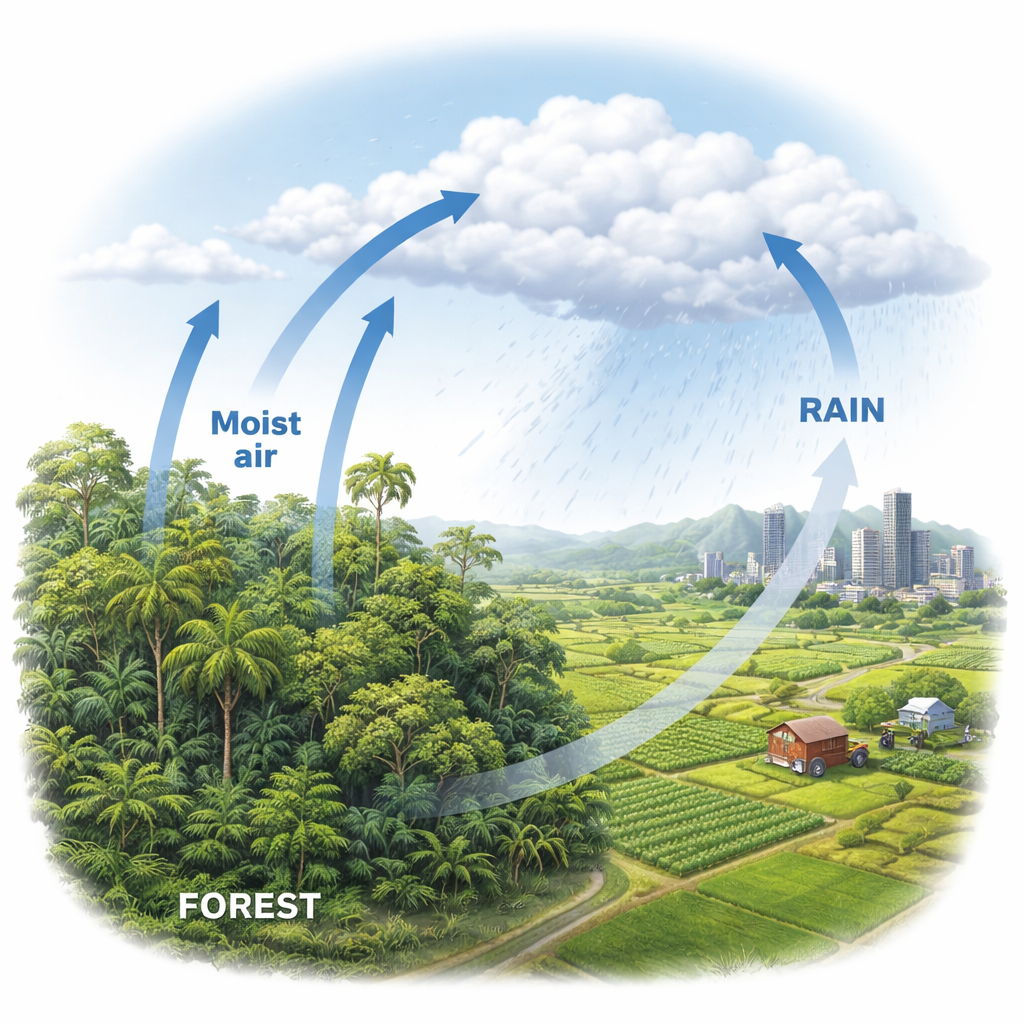
When rain falls on a tropical forest, much of that water does not simply run off into rivers. Instead, trees pull it up through their roots and release it back into the air as invisible vapour. This steady stream of moisture helps form clouds and, ultimately, new rainfall downwind. Scientists have long suspected that cutting down forests would weaken this cycle and dry out surrounding regions, but until now there was no strong, combined estimate of how big the effect is or how much it matters economically.
Measuring How Much Rain Forests Really Make
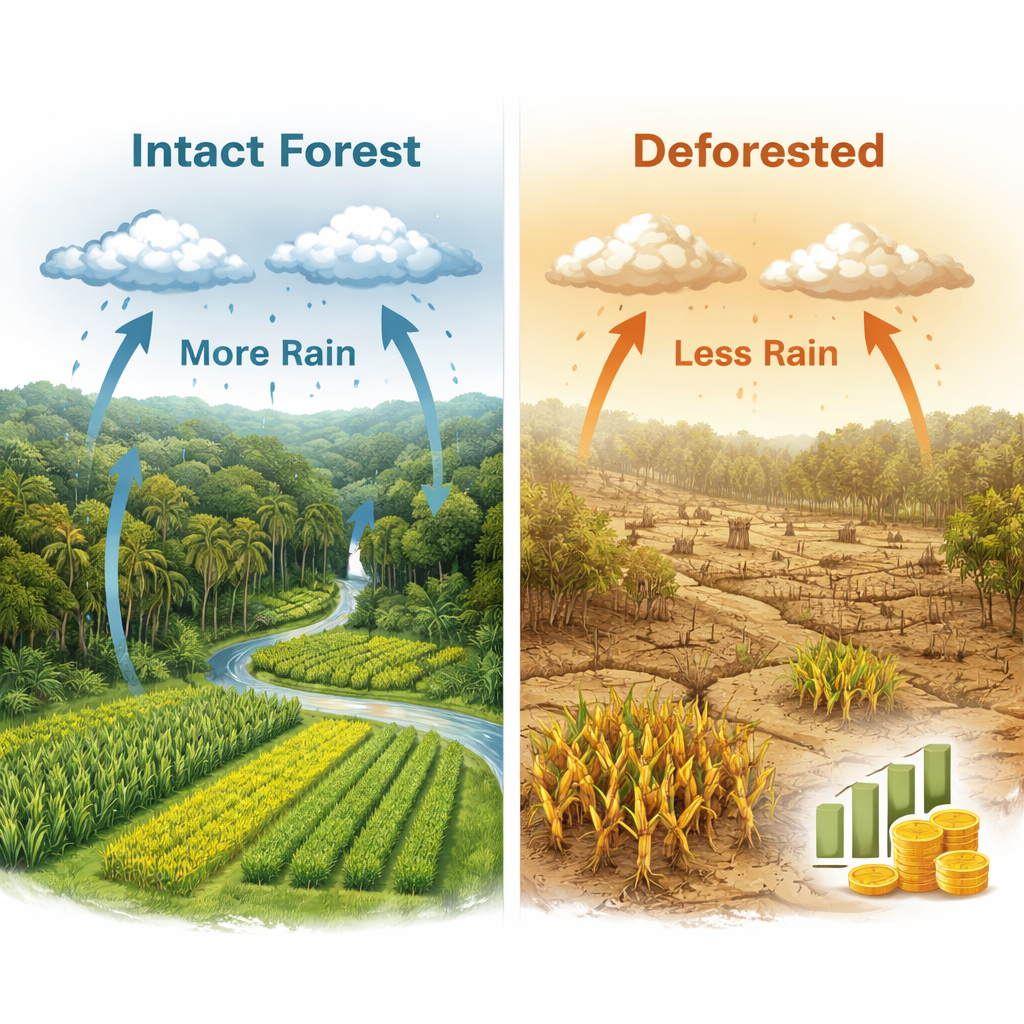
The researchers brought together two powerful sources of information: modern climate models and satellite measurements of rainfall. They analysed how rainfall changed when forests were removed in a set of carefully designed computer experiments, and compared those results with satellite records that track how real-world rainfall shifts as deforestation spreads. Despite using different methods, the numbers lined up. Across the tropical belt, every percentage point of forest lost cuts local rainfall by about 2.4 millimetres per year, on average.
Putting Numbers on a Square Meter of Forest
Using these relationships, the team translated abstract percentages into something more concrete: litres of water. They estimate that each square metre of intact tropical forest helps generate around 240 litres of rainfall for the surrounding region every year. In the Amazon, the effect is even stronger, at roughly 300 litres per square metre per year. To make sense of these numbers, the authors compared them with how much water major crops use. For example, a square metre of cotton fields in Brazil can use more than 600 litres of water yearly, which is roughly the rainfall service provided by about two square metres of intact rainforest.
From Raindrops to Dollars and Policy
Because farmers and cities already pay for water, the authors could estimate a cash value for this free rain. Using official Brazilian figures for the average cost of water to agriculture, they calculated that the rainfall produced by one hectare of Amazon forest is worth about 59 US dollars each year. Scaled up to the entire Brazilian Legal Amazon, this rainfall service totals around 20 billion US dollars annually—more than double some previous estimates of water-related forest benefits. Protected areas and Indigenous lands account for a large share of this rain making, generating billions of dollars’ worth of water every year, far more than is currently spent on managing and safeguarding these territories.
Rethinking Forest Protection Through Water
The study also highlights financial tools that could translate this hidden value into real incentives to keep forests standing. Emerging “green” and “outcome-linked” bonds, blended public–private funds, and planned international facilities aim to reward countries for conserving tropical forests. Yet current funding levels still fall well short of the value of the rain forests produce. The authors argue that recognising forests as critical water infrastructure—not just carbon stores or wildlife havens—could reshape debates between agricultural expansion and conservation, encouraging policies that see forest protection as an investment in stable rainfall, food security and economic resilience.
What This Means in Everyday Terms
For a layperson, the message is simple: tropical forests help decide whether fields get soaked or shrivel, whether rivers stay navigable, and how reliable our food and power supplies are. Each patch of rainforest quietly manufactures rain that sustains farms and cities far away, and that water has a clear economic value. Treating forests as living engines of the water cycle, rather than empty land waiting to be cleared, could unlock new funding to protect them and, in turn, help secure the rainfall that millions of people rely on.
Citation: Baker, J.C.A., Smith, C., Veiga, J.A.P. et al. Quantifying tropical forest rainfall generation. Commun Earth Environ 7, 150 (2026). https://doi.org/10.1038/s43247-025-03159-3
Keywords: tropical rainforest, deforestation, rainfall generation, Amazon basin, ecosystem services