Clear Sky Science · en
Measurement of a lithium plume from the uncontrolled re-entry of a Falcon 9 rocket
Why falling rockets matter for our air
Most of us think of space junk as a problem for satellites and astronauts, not for the air we breathe. But every time a rocket or satellite falls back to Earth, it burns up high above our heads and releases man‑made metals into a fragile part of the atmosphere. This study follows one such event in remarkable detail, showing how the breakup of a SpaceX Falcon 9 rocket left behind a detectable plume of lithium over northern Germany. The work offers an early look at how the booming “New Space Age” could quietly change the chemistry of the upper atmosphere and, in the long run, even affect climate and ozone.
A fiery return and a hidden metal trail
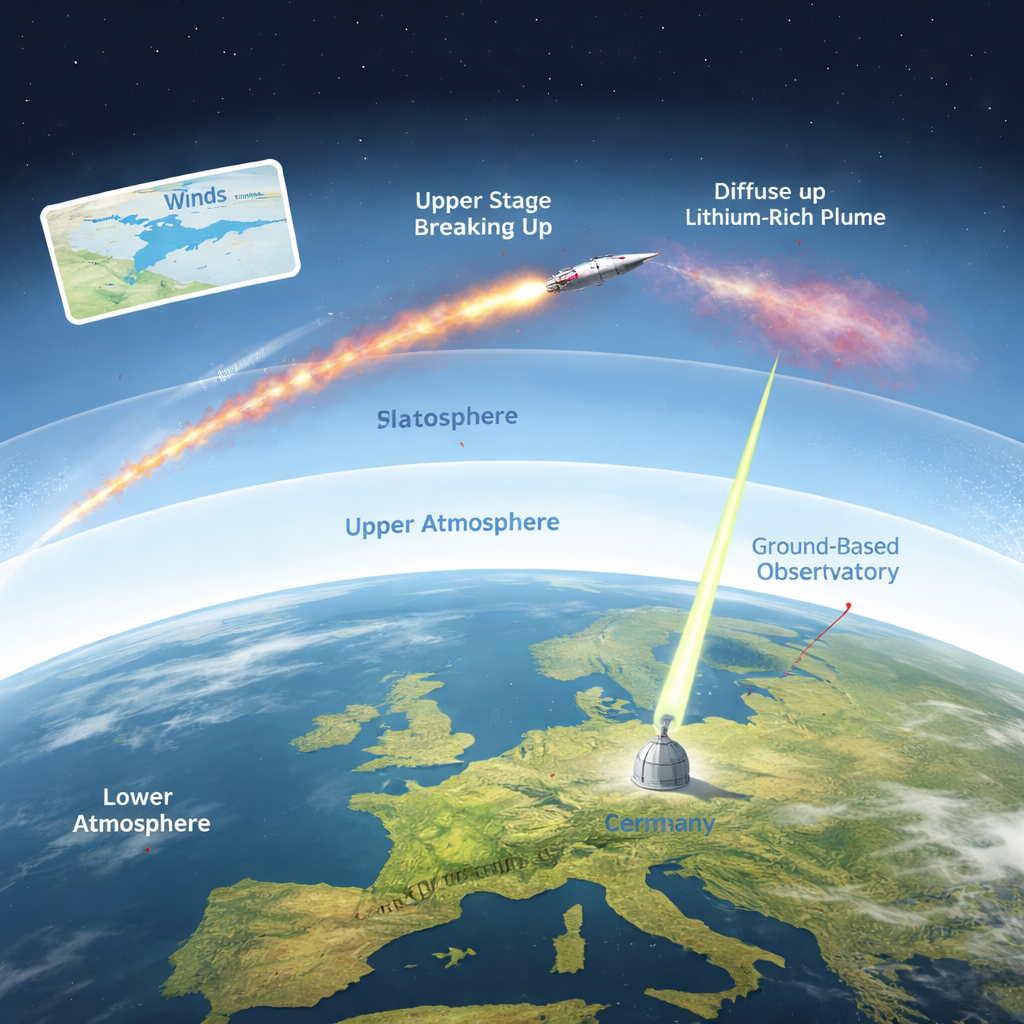
On 19 February 2025, the upper stage of a Falcon 9 rocket made an uncontrolled re‑entry over Europe. People on the ground saw a bright fireball streak across the sky as the hardware broke apart around 100 kilometers above the surface, west of Ireland. What they could not see was that the rocket’s aluminum‑lithium hull and components were vaporizing, releasing lithium atoms into a region called the mesosphere and lower thermosphere. Because lithium is extremely rare in incoming space dust but common in spacecraft alloys and batteries, it serves as a clean fingerprint of human‑made material rather than natural meteors.
Listening to the sky with lasers and radar
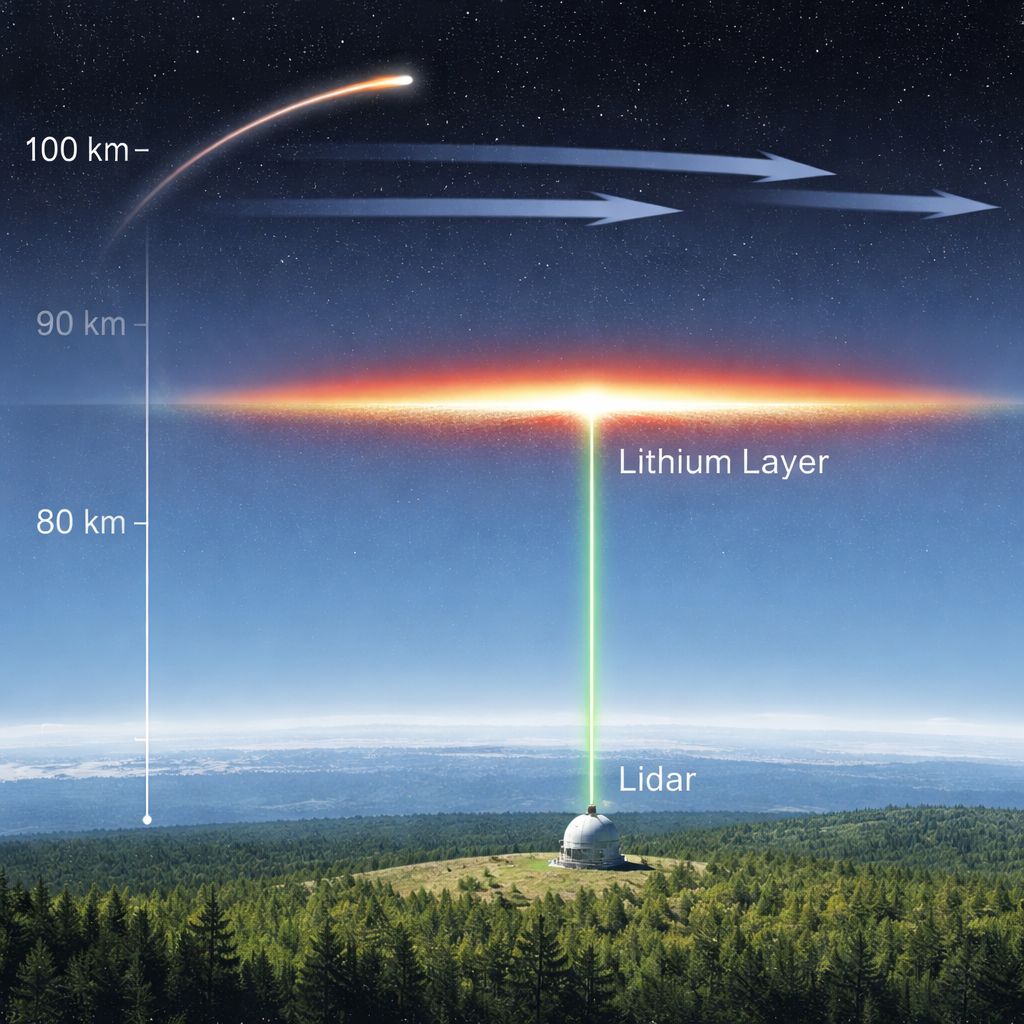
Researchers in Kühlungsborn, Germany, happened to be operating a specialized laser system, or lidar, tuned to the color of light that lithium atoms naturally absorb and re‑emit. For most of the night, the lithium signal in the upper atmosphere was barely above background levels. Then, just after midnight on 20 February, the instrument suddenly recorded a ten‑fold jump in lithium within a narrow layer between about 94.5 and 96.8 kilometers altitude. This intense layer lasted roughly 40 minutes, right up to the end of the measurement period, and stood out sharply from normal conditions. At the same time, a meteor radar network was tracking upper‑air winds in three dimensions, providing a detailed picture of how air was flowing around the region.
Tracing the plume back to its source
To find out where this lithium‑rich air had come from, the team used a global atmosphere model that extends into the upper layers of the air and is linked to real‑world weather analyses. They released thousands of “virtual air parcels” from the place and time of the lidar detection and ran their trajectories backward in time, adding realistic wind fluctuations measured by radar. Many of these back‑traced paths converged on a region just west of Ireland, at about 100 kilometers altitude, at the same time and place as the known Falcon 9 re‑entry track. One example path passed within a few kilometers of the rocket’s trajectory in both height and horizontal distance, strongly suggesting that the plume seen over Germany was debris from the earlier breakup that had been carried about 1,600 kilometers by the winds in roughly 20 hours.
Ruling out nature’s usual suspects
The upper atmosphere does host natural metal layers created when meteors burn up, and these can sometimes be reshaped by electrical and wind patterns into thin sheets of neutral metal atoms. To test whether the observed lithium layer could be one of these ordinary features, the scientists examined ionospheric measurements, wind shear, and geomagnetic activity from nearby monitoring stations. There was no strong “sporadic E” layer of charged metals, no wind pattern favoring the build‑up and descent of such layers, and no geomagnetic storm capable of stirring the region in a way that might concentrate lithium naturally. Taken together with the extreme rarity of lithium in meteoric material, these observations made a natural explanation highly unlikely.
What this means for the future sky
This case study is the first direct, time‑resolved measurement of pollution in the upper atmosphere from a known piece of re‑entering space hardware, and the first to show that ablation of spacecraft material can begin near 100 kilometers altitude. The authors estimate that a single Falcon 9 stage may contain hundreds of times more lithium than Earth naturally receives each day from space dust. As satellite mega‑constellations grow and more stages and satellites burn up, the total mass and unusual mix of metals entering the atmosphere are expected to increase dramatically. While the exact consequences for ozone, high‑altitude clouds, and climate are still uncertain, this work demonstrates that it is now possible to identify and trace space‑derived pollutants from the ground. Expanding such measurements to more locations and more metals will be crucial for understanding, and eventually managing, the environmental footprint of our expanding presence in space.
Citation: Wing, R., Gerding, M., Plane, J.M.C. et al. Measurement of a lithium plume from the uncontrolled re-entry of a Falcon 9 rocket. Commun Earth Environ 7, 161 (2026). https://doi.org/10.1038/s43247-025-03154-8
Keywords: space debris, rocket reentry, upper atmosphere, lithium plume, satellite pollution