Clear Sky Science · en
Controls of root-system overlap on hillslope stability
Why roots matter when hillsides get soaked
As climate change brings more intense rainstorms, communities in steep landscapes face growing risks from sudden shallow landslides. Trees and other plants are often promoted as natural protectors that hold soil together, but their underground root networks can both strengthen and weaken a slope. This study explores a surprisingly simple question with big consequences for hillside safety and nature-based solutions: how does the density and overlap of plant roots control when and how a slope fails during heavy rain?
Growing a miniature hillside in the lab
To untangle this problem, the researchers built a scaled-down hillside in a laboratory flume—a long box filled with sand and tilted to mimic a steep slope above a gentler runout area. They planted fast-growing pea plants at four different densities, representing very sparse, sparse, moderate, and very dense vegetation, and also tested a bare slope with no plants. The peas were chosen because their simple root systems resemble those of many tree species when scaled appropriately. Above the flume, a set of mist nozzles produced strong artificial rainfall, and cameras, water sensors, and surface markers tracked how the soil deformed, when cracks opened, how water moved through the slope, and when and where landslides broke loose.
Roots as both glue and water pipes
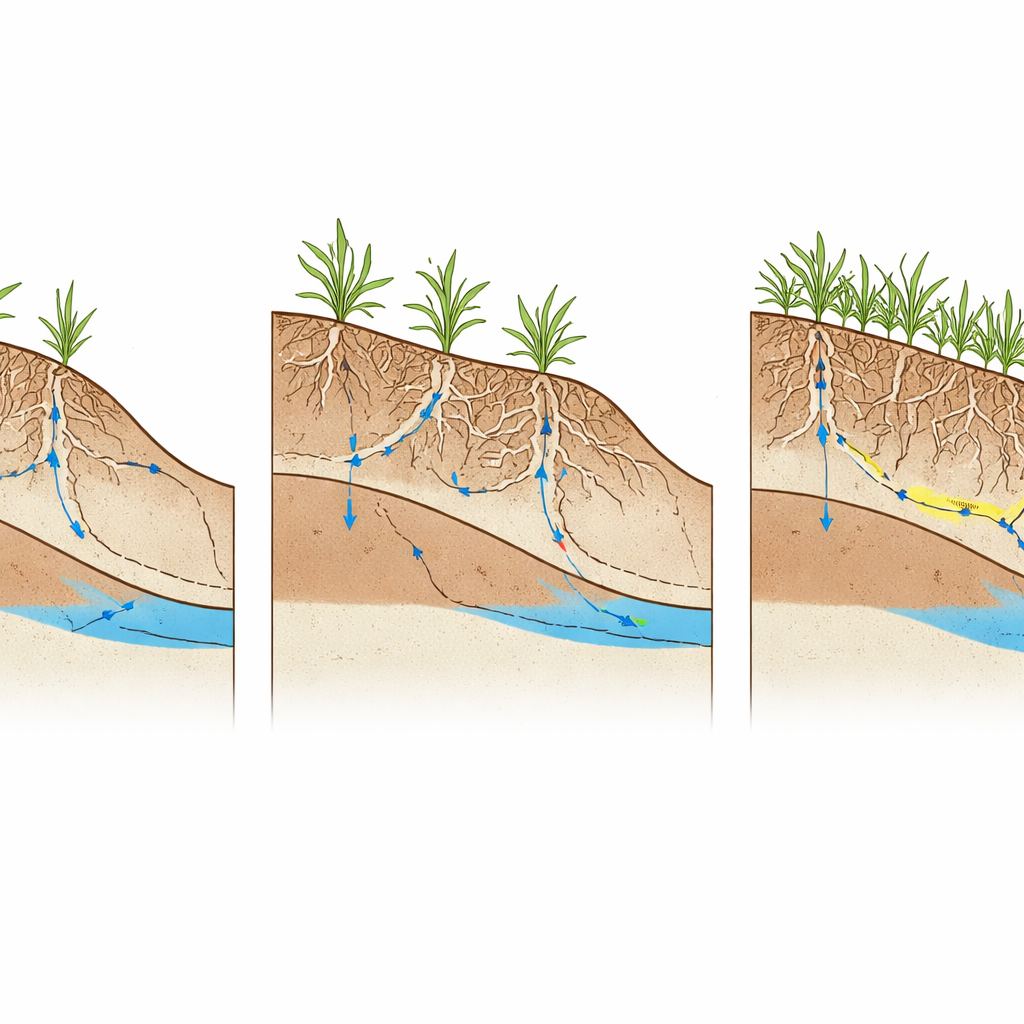
The experiments revealed a delicate balance between two competing roles of roots. First, overlapping lateral roots act like a web of underground cables that bind soil grains together, increasing the force needed to start a slide. As plant density increased, the total length and mass of roots in the slope rose sharply, and so did the added strength they provided. However, roots also acted as express pathways for water. In densely planted slopes, overlapping root networks sped up the movement of rainwater down and through the soil, leading to faster and more extensive saturation near the base of the slope. Saturated sand loses friction and becomes much easier to slide, meaning that in some cases the same roots that reinforced the soil also helped prepare the ground for failure by moving water efficiently into critical zones.
Finding a “just right” amount of vegetation
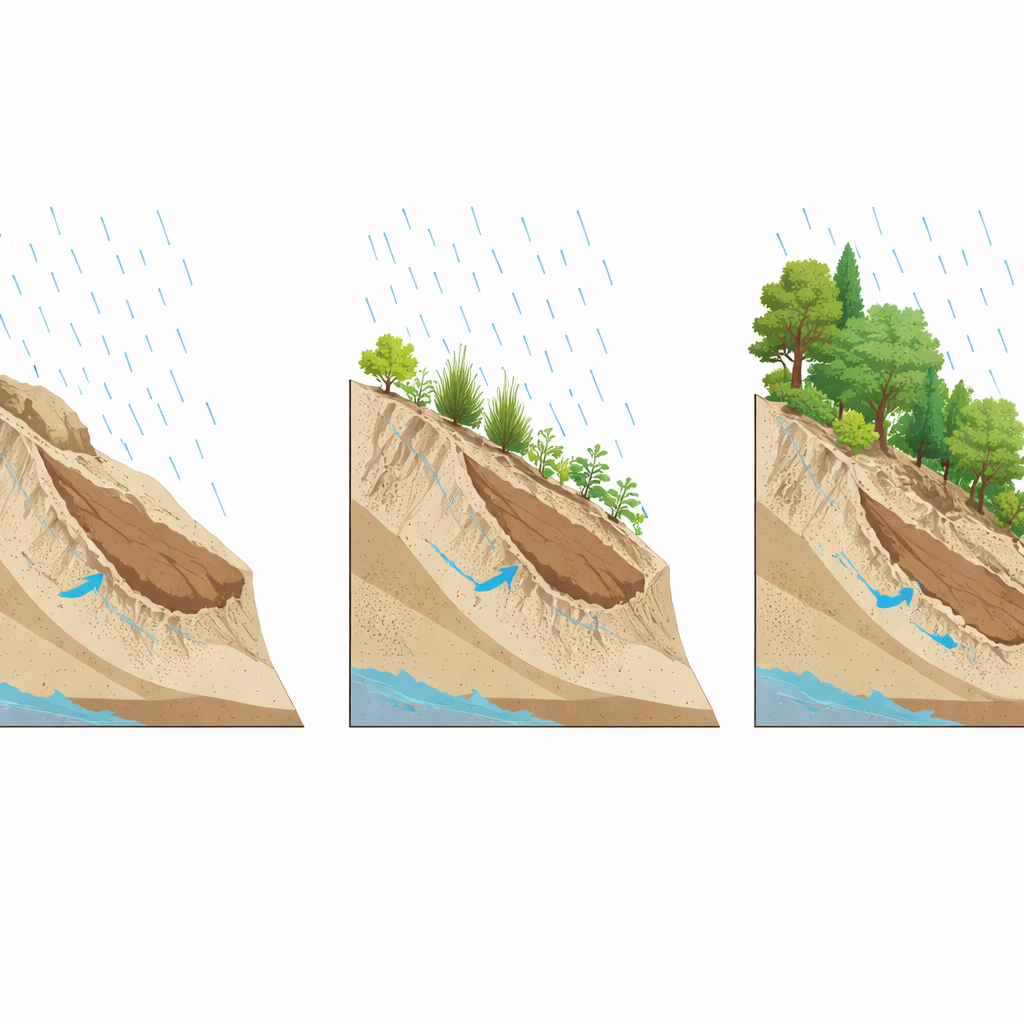
Across the range of plant densities, the timing and size of landslides responded in a distinctly non-linear way. Compared with the bare slope, all vegetated slopes delayed the onset of failure, but not equally. The densest treatment took the longest to fail, indicating strong mechanical reinforcement from an intertwined root mat. Yet this very dense cover often produced the largest and most variable landslide areas, because once the heavily saturated soil finally gave way, the tightly connected roots helped the mass move as a single large block. At the other extreme, very sparse vegetation provided little overlap among neighboring roots, leaving mechanically weak gaps between plants where cracks and failures could start. The standout performer was the moderate-density treatment, which produced the smallest and most consistent landslides. Here, roots overlapped enough to form a relatively uniform reinforcing mesh without accelerating water movement to the point of creating a large, unstable saturated zone.
From lab peas to real-world forests and farms
The findings suggest that there is an optimal range of plant density for minimizing landslide size under intense rainfall, at least in situations where shallow lateral roots dominate and deeper anchoring roots are limited. Importantly, the study shows that simply adding more plants does not always make slopes safer: beyond a certain point, extra roots may mainly enhance water movement and the cohesion of a potentially mobile soil block, rather than preventing failure. This helps explain why some densely vegetated, steep hillsides can still produce large landslides, while well-managed stands with moderate spacing may better break up unstable masses into smaller, less destructive failures.
Designing smarter nature-based protection
For land managers, engineers, and planners, this work underscores that vegetation is not a one-size-fits-all solution. Effective nature-based strategies for stabilizing slopes must consider not only which species to plant and how old or tall they are, but also how closely they are spaced and how their root systems overlap beneath the surface. By integrating plant density and root overlap into hazard assessments and reforestation or agroforestry designs, it becomes possible to harness roots as both structural support and hydrological regulators, improving hillside resilience while avoiding unintended increases in landslide size.
Citation: Noviandi, R., Gomi, T., Sidle, R.C. et al. Controls of root-system overlap on hillslope stability. Commun Earth Environ 7, 235 (2026). https://doi.org/10.1038/s43247-025-03012-7
Keywords: shallow landslides, root systems, vegetation density, slope stability, nature-based solutions