Clear Sky Science · en
Backbone rigidity promoting hole delocalization and enabling efficient charge generation with minimal voltage loss in nonfullerene organic photovoltaics
Why better plastic solar cells matter
Solar panels made from flexible carbon-based materials promise light, bendable, and potentially very cheap power sources for everything from building walls to wearable electronics. But these organic solar cells still waste more energy as heat than their silicon cousins, especially in the form of "voltage loss" that limits how much useful electrical power they can deliver. This paper explores a new plastic-like material with an unusually rigid backbone that helps organic solar cells turn sunlight into electricity more efficiently, while wasting less voltage than similar devices.
A new kind of light-harvesting plastic
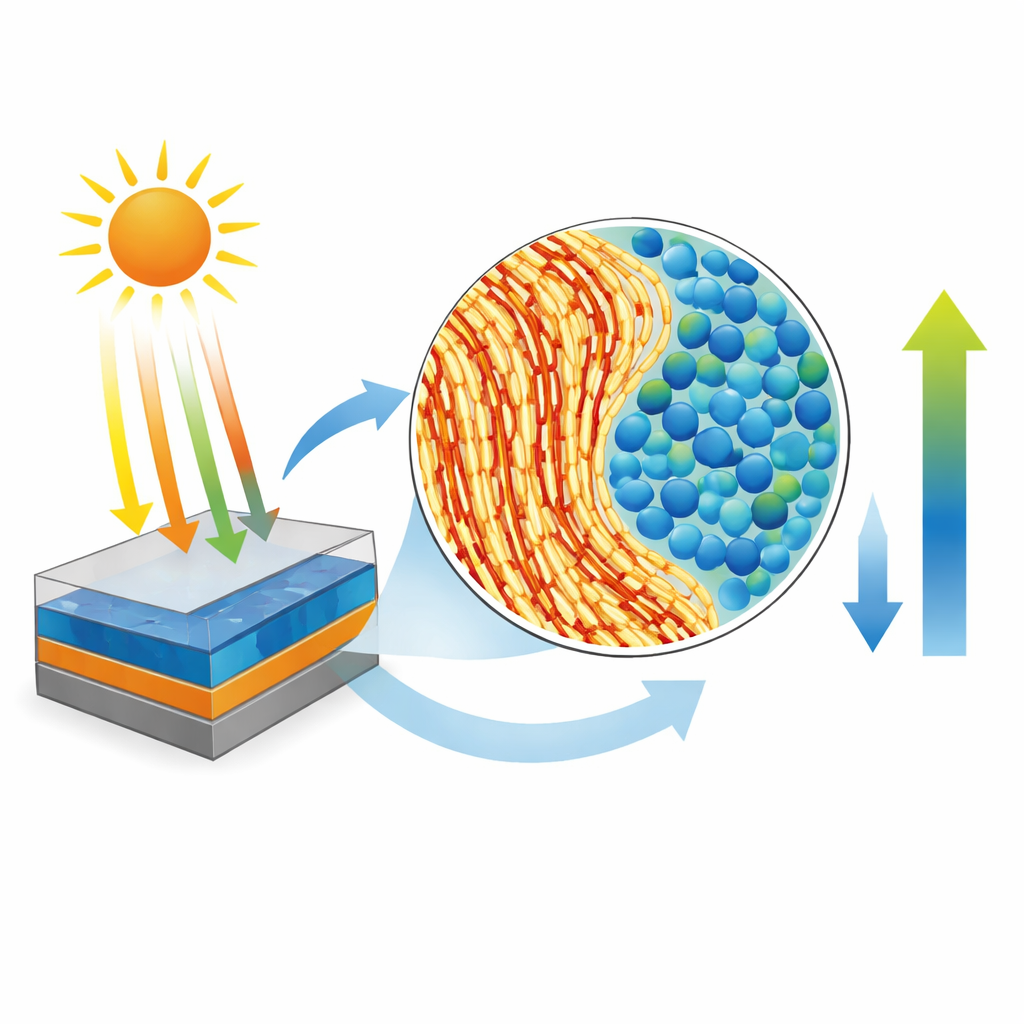
The researchers focus on an organic solar cell made from a blend of two ingredients: a long-chain polymer called PTNT1-F that donates positive charges, and a nonfullerene molecule called Y12 that accepts negative charges. In these devices, light creates tightly bound electron–hole pairs that must be pulled apart at the interface between donor and acceptor to generate current. The catch is that reducing the energy difference that drives this separation usually cuts current, even though it helps reduce wasted voltage. PTNT1-F is designed with a stiff, extended carbon-and-sulfur ring system that keeps its electronic states well organized, a feature the team suspected might allow efficient charge separation even when that driving force is small.
High power with little wasted push
When PTNT1-F is blended with Y12 in a standard solar cell structure, the devices reach power conversion efficiencies above 18 percent, similar to or better than leading organic cells based on popular polymers D18 and PM6. Crucially, the PTNT1-F cells achieve this while suffering an unusually small “nonradiative voltage loss” of only about 0.18 volts. This loss reflects how much energy disappears as heat rather than being emitted as faint light or collected as electrical work. Across many published organic cells, lowering this loss has typically come at the cost of reduced current. Here, the authors show that PTNT1-F breaks that trend: its charge generation efficiency reaches roughly 80 percent of the theoretical limit, the highest yet reported for organic cells operating with such low voltage loss.
Rigid chains that stay ordered in a crowd
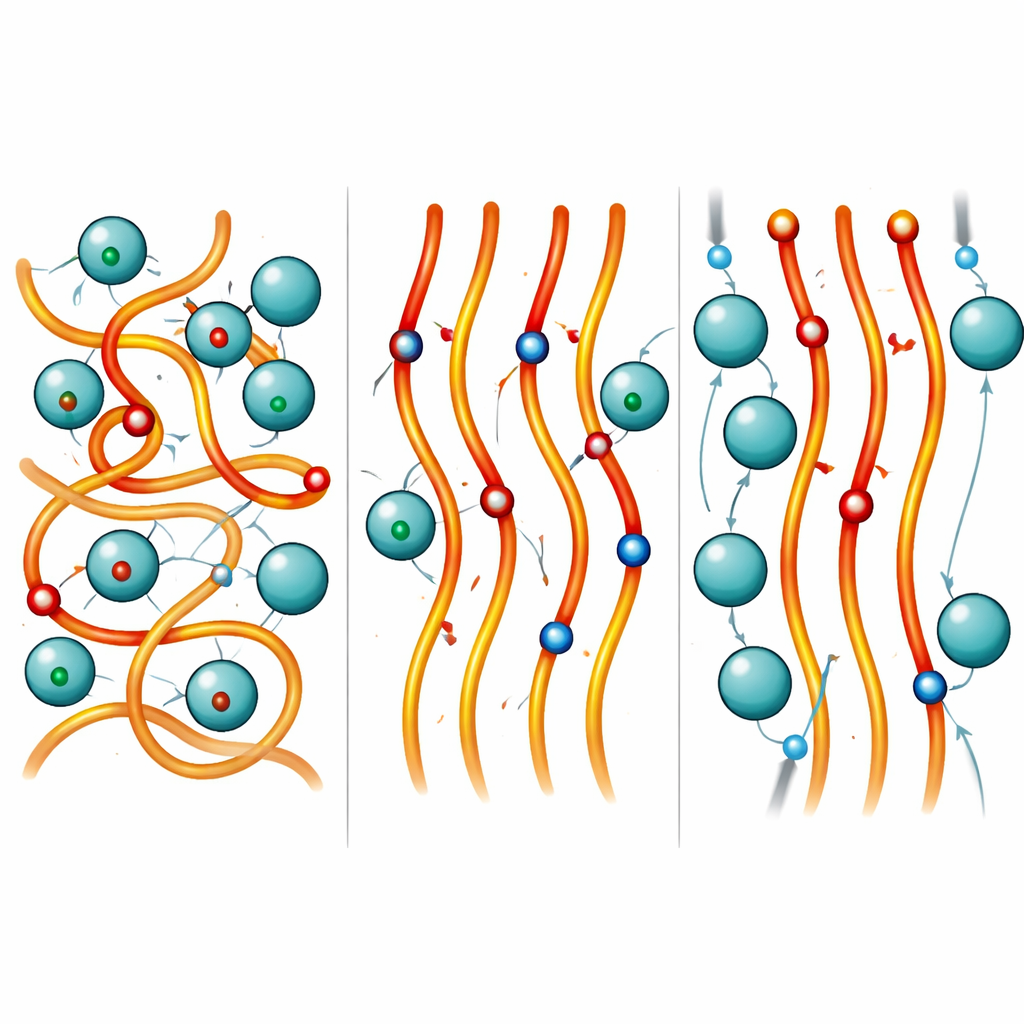
To understand why this material performs so well, the team probed how its long molecular chains pack and how their energy levels are distributed. X-ray scattering and advanced spectroscopy reveal that when PTNT1-F is mixed with Y12, the spread of its energy levels—the so-called density of states—barely broadens. In other words, the polymer keeps a high degree of order even in the complex blended film. In contrast, the reference polymers D18 and PM6 show clear signs of increased disorder once they are blended, which introduces more energetic “roughness” and trap sites. Optical measurements further show that PTNT1-F has a relatively high light-emission efficiency and limited nonradiative decay, traits linked to its stiff backbone that restricts internal motions where energy could be lost as heat.
How stiffness helps charges get away
Zooming in on the mechanism, the authors argue that the rigidity of PTNT1-F allows positive charges (holes) to spread out along the chain instead of remaining localized. Calculations of the effective mass of holes support this picture, indicating that the polymer can support extended electronic states. Additional measurements sensitive to subtle trap states at the interface between donor and acceptor suggest that PTNT1-F blends have fewer deep traps than those based on D18 or PM6. Together, these findings imply that once a hole is transferred from Y12 to PTNT1-F, it can quickly delocalize along a relatively smooth, ordered backbone, making it easier for the electron and hole to separate before they recombine.
Design lessons for next-generation solar plastics
In simple terms, this study shows that making the polymer backbone straighter and more rigid helps organic solar cells get “more bang for their buck”: they need less energetic push to separate charges yet still produce strong current, cutting energy losses that have long held these devices back. The work suggests that carefully shaping the core molecular skeleton—its symmetry, size, and how its rings line up along the chain—can preserve order in the crowded blend and promote charge delocalization. These design rules could guide the development of future plastic solar materials that combine high efficiency with low voltage loss, bringing flexible and lightweight photovoltaics closer to practical, large-scale use.
Citation: Suruga, S., Mikie, T., Sato, Y. et al. Backbone rigidity promoting hole delocalization and enabling efficient charge generation with minimal voltage loss in nonfullerene organic photovoltaics. Commun Mater 7, 79 (2026). https://doi.org/10.1038/s43246-026-01115-y
Keywords: organic solar cells, polymer semiconductors, charge separation, nonfullerene acceptors, photovoltaic efficiency