Clear Sky Science · en
Low stress grain boundary mediated plasticity and early fracture at basal twist grain boundaries in a titanium alloy
Hidden Weak Spots in a Workhorse Metal
Titanium alloys are the backbone of modern jet engines, prized for being both strong and light. Yet despite decades of use, engineers still struggle to predict exactly when and where tiny cracks will begin that can grow into serious damage. This study zeroes in on a very specific type of internal feature—special boundaries between crystals inside the metal—that act as quiet weak spots. By watching these regions deform and crack in real time, and by simulating them atom by atom, the authors reveal why they fail so early and how that knowledge could make future engines safer and longer-lasting.
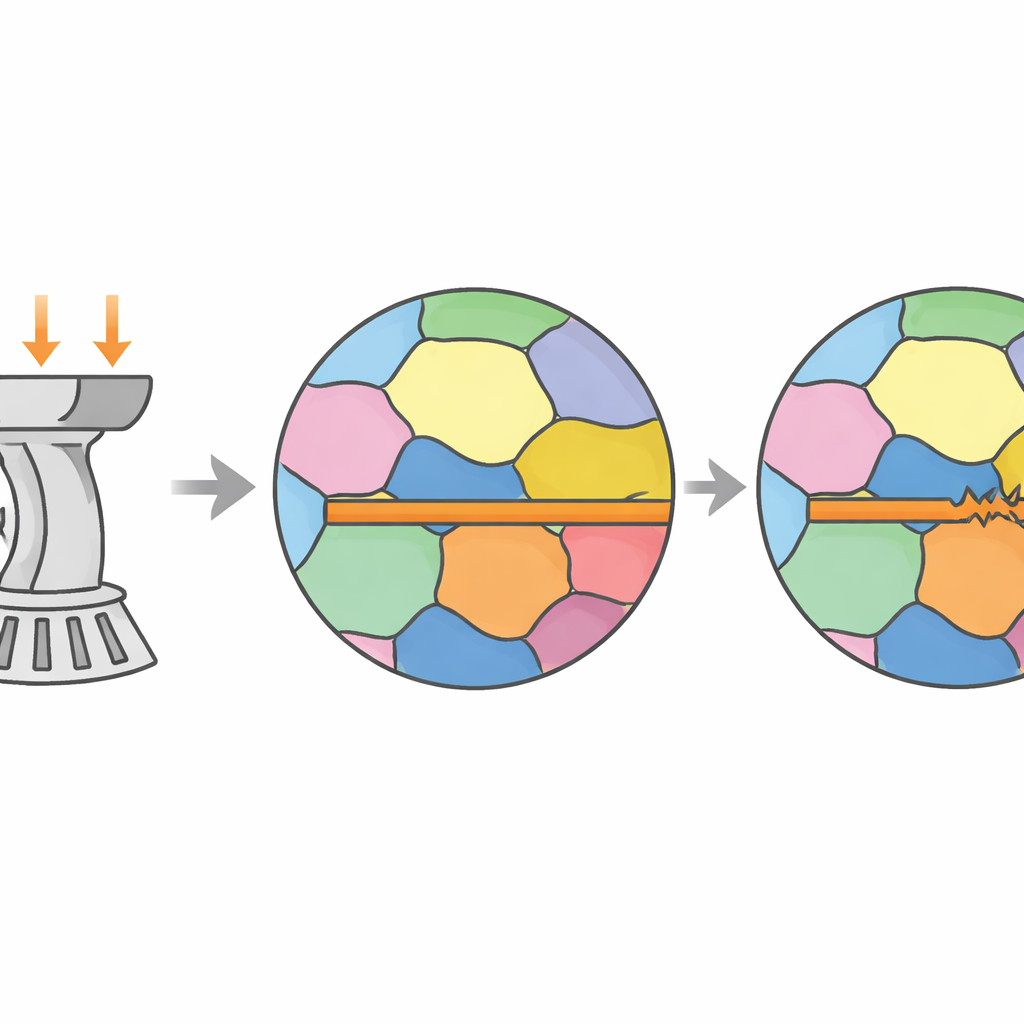
Where Cracks Really Begin
Like many metals, titanium alloys are built from microscopic crystals, or grains, that fit together like a 3D mosaic. The surfaces where two grains meet are called grain boundaries, and most of the time they quietly carry load without drawing attention. But in the widely used Ti‑6Al‑4V alloy, one particular type of boundary—called a basal twist grain boundary—has been repeatedly linked to early crack formation in fatigue tests. These boundaries occur when two neighboring crystals are rotated relative to one another around a key direction in the crystal structure. They are rare, but when present they often coincide with the first tiny cracks that appear under repeated loading, making them prime suspects in unexpected failures.
Watching Metal Deform in Real Time
To understand what makes these boundaries so troublesome, the researchers designed tensile tests inside a scanning electron microscope, stretching small samples of the alloy while tracking local motion on the surface. They used a gold speckle pattern and high‑resolution digital image correlation to measure minute shifts down to a few nanometers. This allowed them to see exactly when and where permanent deformation began, long before the whole specimen yielded. They also used detailed crystallographic maps to locate many basal twist grain boundaries with different orientations and sizes, so they could compare their behavior statistically rather than relying on a single example.
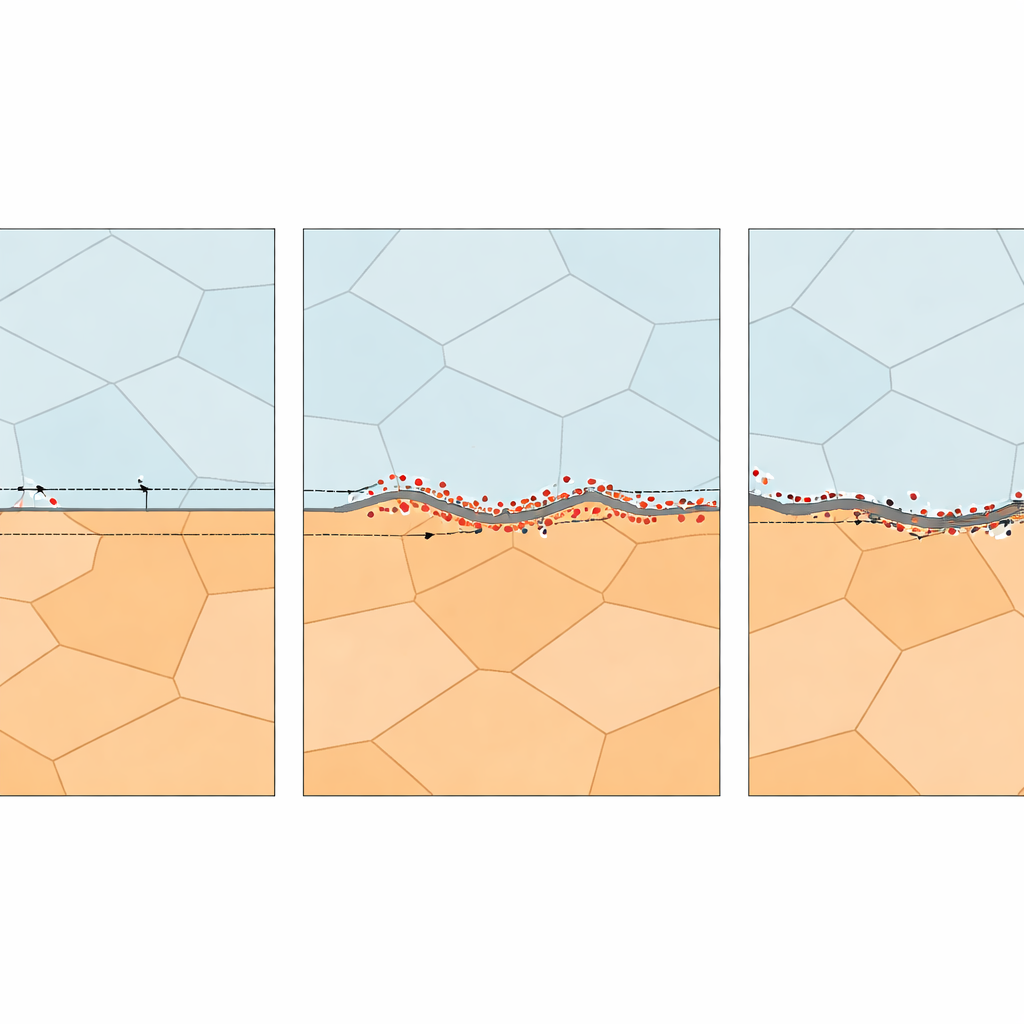
Surprisingly Soft Boundaries and Fast Cracks
The measurements revealed that these special boundaries begin to shear at astonishingly low applied stress—around one eighth of the stress needed to start normal slip within the grains themselves. In terms of critical shear strength, the boundaries were about three to six times easier to deform than the usual slip systems inside the crystals. As the sample was loaded, the first permanent motion consistently appeared along these boundaries, and in some cases the boundary deformation went on to trigger early slip in neighboring grains. At higher strain, some of these same boundaries suddenly opened into sharp, cleavage‑like cracks that ran along their full length within a single loading step, even though the overall sample strain was still only about 1–2 percent.
Atomic Patterns Behind Weakness
To dig deeper, the team built computer models of idealized boundaries in pure titanium and sheared them using molecular dynamics simulations. Even without impurities or pre‑existing defects, they found two distinct strength regimes. When the relative rotation between the grains was small, the boundary hosted a tightly interlocked pattern of dislocations arranged in a so‑called Kagome network, and the boundary resisted shear at stresses around a gigapascal. Above a twist of roughly 8–10 degrees, the interfacial dislocations rearranged into simpler triangular networks or even vanished, and the required shear stress dropped by roughly an order of magnitude—matching the low strengths inferred from experiments. Small tilts between the grains or modest misalignment of their key axes barely changed this behavior, suggesting that the twist‑controlled dislocation pattern at the interface is the main architectural feature setting the weakness.
When Deformation Turns into Damage
Not every soft boundary cracked, so the authors searched for what separates those that merely deform from those that fail. They found that cracking only occurred along boundaries that had already experienced significant shearing and that were oriented so that the overall load pressed partly normal to the boundary plane. In other words, crack formation required a two‑step recipe: first, easy sliding along the boundary to concentrate stress, and second, a suitable orientation so that the normal component of stress could prise the boundary open. This explains why only a handful of boundaries cracked in their tests, yet those few cracks appeared at very low global strain and always along these same special interfaces.
What This Means for Real‑World Parts
For non‑specialists, the key message is that a small and uncommon type of internal “seam” inside titanium alloys can begin to move and then split apart at loads far below those that affect the bulk of the material. The study links this weakness to the fine‑scale arrangement of atomic‑level defects at the boundary and shows that both shear and opening stresses must act together to trigger fracture. This improved picture of how and why these hidden weak spots fail offers a path to better lifetime predictions and, ultimately, to designing processing routes and component geometries that avoid the most dangerous boundary configurations in critical aerospace hardware.
Citation: Yvinec, T., Iabbaden, D., Hamon, F. et al. Low stress grain boundary mediated plasticity and early fracture at basal twist grain boundaries in a titanium alloy. Commun Mater 7, 85 (2026). https://doi.org/10.1038/s43246-026-01102-3
Keywords: titanium alloys, grain boundaries, fatigue cracks, microstructure, aerospace materials