Clear Sky Science · en
Superior strain hardening in refractory complex concentrated alloys via confined nano-martensite transformation
Making Tough Metals That Can Still Stretch
Modern engines, rockets and nuclear systems demand metals that stay strong at blazing temperatures and under intense loads. A new class of metallic "cocktails" called refractory complex concentrated alloys already offers impressive strength, but they tend to fail after only a small amount of stretching. In this work, researchers show how to reorganize the metal at the nanoscale so that it keeps hardening as it is pulled—allowing it to bend and stretch far more before breaking.
Why These Exotic Alloys Matter
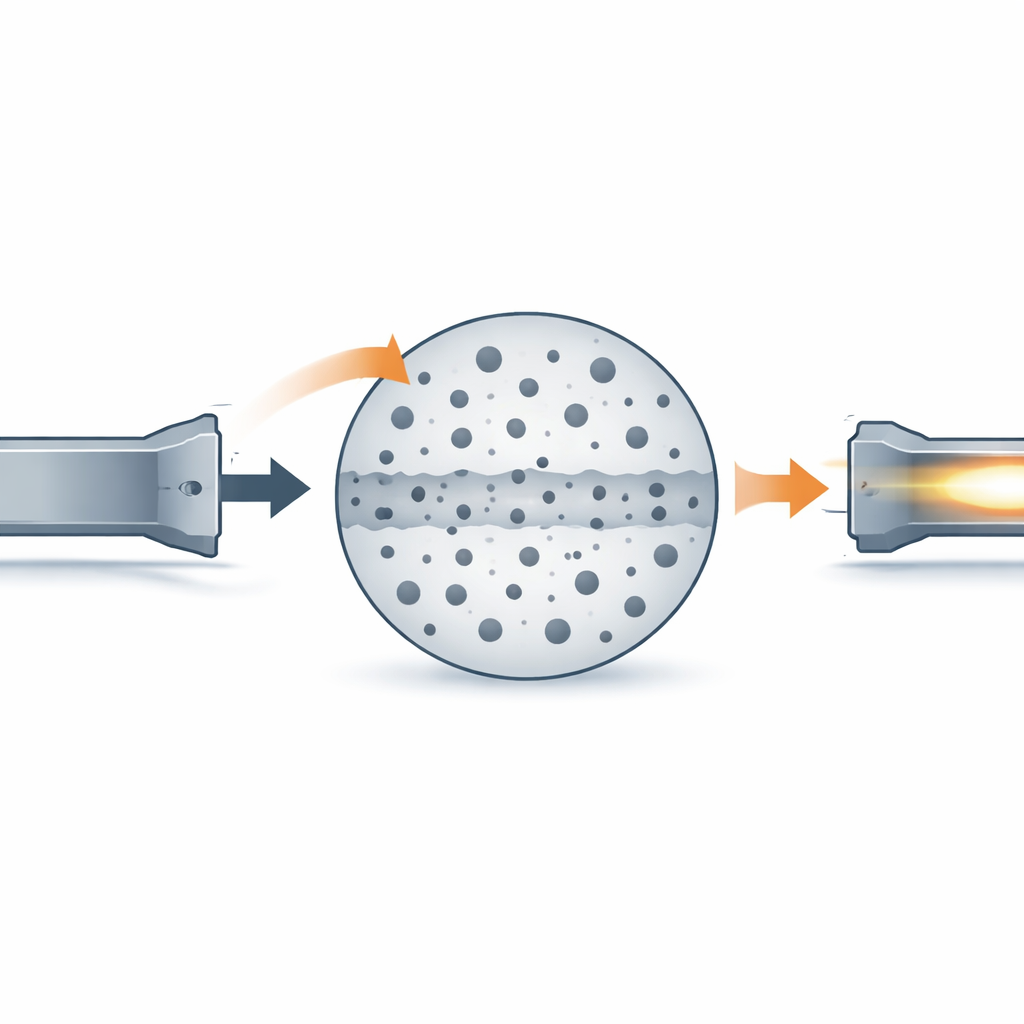
Refractory complex concentrated alloys mix several heavy, high‑melting‑point elements into a single solid solution. Their internal atomic lattice is naturally distorted, which makes them very strong and stable at high temperatures, and resistant to radiation and impact. The downside is that their crystal structure lets only a limited number of defects move and tangle during loading, so the metal cannot keep strengthening as it deforms. As a result, many such alloys show high strength but very low uniform elongation—typically only a few percent—limiting their usefulness in demanding structural parts.
Designing a Hidden Nanoscale Landscape
The team focused on an alloy made of titanium, zirconium and tantalum (Ti2ZrTa0.75). First, they heavily cold‑rolled it, squeezing the thickness down by 90%. This step packed the material with defects and stored elastic energy while keeping a single, simple crystal phase. They then applied a brief heat treatment: just one minute at 750 °C, followed by cooling in water. That short anneal did not allow the grains to grow or the overall structure to fully relax, but it did let atoms rearrange slightly. Advanced X‑ray and electron‑microscopy studies revealed that the once‑uniform alloy had separated into two intertwined phases: tantalum‑rich regions forming most of the matrix, and tantalum‑poor nano‑domains only about 15 nanometers across, all still sharing the same basic crystal type.
Switchable Tiny Regions That Resist Growth
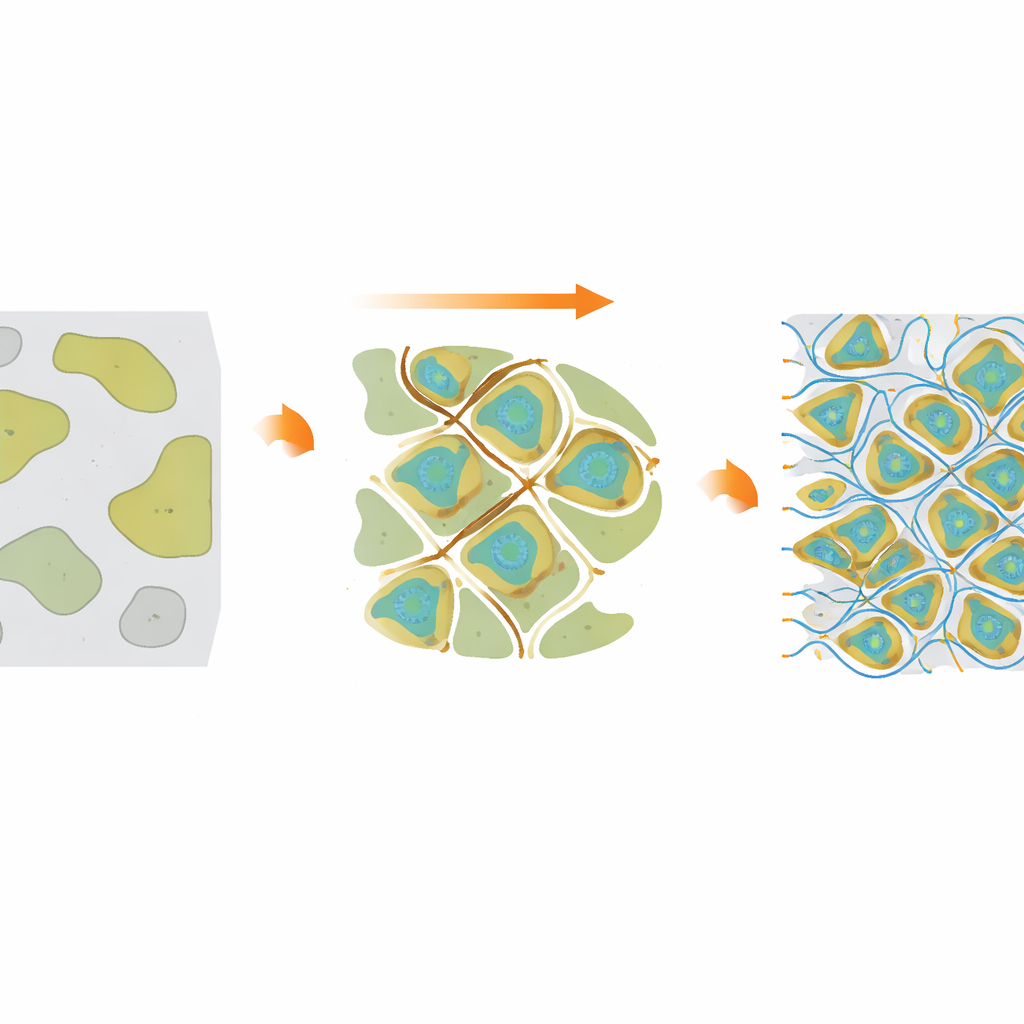
Inside the tantalum‑poor pockets, the researchers detected an even finer pattern: tiny needle‑like areas only one to two nanometers in size that had already switched to a different, slightly distorted crystal form during quenching. These embryos act as seeds for a new phase that can appear when the metal is pulled. Because tantalum stabilizes the original crystal structure, the surrounding tantalum‑rich matrix has a higher resistance to such switching and behaves as a stiff cage. When the alloy is stretched in a tensile test, the first stage of deformation is carried mainly by the motion of conventional defects. At around one percent strain, the metal yields, but as straining continues, the low‑tantalum nano‑domains begin to transform, growing these new crystal regions only within their confined 15‑nanometer boundaries.
How Confined Changes Boost Hardening
As stretching proceeds toward about five percent strain, more and more of the nano‑domains switch to the new crystal form until they nearly saturate. Each transformed pocket introduces many fresh internal boundaries and mismatches with the surrounding matrix, which concentrate local strain and attract moving defects. Dislocations are forced to interact with these dense nano‑interfaces instead of gliding freely, which dramatically raises the resistance to further deformation. The alloy shows an unusual double‑yielding behavior and develops a work‑hardening capacity of roughly 527 megapascals—several times higher than typical for this family of materials—while maintaining uniform elongation of about six percent and total elongation of about ten percent.
From Laboratory Insight to Real‑World Use
By carefully exploiting the alloy’s natural tendency to fluctuate in composition and by tuning heat treatment to steer phase separation, the researchers created a built‑in population of nanoscale zones that can transform only in a tightly confined way under load. This "confined nano‑martensite" mechanism lets the metal keep strengthening as it stretches, rather than softening and failing early. The approach points to a generally applicable strategy: use short‑time heat treatments to engineer transformable nano‑domains inside strong but brittle alloys, turning them into tougher, more damage‑tolerant materials for extreme environments.
Citation: He, J., Liu, H., Shen, B. et al. Superior strain hardening in refractory complex concentrated alloys via confined nano-martensite transformation. Commun Mater 7, 84 (2026). https://doi.org/10.1038/s43246-026-01101-4
Keywords: refractory alloys, strain hardening, nano-martensite, high-entropy alloys, phase transformation