Clear Sky Science · en
Perovskite-R1: a domain-specialized large language model for intelligent discovery of precursor additives and experimental design
Smarter helpers for better solar power
Perovskite solar cells are one of the most promising routes to cheaper, more efficient solar energy, but turning lab breakthroughs into long‑lasting commercial panels remains difficult. Tiny chemical additives can dramatically improve these materials, yet choosing the right ones is like searching for a needle in a haystack of tens of thousands of possibilities and thousands of research papers. This study introduces Perovskite‑R1, a specialized artificial intelligence system built to read the literature, reason about chemistry, and propose more reliable recipes for making high‑performance perovskite solar cells.
Why perovskite solar cells need a boost
Perovskite solar cells have leapt from a few percent efficiency to nearly 27% in just over a decade, rivaling the best silicon cells while being easier and cheaper to process from solution. Their Achilles’ heel is stability: the light‑absorbing layer can degrade under heat, moisture, and long‑term operation, especially if its crystal structure contains many defects. One proven way to strengthen these films is to add carefully chosen molecules to the starting solution, which guide how the crystals grow and help “heal” flaws. But with the scientific literature on perovskites exploding and chemical space being almost endless, human trial‑and‑error and intuition struggle to keep up.
Training an AI expert in a narrow field
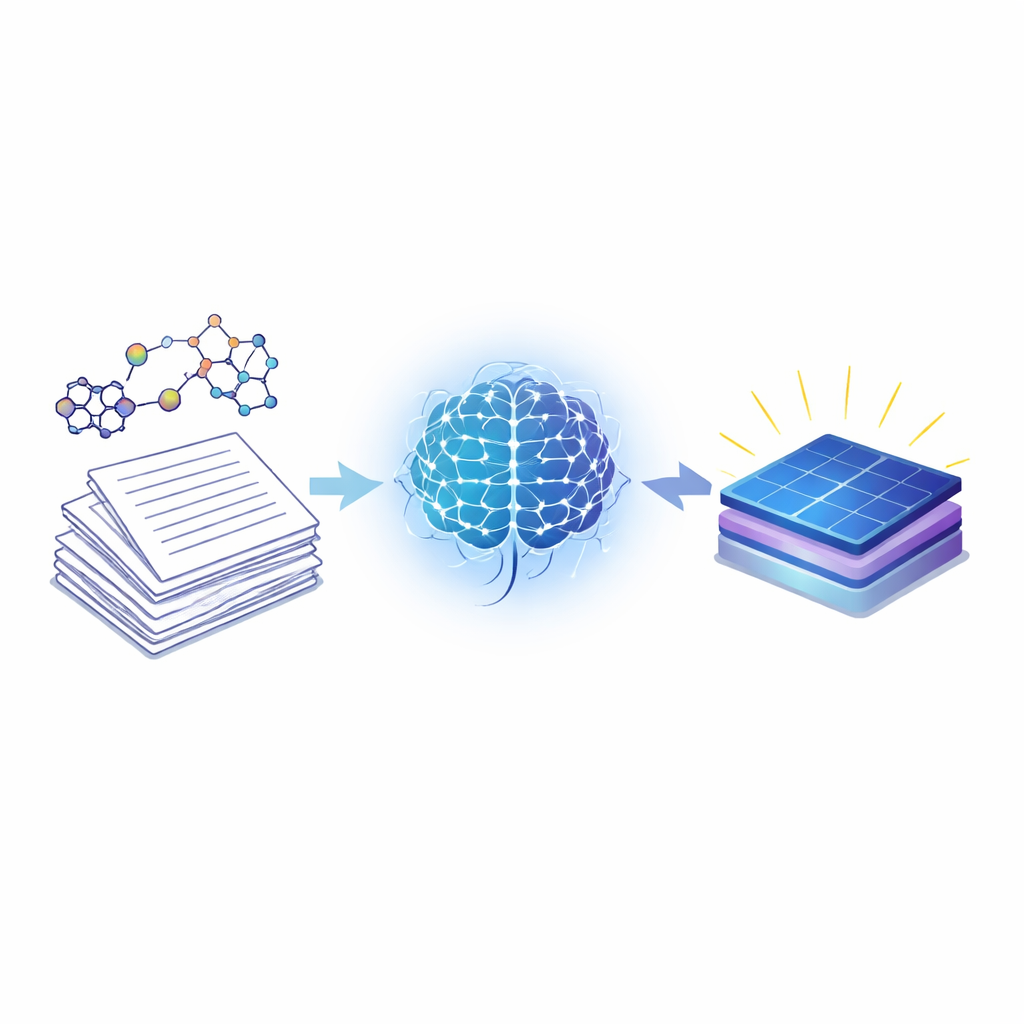
The researchers tackled this problem by building Perovskite‑R1, a large language model fine‑tuned specifically for perovskite chemistry. They began by curating 1,232 high‑quality research papers focused on how additives influence perovskite films, including their synthesis, structure, and performance. They also assembled a library of 33,269 “drug‑like” small molecules with diverse structures that might serve as candidate additives. Using another powerful AI model, they transformed the papers and molecule descriptions into almost 10,000 question‑and‑answer examples that include explicit reasoning steps. These examples were then used to retrain an existing large language model so that it could talk about perovskites in a detailed, lab‑ready way rather than only in general scientific terms.
From text prompts to concrete lab recipes
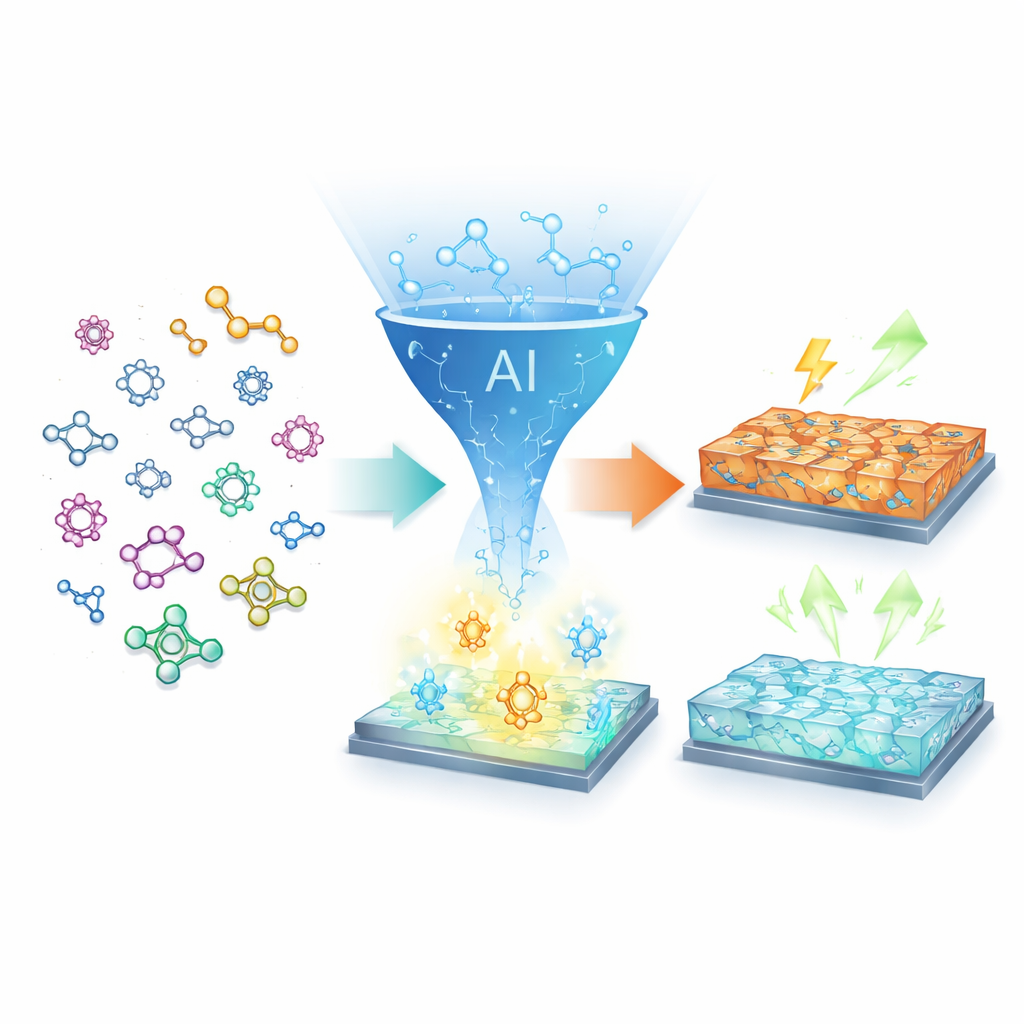
Perovskite‑R1 is not just answering quiz questions; it is guided with carefully constructed prompts that mimic the way a scientist would frame a design task. Each prompt explains the goal (for example, to find additives that reduce defects in a specific perovskite composition), lists scientific criteria (such as the types of chemical bonds the additive should form or how it should influence crystal growth), and specifies the desired output (candidate molecules, suggested concentrations, and expected mechanisms). The model can sift through its learned knowledge, virtually “screen” thousands of molecules, and return a short list along with its chain‑of‑thought explaining why each choice should work. Benchmark tests show that, on perovskite‑specific reasoning questions ranging from basic to very challenging, Perovskite‑R1 consistently outperforms several leading general‑purpose language models.
Putting AI‑chosen ingredients to the test
To see whether these ideas hold up in the lab, the team asked Perovskite‑R1 to select promising additives and then compared them to molecules chosen by experienced researchers using conventional chemical intuition. All four candidates—two from the AI and two from humans—shared seemingly sensible features, such as functional groups that can bind to the perovskite’s lead and iodine components. The additives were mixed into identical perovskite solar cells at the same low concentration, and 24 devices were built and tested for each case. The AI‑chosen molecules consistently increased average efficiency and made performance more reproducible, whereas the manually selected additives actually degraded both efficiency and reliability, despite looking reasonable on paper.
How the AI’s reasoning matched real chemistry
Beyond raw numbers, the researchers probed why the AI‑picked additives worked better. Perovskite‑R1 had predicted that one molecule would form coordination bonds with lead ions, while another would form stabilizing hydrogen bonds within the crystal. Follow‑up infrared spectroscopy experiments indeed showed the expected shifts in bond vibrations, confirming those interactions. Devices with AI‑selected additives also had fewer electrically active defects and retained their performance longer under heat and storage, whereas control devices and those with human‑chosen additives degraded more quickly. These results suggest that Perovskite‑R1 is capturing meaningful structure‑function relationships rather than generating lucky guesses.
What this means for future materials discovery
The work shows that a domain‑tuned language model can act as a practical partner in experimental materials research, narrowing the search for effective additives from tens of thousands of options to a manageable, high‑quality shortlist. Perovskite‑R1 does not replace lab work; instead, it generates well‑reasoned hypotheses that scientists can test, speeding up discovery while making better use of existing knowledge. The authors envision extending the same approach to other aspects of perovskite devices—such as interfaces and multi‑layer architectures—and eventually coupling models like Perovskite‑R1 to automated synthesis platforms. For non‑specialists, the key message is that carefully trained AI systems can now help design better solar materials in a targeted, explainable way, bringing durable, high‑efficiency perovskite technologies closer to everyday use.
Citation: Wang, XD., Chen, ZR., Guo, PJ. et al. Perovskite-R1: a domain-specialized large language model for intelligent discovery of precursor additives and experimental design. Commun Mater 7, 86 (2026). https://doi.org/10.1038/s43246-026-01099-9
Keywords: perovskite solar cells, materials discovery, large language models, precursor additives, artificial intelligence in chemistry