Clear Sky Science · en
Controlling spectral and power flow behavior in rotated hyperbolic resonators
Guiding Light with a Twist
Infrared light is the workhorse of many modern technologies, from chemical sensing and thermal imaging to on-chip communications. Engineers would like to steer and confine this light with the same precision that electronics offers for electrons, but doing so at very small scales is challenging. This study shows that a common crystal, calcite, can act as a powerful platform for sculpting infrared light—simply by rotating tiny grooves carved into its surface relative to the crystal’s internal directionality.
A Crystal with Built-In Directions
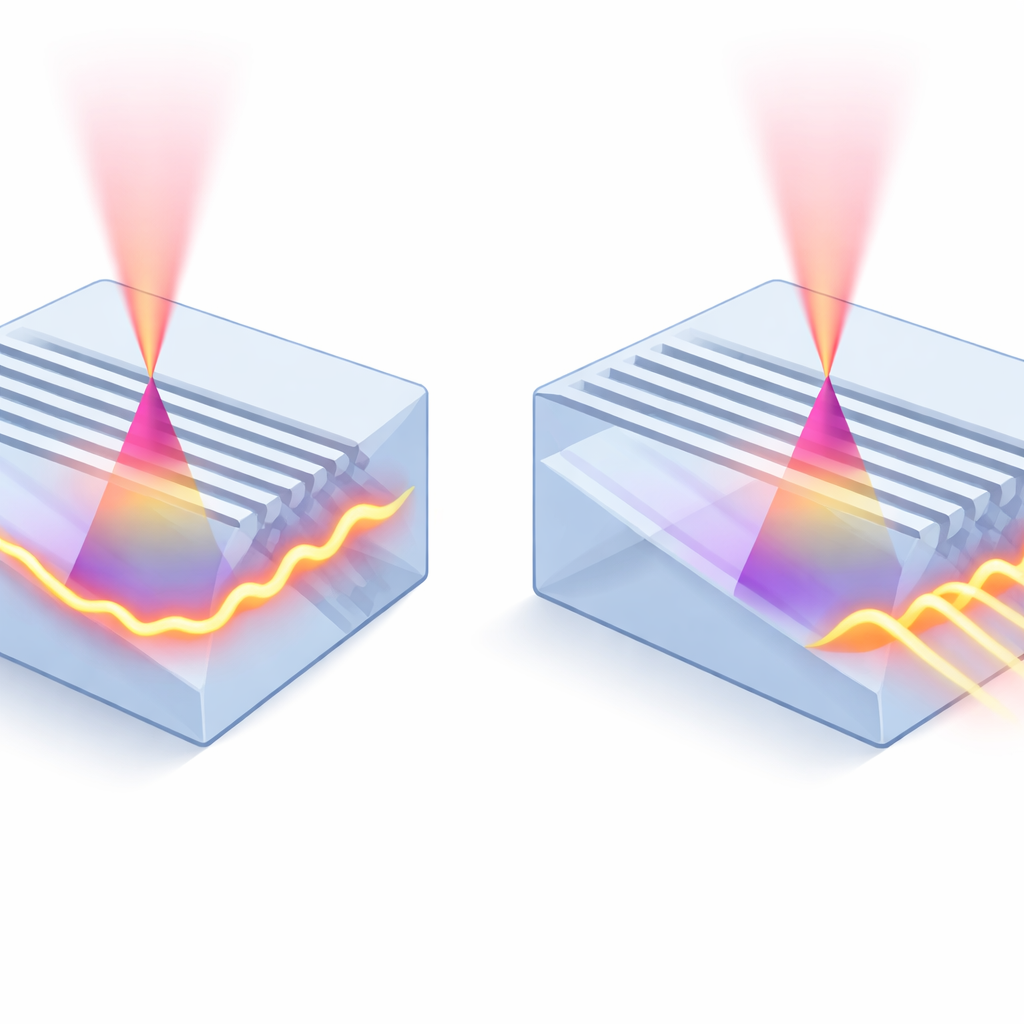
Calcite is not optically uniform in all directions. Along one special axis inside the crystal, light “sees” a metallic-like response at certain infrared colors, while along other axes it behaves more like a normal transparent material. This extreme directional behavior creates so-called hyperbolic modes, where light can be squeezed into volumes far smaller than its wavelength and guided along sharp, slanted paths. Unlike better-known hyperbolic materials that are thin flakes with nearly circular symmetry in their plane, calcite’s properties are strongly different along different in-plane directions, giving experimenters an extra handle to control how light moves.
Carving Resonators that Rotate
To harness this built-in directionality, the researchers etched a series of evenly spaced grooves—one-dimensional resonators—directly into the surface of a bulk calcite crystal. Each set of grooves had the same size and shape, but the whole pattern was rotated by a different angle relative to the crystal’s special axis lying in the surface. Using polarization-sensitive infrared reflectance spectroscopy, they found that these identical resonators produced markedly different resonant colors depending only on their orientation. When the grooves were aligned with the metallic-like axis, two strong resonances appeared, corresponding to waves bouncing inside the grooves and extending into the crystal. As the grooves were rotated away from this axis, these resonances shifted smoothly to lower frequency and weakened, disappearing entirely when the grooves were turned 90 degrees.
Simple Rules Behind Complex Waves
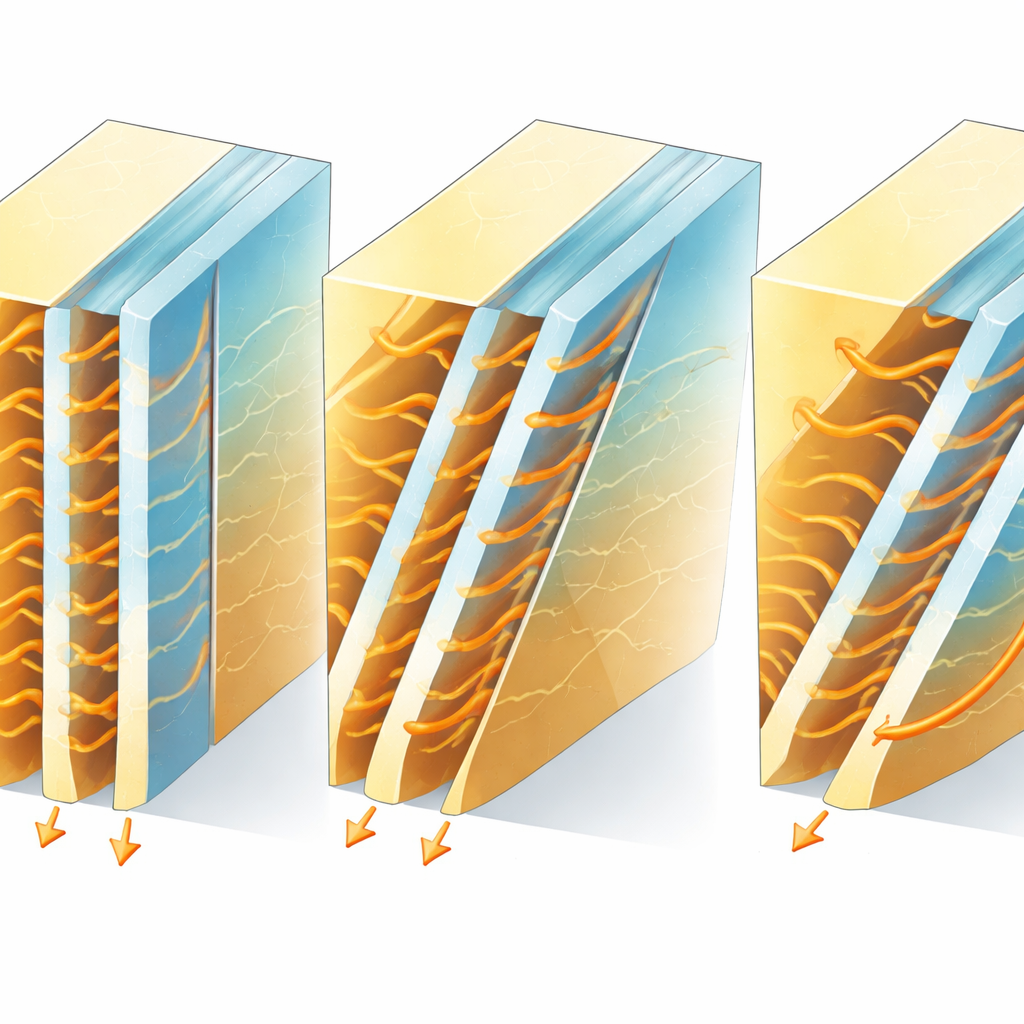
To explain this behavior, the team turned to how waves propagate inside hyperbolic materials. At the resonant colors, the allowed wave directions form a hyperboloid surface in wave space. Only those waves that both lie in the plane defined by the groove cross-section and meet a standing-wave condition can be excited by incoming light. When the grooves and the crystal’s axis are aligned, a broad set of wave directions satisfies this condition, producing strong confined modes that crisscross the grooves and dive into the bulk. Rotating the grooves effectively slices through the allowed wave surface at a different angle. To maintain the standing-wave pattern, the system must shift to a lower frequency where the allowed wave cone opens wider, leading to the observed redshift. Beyond a certain rotation, the necessary intersection vanishes, and the resonances switch off.
Steering Power Flow in the Plane
The study also shows that the orientation of the grooves controls not just the color of the resonances but the direction in which energy flows. In hyperbolic media, energy travels normal to the allowed-wave surface, and when the grooves are aligned with the special axis, power flows entirely within their cross-sectional plane. As the grooves rotate, the energy flow tilts, gaining a component that runs along the grooves and out of the original plane. Numerical simulations reveal that even a small twist—about ten degrees—can redirect most of the power away from the initial direction, providing a sensitive way to steer infrared energy at the nanoscale without changing the physical shape of the structures.
A Design Map for Future Infrared Devices
To turn these insights into a practical design tool, the authors derived a compact analytical formula that predicts how each resonance shifts with groove orientation using only the material’s optical constants and one reference measurement or simulation. This avoids heavy numerical modeling and makes it straightforward to design rotated resonators with target frequencies and energy-flow directions. Although the experiments focus on a narrow infrared band in calcite, the underlying mechanism depends only on having in-plane hyperbolic behavior, so it can be transferred to other materials and wavelength ranges. In simple terms, the work shows that by “twisting” nano-grooves relative to a crystal’s built-in directions, one can dial in both the color and the path of deeply confined infrared light—an appealing strategy for future miniature sensors, waveguides, and on-chip light sources.
Citation: Seabron, E., Jackson, E., Meeker, M. et al. Controlling spectral and power flow behavior in rotated hyperbolic resonators. Commun Mater 7, 81 (2026). https://doi.org/10.1038/s43246-026-01094-0
Keywords: hyperbolic materials, infrared photonics, calcite resonators, nanophotonics, light confinement