Clear Sky Science · en
Deep learning-based dual-reference triboelectric sensor for direct surface potential prediction
Why Rubbing Surfaces Matters
Every time you pull off a sweater and hear crackling, you’re seeing the triboelectric effect in action—the tendency of different materials to gain or lose electrons when they touch and separate. Engineers are trying to harness this everyday phenomenon to build self-powered sensors and energy harvesters for devices like wearables and soft robots. But one key ingredient has been hard to measure quickly: how strongly a given material prefers to hold or give up electrical charge, a property tied to its surface potential. This paper presents a new way to read that hidden property directly from a simple contact-and-release motion, using a smart sensor and deep learning.
A New Kind of Touch Sensor
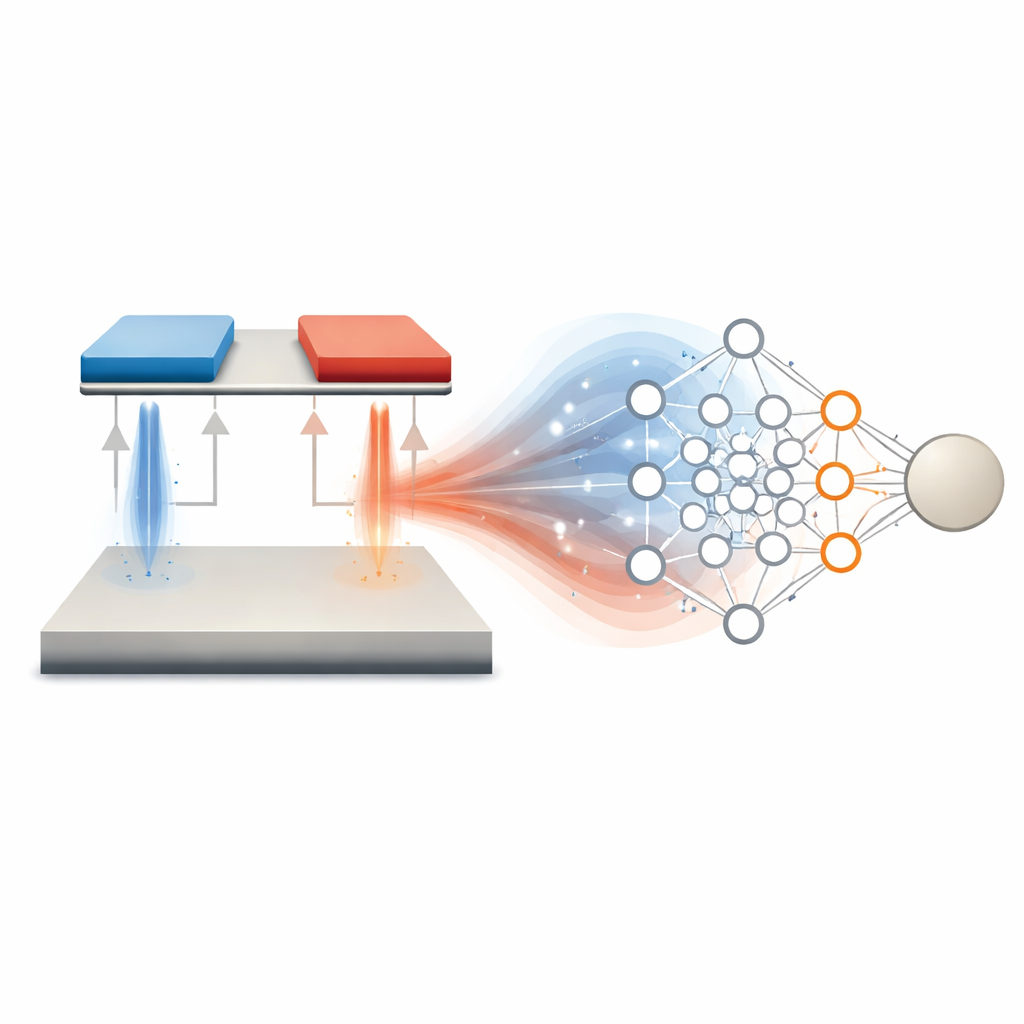
The researchers built a thin, flexible sensor that feels like a stack of rubbery films. At its heart are two nearly identical layers made of silicone rubber (PDMS), but their surfaces are chemically tuned to behave in opposite ways when rubbed: one tends to become more positive, the other more negative. When an unknown material is pressed against both layers and then pulled away, each layer produces an electrical signal. Because the two layers start from different charge preferences, the pair of signals together contains much richer information about the material than a single reading would. This dual setup also helps cancel out random disturbances from the environment, such as stray dust or small humidity shifts.
Turning Raw Signals into Hidden Properties
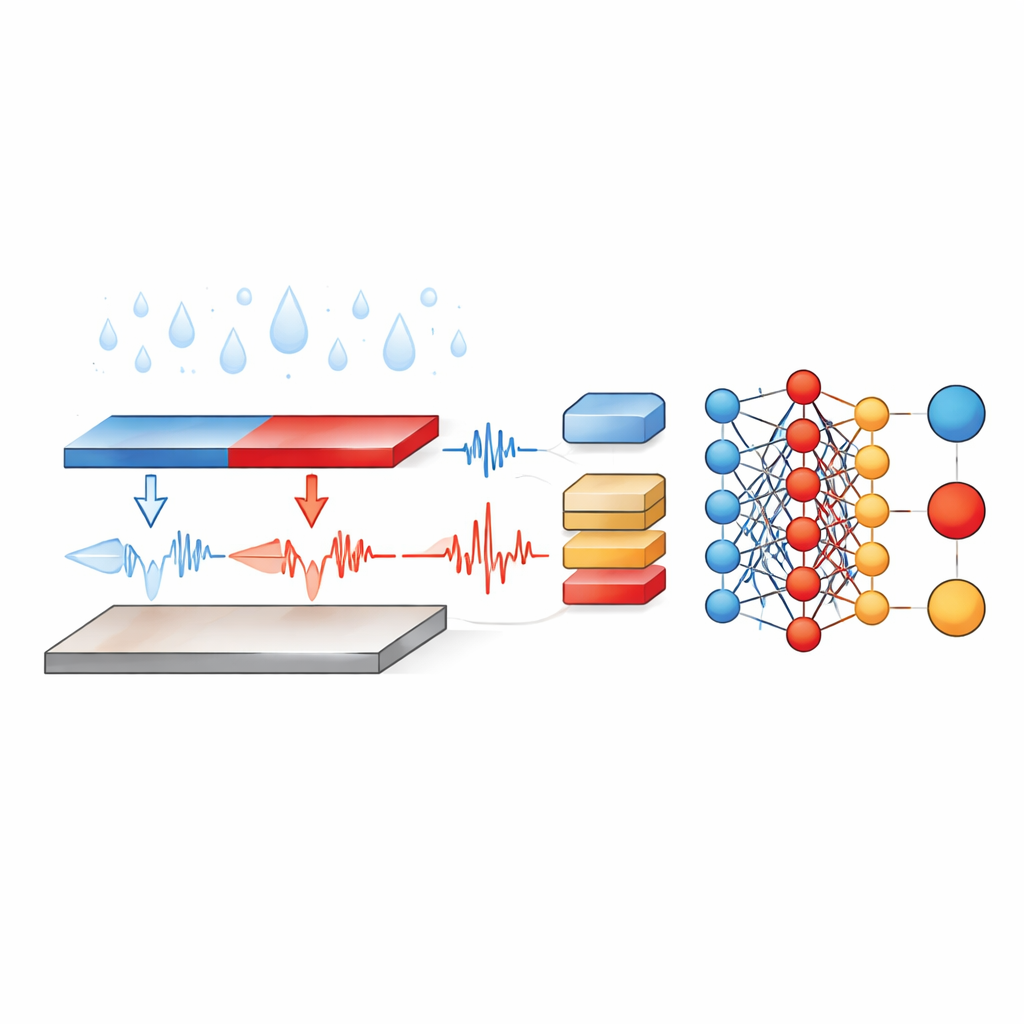
To convert those paired electrical pulses into a meaningful value for surface potential, the team leans on deep learning. They first measured the true surface potentials of ten common materials using a specialized microscope technique called Kelvin probe force microscopy under controlled dry conditions. Then they recorded thousands of voltage waveforms from their sensor as each material was repeatedly pressed and released at two humidity levels. Instead of trying to write an equation that links every influence—roughness, trapped charge, moisture—the researchers trained several neural network models to learn the relationship directly from data. Among the designs tested, a temporal convolutional network, which excels at recognizing patterns in time series, proved especially effective.
How Well It Works in Real Conditions
Once trained on seven of the materials, the models were challenged to predict the surface potential of three new ones the networks had never seen before, under a range of humidity levels. With both sensor layers used together, the best model consistently kept its prediction error below about eight percent compared with microscope measurements, and it clearly placed each material in the correct order along the triboelectric series—from strongly electron-gaining to strongly electron-giving. The dual-reference design boosted accuracy by roughly 85 percent over using a single layer alone, and the predictions remained reliable across moderate humidity changes. At very high humidity, where water films on surfaces strongly weaken charge buildup, all models struggled, but the dual-layer approach still got the sign of the surface potential right.
Robust Learning from Limited Data
The authors also probed how sensitive their approach is to practical constraints like how much data is available and how fast the sensor signals are sampled. As expected, more training examples improved performance up to a point, but beyond a moderate data size the gains became small, suggesting the method does not require enormous datasets. Similarly, raising the sampling rate helped only until the signals’ main features were captured; after that, model design and the use of dual signals mattered more than raw speed. Across these tests, the dual-reference setup consistently enabled the deep learning models to reduce prediction error, while simpler linear fitting methods failed to cope with the nonlinear, time-varying nature of the signals.
What This Means for Future Smart Surfaces
By combining a cleverly designed triboelectric sensor with modern deep learning, this work shows that the hidden charge preferences of everyday materials can be inferred from a straightforward pressing motion, without expensive or slow lab instruments. Instead of measuring delicate surfaces point by point, a device could tap or rub them once and estimate an effective surface potential that is stable enough to use as a reference, even when humidity shifts. Such a capability could help soft robots recognize what they are touching, allow wearable electronics to self-calibrate as their surfaces age, and support smarter, self-powered interfaces that monitor how their own charge states evolve over time.
Citation: Phan, V.Q., Cao, V.A., Kim, M. et al. Deep learning-based dual-reference triboelectric sensor for direct surface potential prediction. Commun Mater 7, 88 (2026). https://doi.org/10.1038/s43246-026-01090-4
Keywords: triboelectric sensors, surface potential, deep learning, self-powered electronics, material identification