Clear Sky Science · en
Threefold enhancement of ductility in dual-phase L1₂–B2 high-entropy alloys via interface-orientation-weakening-induced B2→BCT phase transformation
Making Tough Metals Less Brittle
Modern engines, turbines, and spacecraft all need metals that are both very strong and able to stretch without snapping. High-entropy alloys—complex mixes of several metals—are promising candidates, but they often trade ductility (how much they can stretch) for strength. This paper shows a clever way to triple the stretchability of one such alloy without changing its chemistry, simply by subtly rearranging how its internal building blocks line up with each other.
Two Interlocking Building Blocks
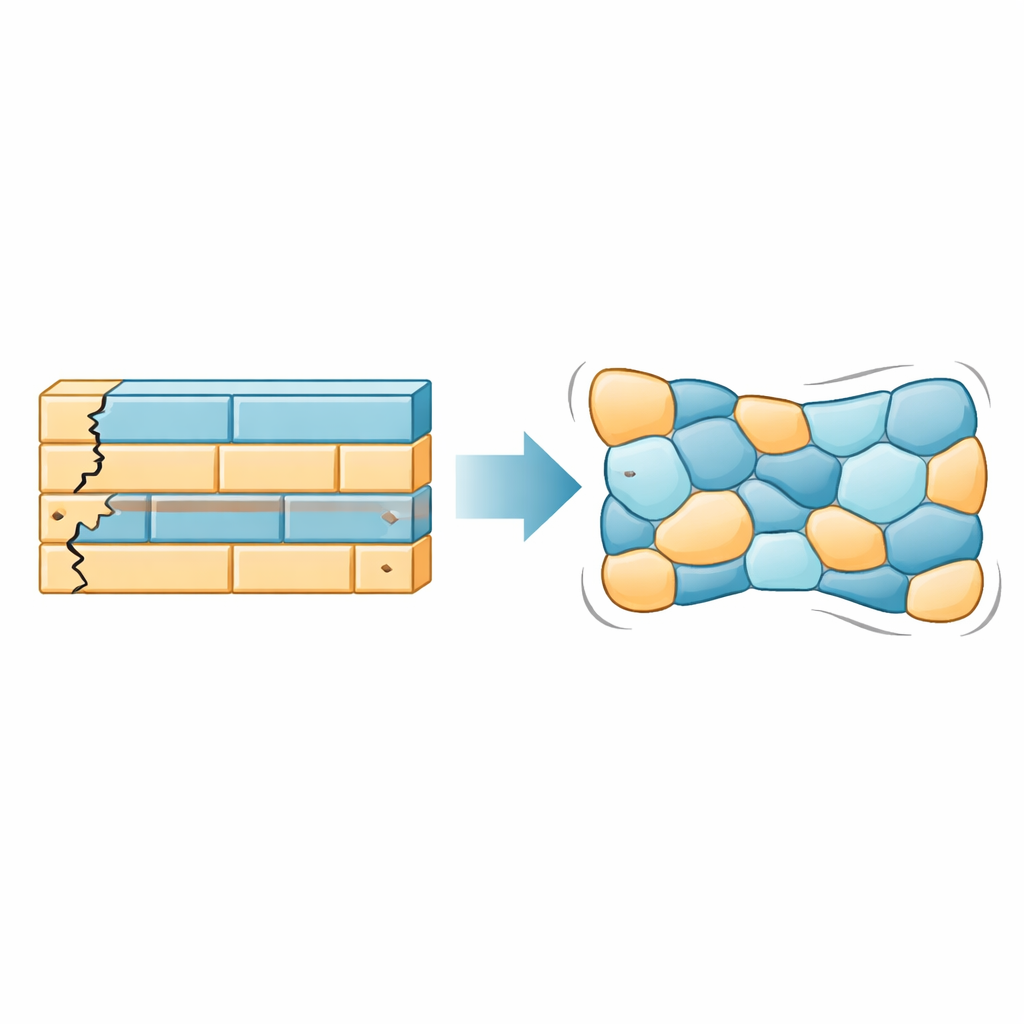
The alloy studied here contains aluminum, iron, cobalt, and nickel mixed so that two different types of ordered atomic structures form side by side. One, called L1₂, behaves as the softer, more easily deformable phase; the other, called B2, is harder and stronger. In the as-cast state, these two phases appear in long, parallel layers, a bit like alternating stripes of different woods glued together. Crucially, their atomic lattices are lined up in a very specific way, an orientation relationship that makes the interface between them extremely orderly and rigid. That strong alignment boosts strength but also pins down how atoms and defects can move when the alloy is pulled, leaving the hard phase prone to cracking.
Loosening the Internal Alignment
Instead of redesigning the alloy’s composition, the researchers altered its internal geometry using a thermo-mechanical treatment: cold rolling followed by high-temperature annealing, repeated twice. This process deforms the original lamellar structure and then allows it to recrystallize into a new arrangement. The resulting microstructure still has roughly half soft L1₂ and half hard B2, but the layers are thicker and the grains of each phase become more equiaxed, with a much more random mix of orientations. Measurements of grain orientation show that most of the formerly strict alignment at the phase boundaries is lost, meaning the interface orientation has been deliberately “weakened.”
Unlocking a Hidden Shape-Shift
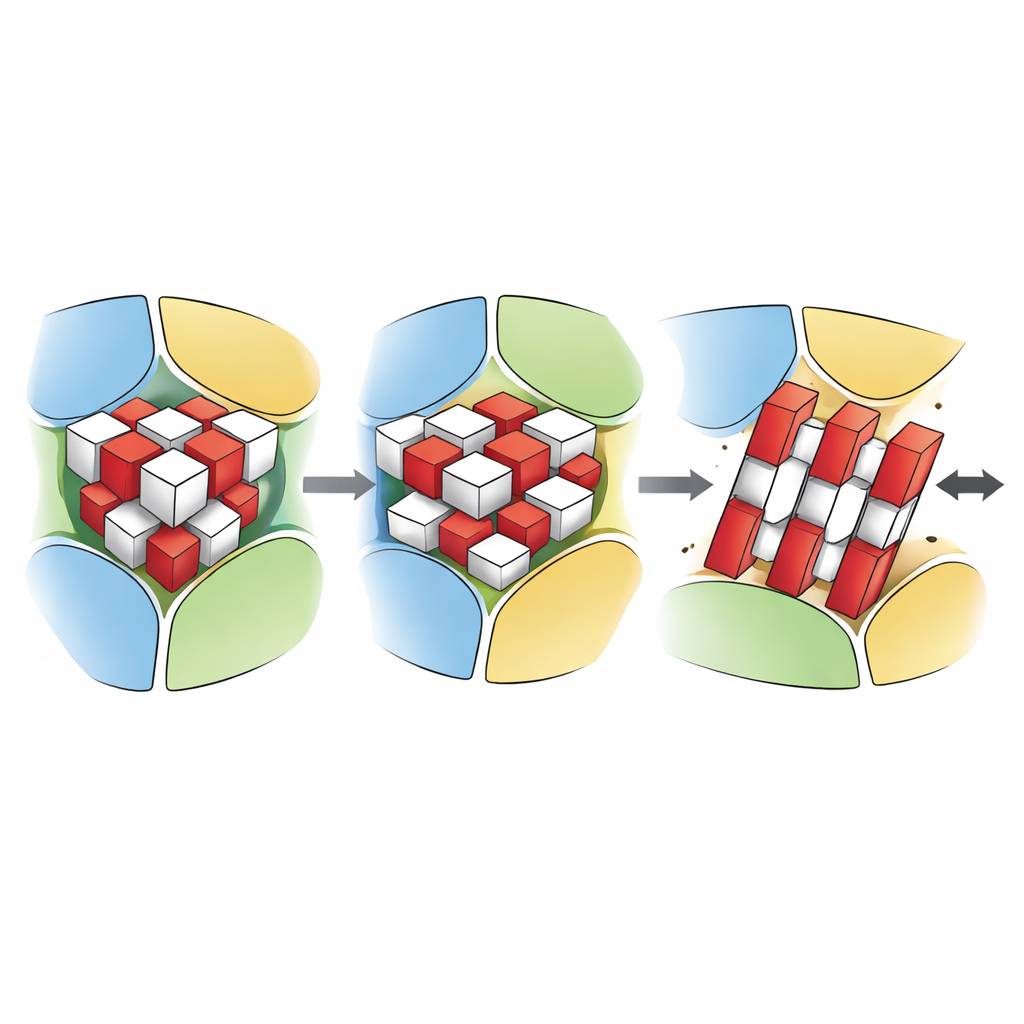
When these treated samples are pulled in tension, they behave strikingly differently from the as-cast ones. The original material fractures after less than 5% strain, with cracks running through large B2 regions. The processed alloy, by contrast, reaches about 18% strain—more than three times the ductility—yet maintains similar yield and ultimate strengths. Detailed X-ray and electron diffraction studies reveal why: as the alloy is stretched, much of the B2 phase gradually transforms into a closely related but elongated structure called body-centered tetragonal (BCT). This shape-change involves the crystal stretching along one direction and shrinking slightly along the others, but with almost no change in volume. Because the surrounding L1₂ grains can now slip and deform more freely along compatible directions, they help accommodate this elongation, turning what would have been damaging local stress into useful, energy-absorbing deformation.
Following the Transformation in Real Time
To watch this process as it happens, the team used synchrotron X-ray diffraction during tensile tests. As strain increased, diffraction rings from the B2 phase distorted and then split, signaling the emergence of the BCT lattice. By tracking how lattice spacings changed with strain and during loading–unloading cycles, they showed that the transformation is progressive and partially reversible at intermediate loads. Statistical analysis of many grains indicated that B2 regions surrounded by L1₂ neighbors that can best supply strain in the right direction are the ones most likely to transform. By weakening the original strict alignment at the interfaces, the treatment increases the number of such favorable neighbors, thereby lowering the barrier for the phase change and spreading deformation more evenly through the material.
Designing Friendlier Phase Boundaries
In everyday terms, the study demonstrates that how the different “tiles” inside a metal are oriented relative to each other can be just as important as which elements they are made of. Here, relaxing the precise fit at the boundaries between hard and soft phases enables a beneficial, stress-driven shape-shift in the hard phase that dramatically improves ductility while preserving strength. This suggests a new design rule for advanced structural alloys: instead of only tuning composition or applying extreme pressures, engineers can deliberately adjust interface orientations—through rolling, annealing, or even ultrasonic treatment—so that neighboring phases help each other deform rather than compete, leading to tougher, more damage-resistant materials.
Citation: Shu, Q., Ding, X., Lu, Y. et al. Threefold enhancement of ductility in dual-phase L1₂–B2 high-entropy alloys via interface-orientation-weakening-induced B2→BCT phase transformation. Commun Mater 7, 75 (2026). https://doi.org/10.1038/s43246-026-01088-y
Keywords: high-entropy alloys, ductility, phase transformation, microstructure, interface engineering