Clear Sky Science · en
Scalable Sondheimer oscillations driven by commensurability between two quantizations
Why tiny metal slabs act in surprising ways
When metals are carved down to hair‑thin slabs and placed in strong magnetic fields, their electrons no longer flow smoothly. Instead, the electrical resistance of the metal starts to wiggle up and down in a regular pattern. This paper revisits a long‑known version of that effect, called Sondheimer oscillations, and shows that in ultra‑clean cadmium crystals those wiggles are governed not just by classical motion of electrons, but by quantum rules usually seen in more exotic systems. 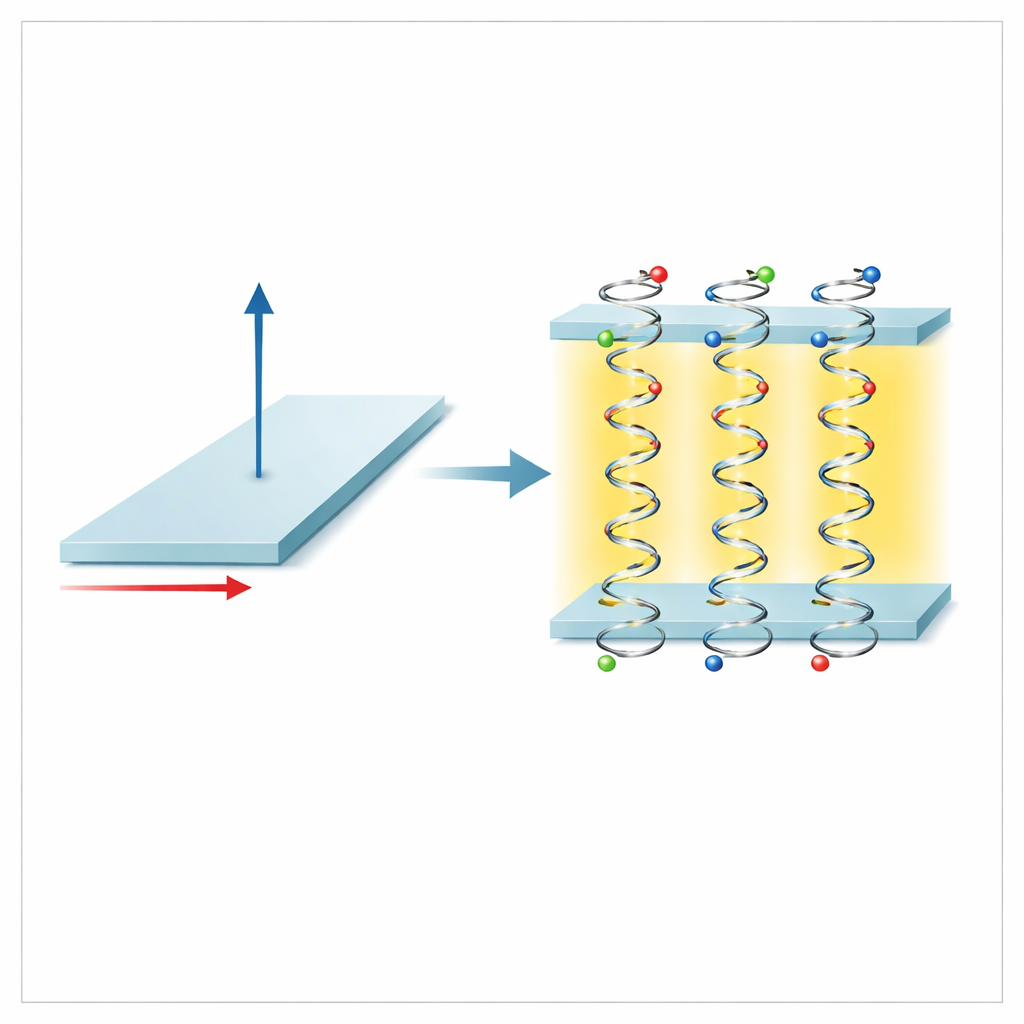
Electrons, spirals, and the thickness of a slab
In a metal, electrons carry current much like cars moving along many lanes of a highway. When a magnetic field is applied sideways to that flow, the electrons curve into spiral paths as they move through the material. In a thick block this mostly changes the overall resistance. In a very thin slab, however, the distance between the top and bottom surfaces becomes comparable to the spiral “pitch” of the electrons. Whenever the slab thickness fits an exact whole number of spiral turns, the current responds strongly, producing Sondheimer oscillations—repeated rises and dips in conductivity as the field is increased.
Making and measuring ultra‑clean cadmium
The authors grew exceptionally pure single crystals of cadmium and then used a focused ion beam, a kind of nanometer‑precision sculpting tool, to cut them into slabs between about 13 and 475 micrometers thick. They measured how easily current flowed along the slabs while sweeping a magnetic field perpendicular to the current, and monitored both the direct resistance and the Hall response, which is sensitive to how electrons and holes bend sideways in the field. After carefully subtracting the large, smooth background signal from cadmium’s strong magnetoresistance, they isolated the oscillatory part and tracked how its period and strength changed with thickness.
A magnetic rhythm set by crystal geometry
The spacing in magnetic field between oscillation peaks turned out to be extremely simple: the product of oscillation period and sample thickness is constant over more than a forty‑fold range in thickness. That means thinner samples show more closely spaced oscillations, but all are controlled by the same underlying geometric property of cadmium’s Fermi surface—the “surface” in momentum space separating occupied from empty electron states. Theory predicts that this property should match the way the available electron orbits slice through the crystal in a magnetic field, and the measured value agrees almost perfectly with detailed calculations. Unusually, a large patch of cadmium’s Fermi surface shares the same geometric parameter, making its electrons particularly sensitive to thickness.
Quantum fingerprints in a supposedly classical effect
Classical explanations of Sondheimer oscillations treat electrons as particles following smooth orbits, without invoking discrete quantum energy levels. By contrast, the cadmium data show an amplitude that falls with field in a way that cannot be explained by those models. For the first ten or so oscillations, the amplitude scales with magnetic field and thickness according to a simple rule that includes an exponential factor—just what one expects from quantum tunneling. The authors argue that two separate quantizations are at work: Landau levels created by the magnetic field, which slice the Fermi surface into stacked “tubes,” and discrete steps in allowed motion along the thickness direction, enforced by the finite size of the slab. As the field is swept, these two quantized ladders periodically line up, and their commensurability controls the oscillations’ strength. 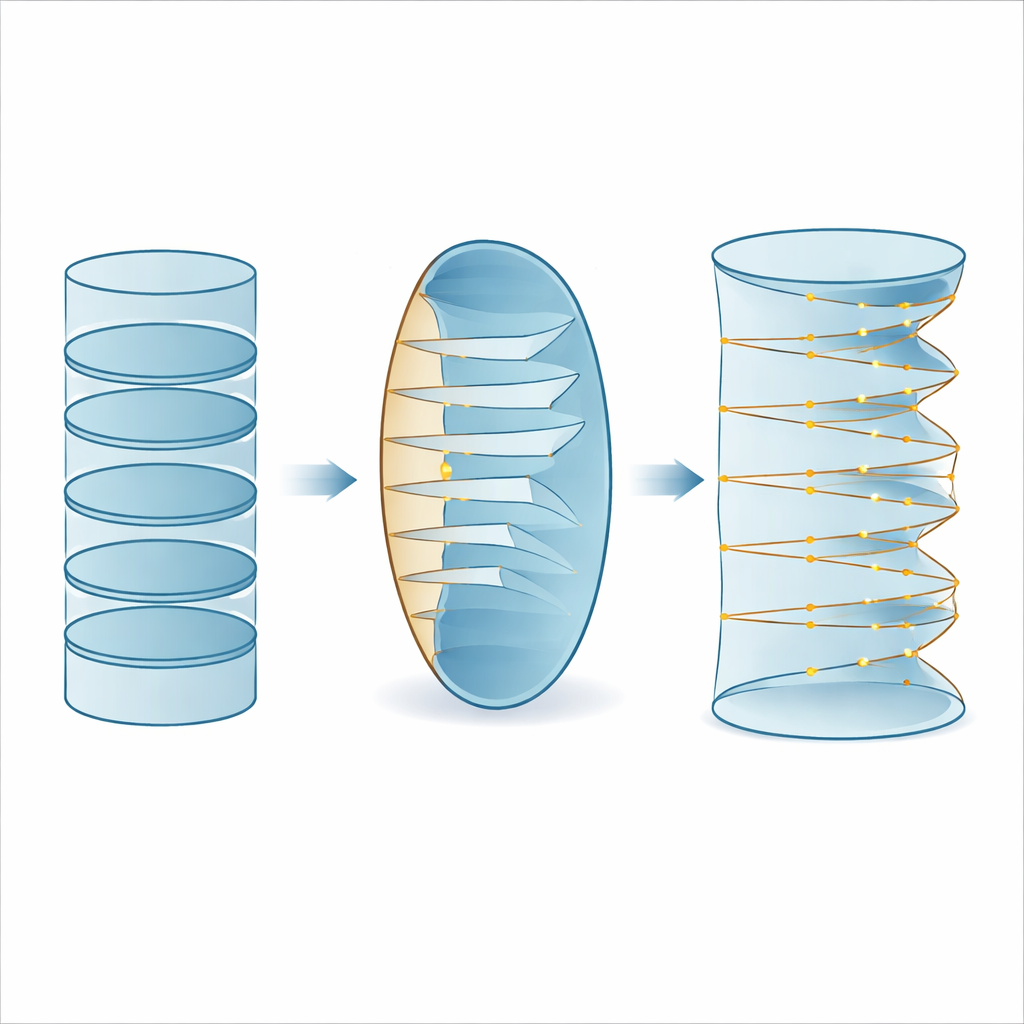
Why cadmium is special and what it teaches us
To test whether this behavior is universal, the team repeated similar experiments on copper, a more ordinary metal with a well‑known electronic structure. In copper they saw Sondheimer oscillations that follow the classical expectations and lack the exponential quantum signature found in cadmium. The difference traces back to cadmium’s unusual band structure and its nearly perfectly compensated mixture of electrons and holes. Put simply, cadmium provides just the right electronic landscape for the magnetic quantization and thickness‑induced quantization to talk to each other. The work shows that even in relatively simple metals, size effects in transport can be governed by subtle quantum rules, turning thin metallic slabs into model systems for exploring how different types of quantization combine to shape electrical behavior.
Citation: Guo, X., Li, X., Zhao, L. et al. Scalable Sondheimer oscillations driven by commensurability between two quantizations. Commun Mater 7, 76 (2026). https://doi.org/10.1038/s43246-026-01087-z
Keywords: Sondheimer oscillations, quantum transport, cadmium crystals, size effects in metals, Landau quantization