Clear Sky Science · en
Quantum correlation of channel-confined ions in graphene-based transistors for energy-efficient neuromorphic chips
Why Tiny Ions Could Power Future AI Chips
Today’s artificial-intelligence hardware burns enormous amounts of energy because it relies on streams of electrons moving through conventional silicon chips. Our brains, by contrast, send signals using ions—charged atoms—slipping through narrow biological channels with astonishing efficiency. This paper explores a new kind of transistor made from graphene, a one-atom-thick form of carbon, where potassium ions replace electrons as the information carriers. By uncovering how these ions move and interact at the atomic scale, the work points toward neuromorphic chips—hardware that works more like the brain—that could dramatically cut the energy cost of AI.
Building a Brain-Inspired Switch
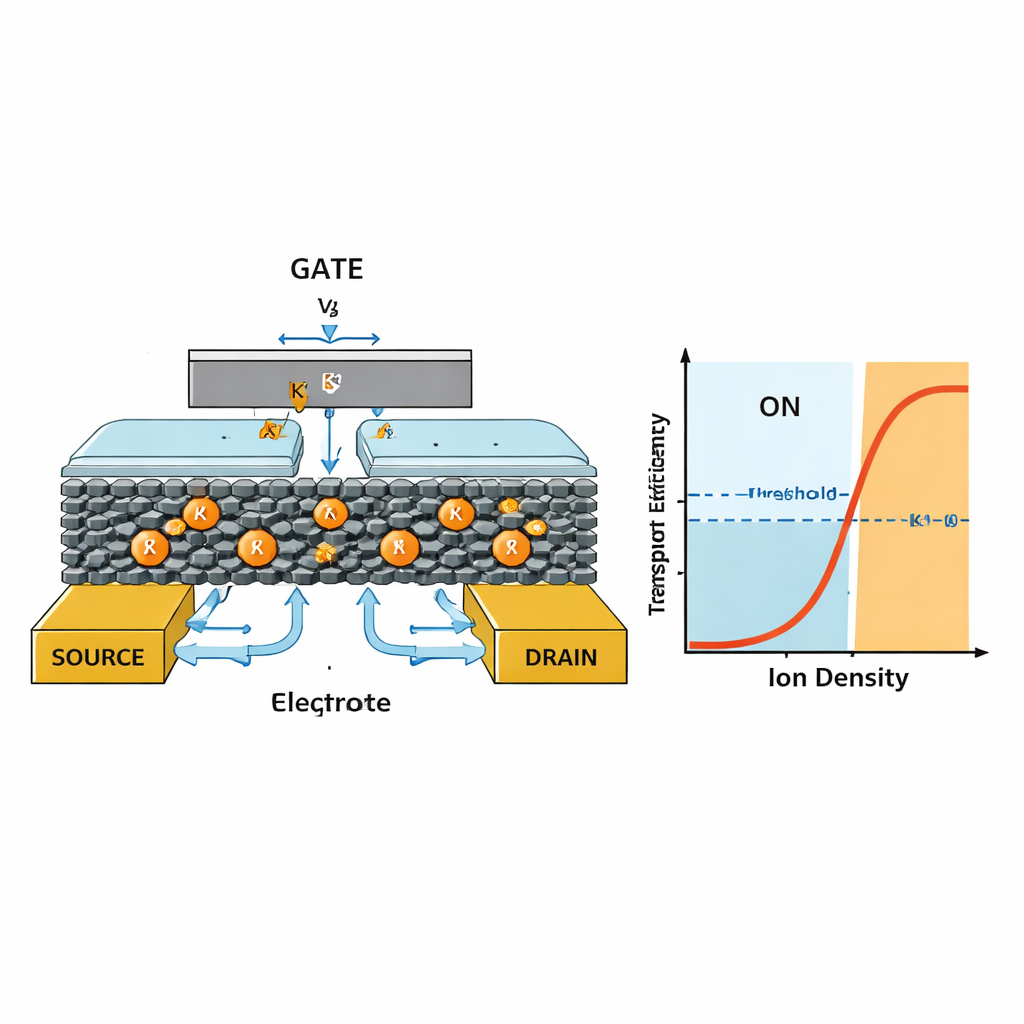
The researchers focus on a graphene-based ion transistor: a device in which potassium ions (K⁺) travel inside ultra-thin channels formed by stacked graphene sheets. Just as in an electronic transistor, there are source and drain electrodes where current flows, and a gate electrode that controls the device. But here the gate changes how many ions sit inside the graphene channel, rather than how many electrons flow in a semiconductor. Experiments had already shown that above a certain critical ion density, the device suddenly switches from “OFF” (ions blocked) to “ON” (ions pass) and even amplifies signals. What was missing was a clear, atom-level explanation of why this happens. To answer that, the authors used ab initio molecular dynamics—quantum-aware computer simulations that track both atoms and electrons—to watch ions move through the channel in slow motion.
When Quantum Effects Make Ions Cooperate
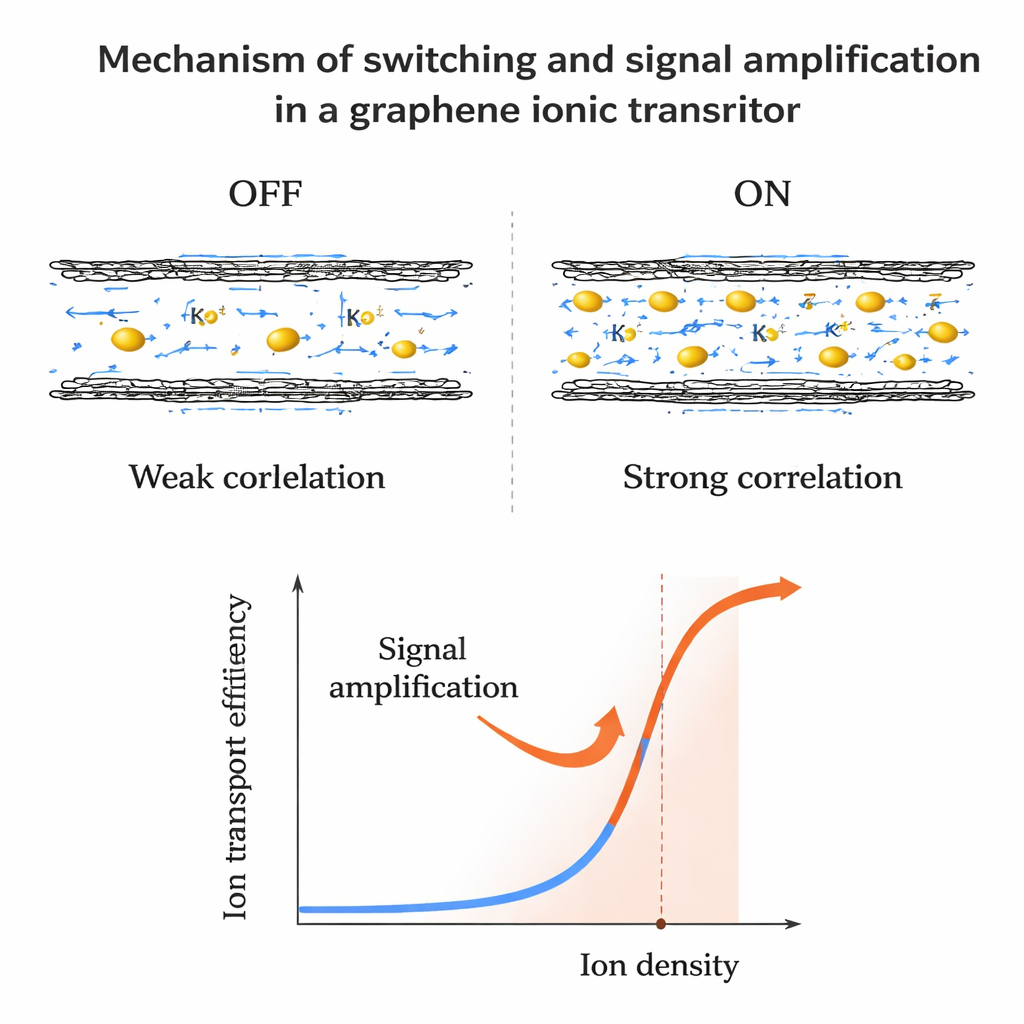
The simulations reveal that as more potassium ions fill the graphene channel, the behavior of the ions changes from isolated jiggling to coordinated motion. Although ions are relatively heavy and slow, the electrons in graphene respond almost instantly to any ion’s movement. These fast-moving electrons create a kind of glue that links distant ions together, so that one ion entering the channel can nudge another ion out at the far end. This long-range “quantum correlation” grows stronger once the ion density crosses the critical threshold. Below that point, an incoming ion only disturbs its neighbors but cannot push a chain of ions through the channel, so the device remains OFF. Above it, the collective response allows ions to move in a coordinated way and the transistor turns ON.
Competing Forces Turn the Switch
At the heart of the ON–OFF behavior is a competition between two ways graphene layers can interact. With few ions present, neighboring graphene sheets sit close together, held by a stacking interaction between their carbon rings. This tight spacing makes it difficult for ions to move, keeping the device OFF. As the ion density increases, positively charged potassium ions slip between the sheets and strongly attract the clouds of electrons in the carbon rings—a so‑called cation–π interaction. This pulls the layers farther apart and rearranges the structure. The simulations show that once ion density passes a narrow range around the experimentally observed threshold, the system abruptly shifts from stacking-dominated to ion-dominated. In this new arrangement, ion–graphene attraction wins, the channel opens, and ions can pass freely, locking the transistor into its ON state.
How Ions Amplify Signals and Move So Fast
Turning the device ON is only part of the story. The authors also find that ions inside the channel vibrate collectively at specific frequencies, much like a tiny orchestra. There are low-frequency and high-frequency modes of motion, and as more ions are packed into the channel, the high-frequency mode grows stronger while the low-frequency one weakens. The simulations show that ion transport efficiency rises as the high-frequency mode intensifies, explaining the transistor’s ability to amplify small changes in input into much larger output signals. A second key effect appears when a hydrated ion—a potassium ion surrounded by water molecules—approaches the channel. At first, it sheds water slowly. But once its vibration frequency locks into resonance with the ions already inside the channel, it loses the remaining water molecules in a rapid burst. This ultrafast “dehydration” slashes the friction that normally slows ions in liquid, leading to ion diffusion rates many millions of times faster than in bulk electrolytes.
What This Means for Future AI Hardware
By tying together quantum-level interactions, collective vibrations, and fast dehydration, the study explains how graphene-based ion transistors can act as ultra-efficient, brain-like switches. The device turns ON when ions reshape the channel from tightly stacked graphene layers to a more open, ion-stabilized structure; it amplifies signals through high-frequency collective ion motion; and it achieves extreme speed because incoming ions resonate with those already confined, allowing them to shed water and zip through. These insights give engineers concrete design targets—such as the critical ion density, preferred edge chemistry, and optimal ion species—for building neuromorphic chips where information flows on ions instead of electrons. Such hardware could deliver AI systems that are not only powerful, but also far more energy-efficient, narrowing the gap between synthetic and biological intelligence.
Citation: Zhao, J., Song, B. & Jiang, L. Quantum correlation of channel-confined ions in graphene-based transistors for energy-efficient neuromorphic chips. Commun Mater 7, 71 (2026). https://doi.org/10.1038/s43246-026-01082-4
Keywords: graphene ionic transistor, neuromorphic computing, ion transport, quantum correlation, energy-efficient AI hardware