Clear Sky Science · en
Discovery of magnetic-field-tunable density modulations and spin tilting in a layered altermagnet
Why this strange magnet matters
Magnets usually fall into two simple camps in school textbooks: they either line up so their tiny internal compass needles add together, or they alternate so perfectly that the overall pull cancels out. In this work, researchers zoom in on a more elusive kind of magnetism, where the tiniest building blocks behave like a magnet for moving electrons while the material as a whole shows almost no magnet at all. Understanding and controlling this unusual state could open paths to faster, more efficient electronics that use electron spins instead of electric charge.
A new kind of hidden magnetism
The material at the center of this study is a layered crystal made of niobium and selenium, with cobalt atoms tucked between the layers. The parent compound, without cobalt, is famous for two collective electronic behaviors: it becomes a superconductor at low temperatures and it develops a regular pattern in its electron density, known as a charge density wave. Adding cobalt at a specific concentration was recently predicted and shown to turn the system into an “altermagnet,” a phase that sits between familiar ferromagnets and antiferromagnets. In such a phase, up- and down-spins are arranged so that the net magnetization cancels, yet the paths that electrons can take through the crystal remain spin-selective.
Seeing buried patterns through the top layer
To probe this hidden order, the team used scanning tunneling microscopy and spectroscopy, tools that measure how electrons tunnel between a sharp metallic tip and the sample at atomic resolution. When they imaged the top selenium layer, they found an unexpected checkerboard-like modulation: every other selenium atom appeared slightly brighter in all directions, forming a pattern that repeats every two lattice spacings. Detailed comparisons with computer simulations based on density functional theory showed that this surface pattern is actually a projection of how the cobalt atoms are arranged just below. In other words, the visible bright–dim spots on the top layer act as a window onto a buried cobalt superstructure that organizes both charge and spin.
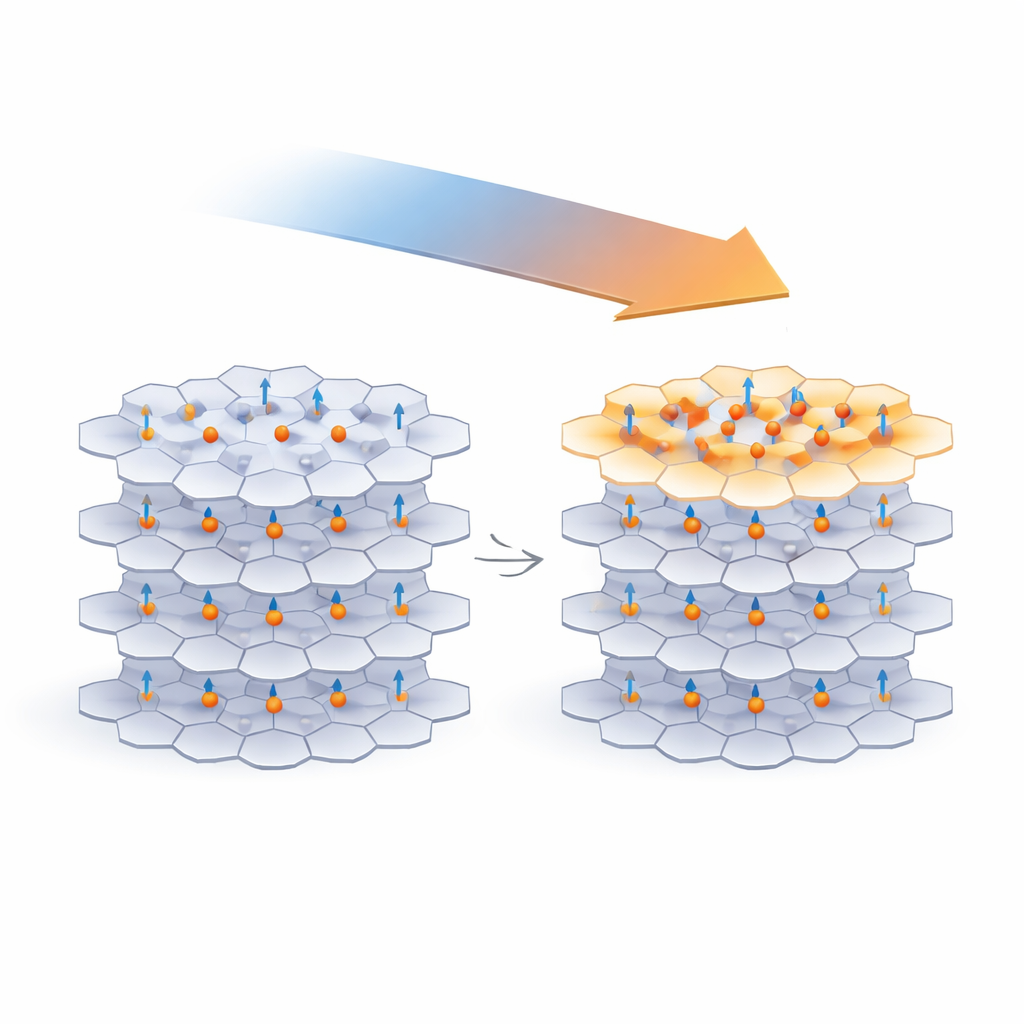
Spin tilting and tunable ripples
Looking not just at height images but also at how easily electrons tunnel at different energies, the researchers discovered a partial gap in the electronic states right around the Fermi level, where the most active electrons live. This V-shaped dip in the density of available states is not reproduced in their simulations of a perfectly ordered altermagnetic state, hinting that an additional, more subtle ordering—perhaps involving charge, spin, or orbital patterns—may be present. Crucially, when they used a tip whose own spins were polarized, they saw that the intensity of the two-by-two modulation depended sensitively on the relative spin direction of the tip and the sample, revealing that the pattern carries a genuine spin component, not just charge variations.
Magnetic field as a fine-tuning knob
Next, the team applied magnetic fields pointing out of the crystal plane, both parallel and antiparallel to the original spin direction. They found that changing the strength and direction of the field gradually reshaped the electronic landscape: the tunneling spectra shifted, and the amplitude of the two-by-two ripples increased or decreased in a smooth, reversible way. With a spin-sensitive tip, these changes were pronounced; even with a normal tip, smaller but clear modifications remained. The most natural explanation is that the cobalt spins are not rigidly fixed upright—they “cant,” or tilt, away from the crystal axis under the applied field. This tilt alters how up- and down-spin electrons experience the crystal, modifying the effective band structure that underpins altermagnetism.
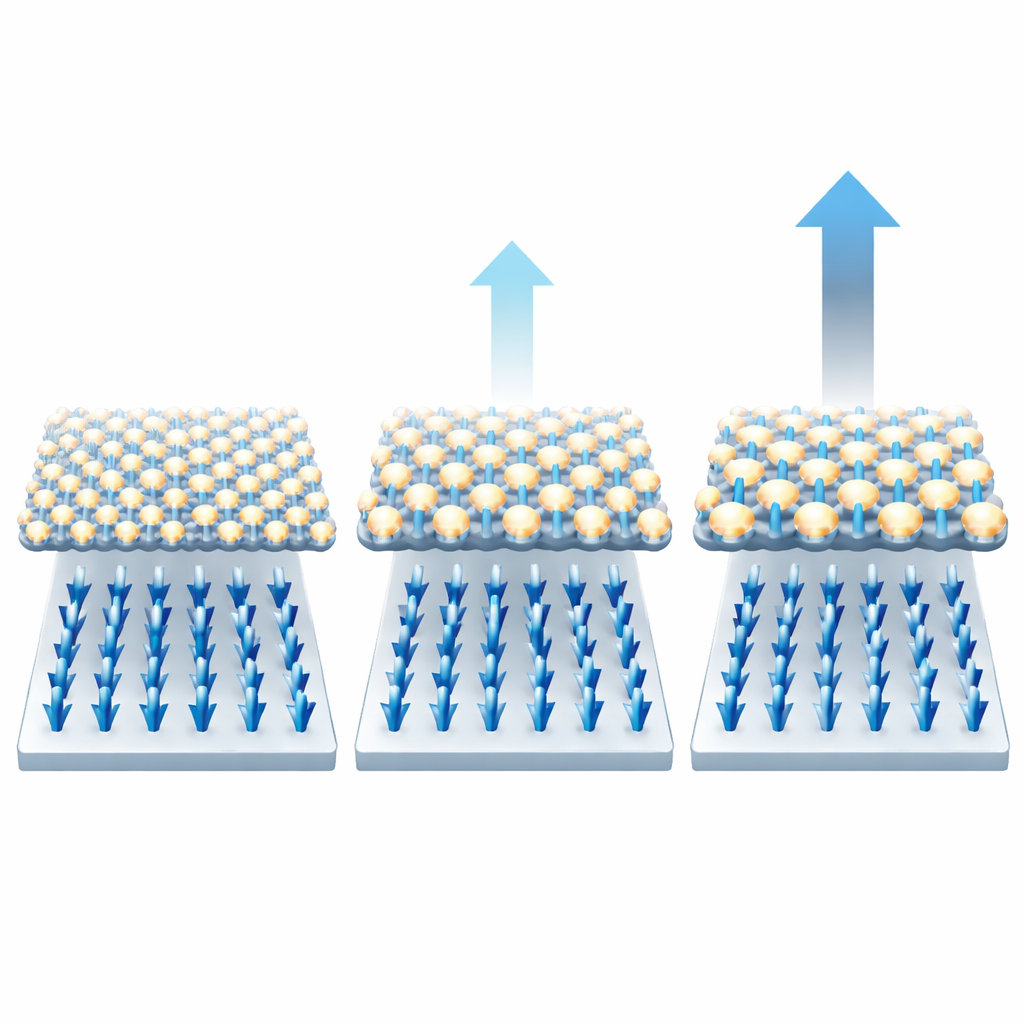
Looking ahead to designer quantum states
By directly imaging both charge and spin modulations at the atomic scale, this work shows that the exotic altermagnetic state in cobalt-intercalated niobium diselenide is remarkably tunable by an external magnetic field. The discovery that cobalt spins can tilt and reshape the electronic patterns suggests a natural link to a mysterious phase transition seen around 50 kelvin in earlier measurements, and raises the possibility that additional “hidden” orders may be intertwined with altermagnetism. More broadly, the study points toward a strategy for engineering layered materials where superconductivity, unusual spin textures, and field-tunable electronic patterns can be combined, potentially enabling new ways to store and process information using the quantum nature of electrons.
Citation: Candelora, C., Xu, M., Cheng, S. et al. Discovery of magnetic-field-tunable density modulations and spin tilting in a layered altermagnet. Commun Mater 7, 74 (2026). https://doi.org/10.1038/s43246-026-01081-5
Keywords: altermagnetism, spin textures, scanning tunneling microscopy, layered quantum materials, magnetic field control