Clear Sky Science · en
Higher-order Hall response arises from octupole order and scalar spin chirality in a noncollinear antiferromagnet
Spins That Act Like Hidden Magnets
Modern electronics mostly relies on materials whose magnetism is simple: tiny bar-magnet–like moments either line up or oppose each other. This study explores a very different kind of magnet, where atoms’ spins point in a swirling pattern rather than straight up or down. The authors show that such a "noncollinear" antiferromagnet can generate an unusual sideways electrical signal, even though it barely behaves like a magnet in the usual sense. Understanding and controlling this hidden order could open paths to faster, more efficient spin-based electronics.
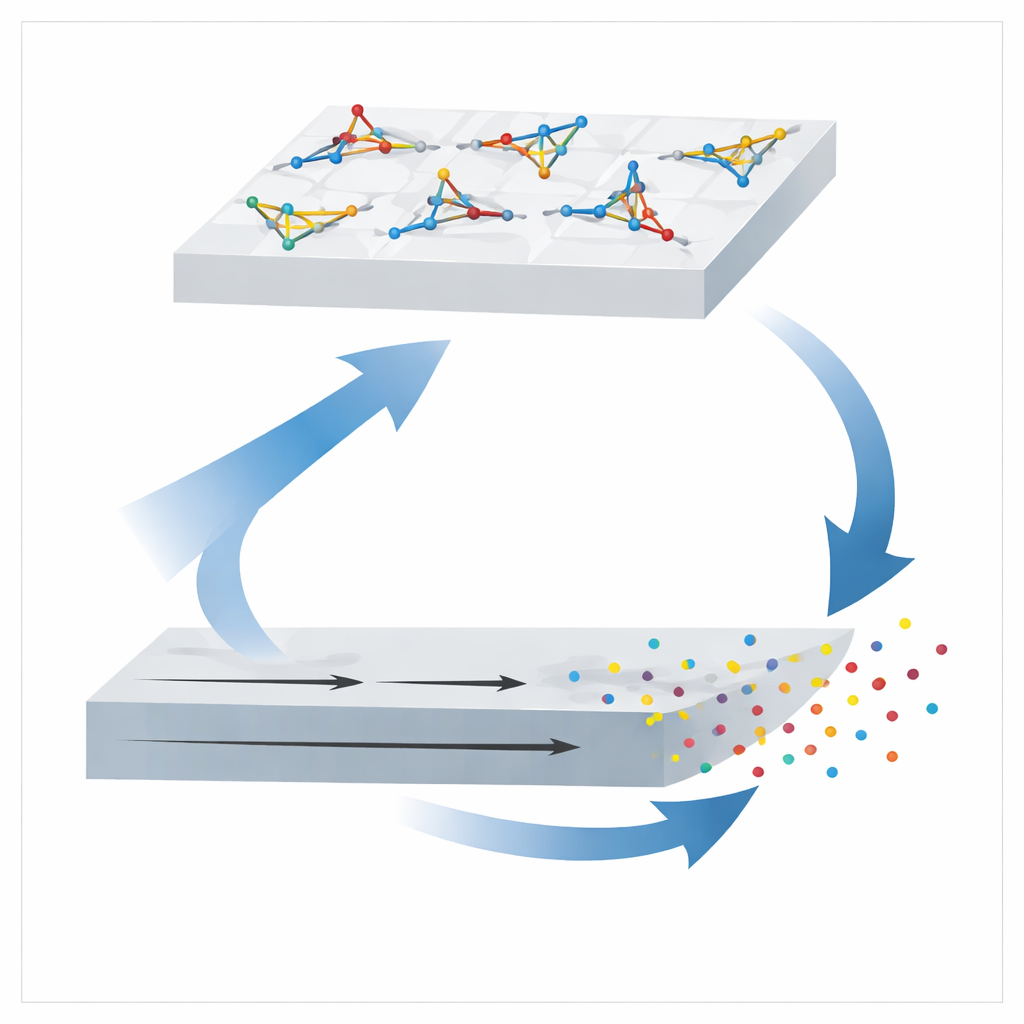
A Sideways Push on Moving Electrons
When an electric current passes through a magnetic material in a magnetic field, the flowing electrons can be nudged sideways, creating a voltage across the sample. This phenomenon, called the Hall effect, is well known in ordinary ferromagnets, where it is tied to the net magnetization—the overall alignment of spins. In conventional antiferromagnets, spins cancel in opposite directions, so this sideways voltage is expected to vanish. Yet in certain crystals where spins form 120-degree patterns on triangular networks, experiments have revealed a strong Hall signal even when the net magnetization is nearly zero. The puzzle is what microscopic magnetic pattern actually drives this effect.
Hidden Patterns Beyond Simple Magnetization
The material studied here, Mn3Ni0.35Cu0.65N, has manganese atoms arranged in a kagome-like pattern within specific crystal planes. In these planes, neighboring spins point 120 degrees apart, forming a frustrated configuration that cannot be satisfied by simple up–down ordering. Instead of behaving as a simple dipole, this spin pattern can be described by a more complex "octupole" order—a collective arrangement that acts like a higher-order magnetic object. The researchers use symmetry analysis and advanced electronic-structure calculations to show that this octupole order can mimic the role of a magnetization and generate a Hall response, even when the ordinary magnetic moment is almost absent.
Probing the Invisible Order with Rotating Fields
To disentangle the different contributions to the Hall effect, the team fabricated thin films of Mn3Ni0.35Cu0.65N and patterned them into Hall bar devices. They then applied magnetic fields not only perpendicular to the film, but also within the plane, precisely aligned along chosen crystal directions. When the field is applied out of the plane, both the tiny net magnetization and the octupole order can contribute to the Hall signal, making it hard to separate them. However, when the field is applied purely in the plane, the geometry suppresses any conventional dipole-driven Hall response. Under these conditions, the researchers still observe a clear, step-like Hall signal whose strength varies with field angle and repeats every 120 degrees—exactly the rotational symmetry expected from the underlying octupole pattern.
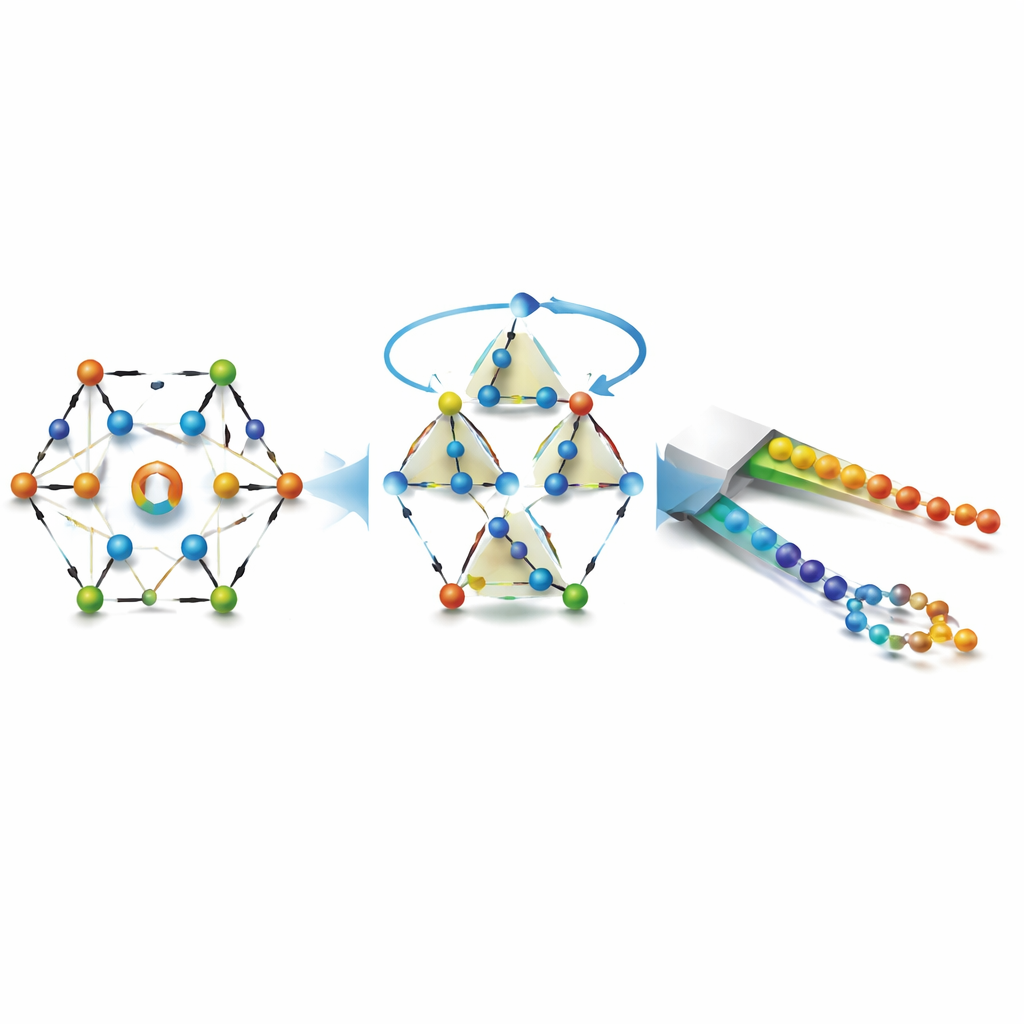
Twisted Spins and an Extra Hall Signal
At low magnetic fields, the data show an additional, more subtle Hall-like feature that appears only near zero field and changes sign with the direction of the field sweep. This behavior is reminiscent of the so-called topological Hall effect, often associated with whirling spin textures such as skyrmions. In Mn3Ni0.35Cu0.65N, the spins do not form such topological objects, but simulations indicate that the field can gently tilt the spins out of their flat, coplanar arrangement, creating noncoplanar triangles with finite "scalar spin chirality"—a measure of how three spins twist out of a common plane. This twisted arrangement acts as an emergent magnetic field for the electrons, adding a distinct low-field Hall contribution that shares the same 120-degree angular rhythm as the octupole response, but with opposite sign.
New Knobs for Future Spin-Based Devices
By combining careful measurements, symmetry arguments, and first-principles calculations, the authors show that three different magnetic ingredients coexist in this noncollinear antiferromagnet: a small conventional magnetization, a dominant octupole order, and a chirality-driven contribution that appears when spins tilt out of plane. Each term becomes important in a different range of magnetic field and orientation, giving a richer and more tunable Hall response than in ordinary magnetic materials. For a general reader, the key message is that magnetism in solids can be far more intricate than a collection of tiny bar magnets, and that these hidden orders can be harnessed to steer electrical currents in new ways—an enticing prospect for future low-power, high-speed spintronic technologies.
Citation: Rajan, A., Saunderson, T.G., Lux, F.R. et al. Higher-order Hall response arises from octupole order and scalar spin chirality in a noncollinear antiferromagnet. Commun Mater 7, 73 (2026). https://doi.org/10.1038/s43246-026-01080-6
Keywords: noncollinear antiferromagnet, anomalous Hall effect, spin chirality, octupole order, spintronics