Clear Sky Science · en
Intrinsically colored artificial silk fibers made from mini-spidroin fusion proteins
Silk That Glows Without Harmful Dyes
Colorful clothing usually comes with a hidden cost: most textile dyes are made from fossil fuels, consume huge amounts of water, and can pollute rivers and harm health. This study explores a radically different idea—building color directly into the fiber itself, using engineered spider silk proteins that naturally glow bright red. The work shows how scientists can make strong, flexible, intrinsically colored fibers in water-based processes, pointing toward textiles that are both high-performance and more environmentally friendly.
Why Spider Silk Inspires New Materials
Spider silk has long fascinated researchers because it is both tough and stretchy, yet light and biodegradable. In recent years, scientists have learned to make simplified versions of spider silk proteins, called mini-spidroins, using bacteria in large tanks. These artificial silks can be spun into fibers that mimic some of the remarkable properties of real spider silk. However, most efforts so far have focused only on copying strength and toughness, not on adding extra useful features such as built-in color or biological activity. At the same time, traditional dyeing methods for textiles still rely on harsh chemicals, large water inputs, and fossil-based dyes, creating a strong motivation to find cleaner alternatives.
Building Color Into the Fiber Itself
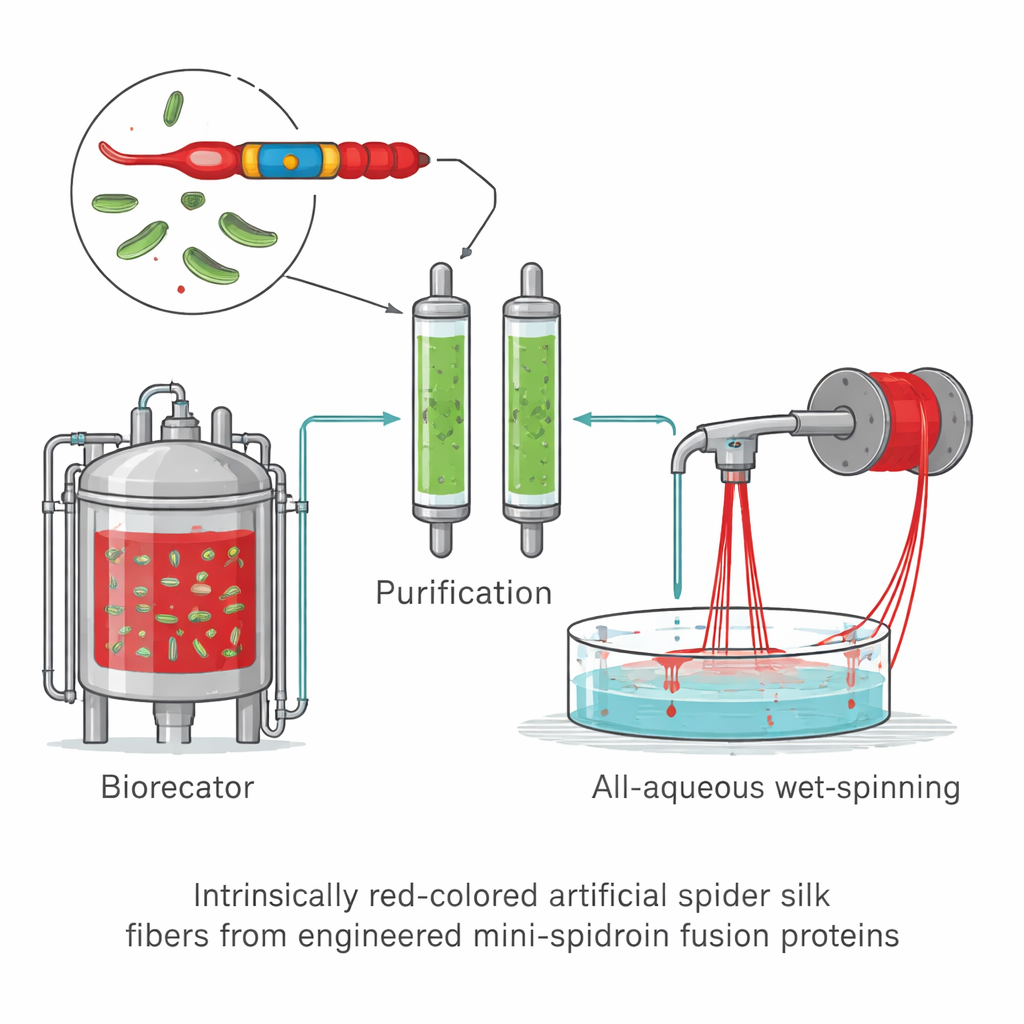
The researchers set out to design a silk protein that carries its own color, avoiding any need to dye the finished fibers. They fused a well-known red fluorescent protein, called mCherry, to a mini-spidroin that is already proven to spin well into fibers. This fusion protein, named A3I-A-mCherry, was produced in bacteria grown in a fed-batch bioreactor, reaching yields of about 20 grams per liter of culture—levels considered promising for high-end textile applications. The team was able to purify the protein under gentle, water-based conditions, and analytical techniques confirmed that it formed mainly dimers, as expected for this type of silk protein. Importantly, the protein solutions had a deep burgundy color and glowed bright red under ultraviolet light, showing that the mCherry part was correctly folded and functional.
Spinning Glowing Fibers in Water
Next, the team tested whether this red fusion protein could be spun into continuous fibers using an all-aqueous, biomimetic spinning method. In this setup, a thick protein solution is extruded through a fine nozzle into a mildly acidic water bath, causing the proteins to lock together into a solid fiber—similar to how spiders spin silk in their glands. When they tried to spin fibers from the fusion protein alone, the result was brittle threads that broke easily. The scientists solved this by blending the colored fusion protein with unmodified mini-spidroin, creating mixtures that contained 12.5%, 25%, or 50% of the red protein by weight. These blends could be continuously wet-spun into stable fibers that kept their burgundy color in normal light and their red fluorescence under UV light, indicating that much of the mCherry remained intact.
Strength, Stretch, and Lasting Glow
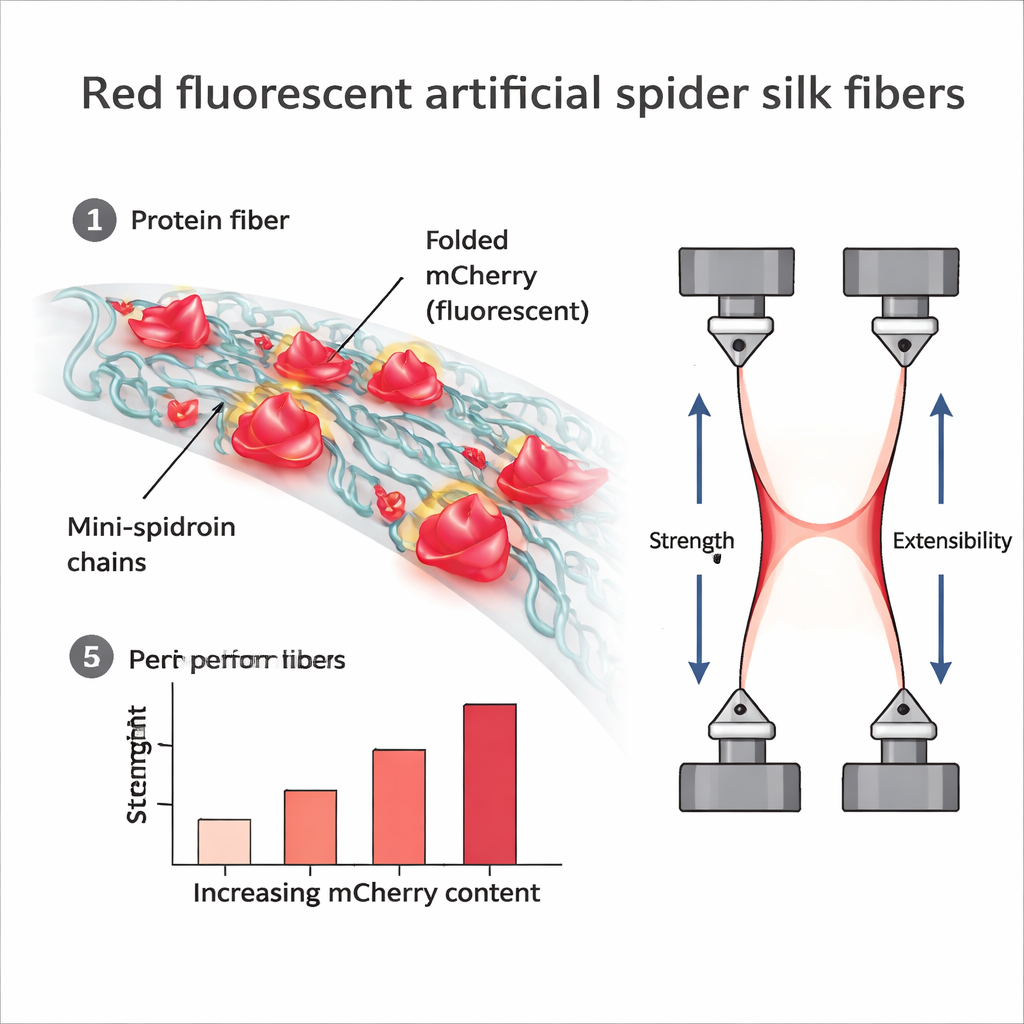
The researchers then asked whether adding the bulky mCherry protein would damage the mechanical performance of the silk fibers. Standard tensile tests showed that as the mCherry content increased, the fibers tended to become slightly less strong but somewhat more stretchy. Only the most extreme comparison—between fibers with no mCherry and those with 50% mCherry—showed clear statistical differences in strength. Even so, the red fibers still reached tensile strengths in the range of 67 to 115 megapascals, comparable to other artificial silks made using water-based spinning. Overall toughness, a measure that combines strength and stretch, remained similar across all fiber types. Microscopy and infrared spectroscopy confirmed that the fibers had typical silk-like structure, while also preserving the characteristic signature of the folded mCherry protein. Fluorescence imaging over a full week showed that the red glow remained stable in the fibers, suggesting that the color is durable over time.
Toward Cleaner, Smarter Textiles
To a layperson, the key message is that these scientists have created a proof of concept for “ready-colored” silk fibers whose hue comes from the protein building blocks themselves, not from added dye. By using only water-based conditions from production to spinning, they preserve both the mechanical performance of the silk and the fluorescence of the color protein. This approach hints at future textiles where color, tracking ability, or other functions are designed into the fibers from the start, potentially reducing pollution from dyeing and offering new kinds of smart, bio-based materials that could one day complement or even replace some petroleum-derived synthetic fibers.
Citation: Bohn Pessatti, T., Schmuck, B., Greco, G. et al. Intrinsically colored artificial silk fibers made from mini-spidroin fusion proteins. Commun Mater 7, 70 (2026). https://doi.org/10.1038/s43246-026-01079-z
Keywords: spider silk, bio-based textiles, fluorescent fibers, sustainable materials, protein engineering