Clear Sky Science · en
Kinetics of vacancy-assisted reversible phase transition in monolayer MoTe2
Why tiny flaws can power future electronics
Modern electronics are racing toward ever thinner materials, sometimes only a single atom thick. This study looks at monolayer MoTe2, a sheet of atoms that can switch between an insulating-like state and a metallic state. The twist is that this switching is controlled not by adding bulky components, but by the tiniest flaws imaginable—missing atoms—offering a route to ultra-thin, low-energy memory and logic devices.
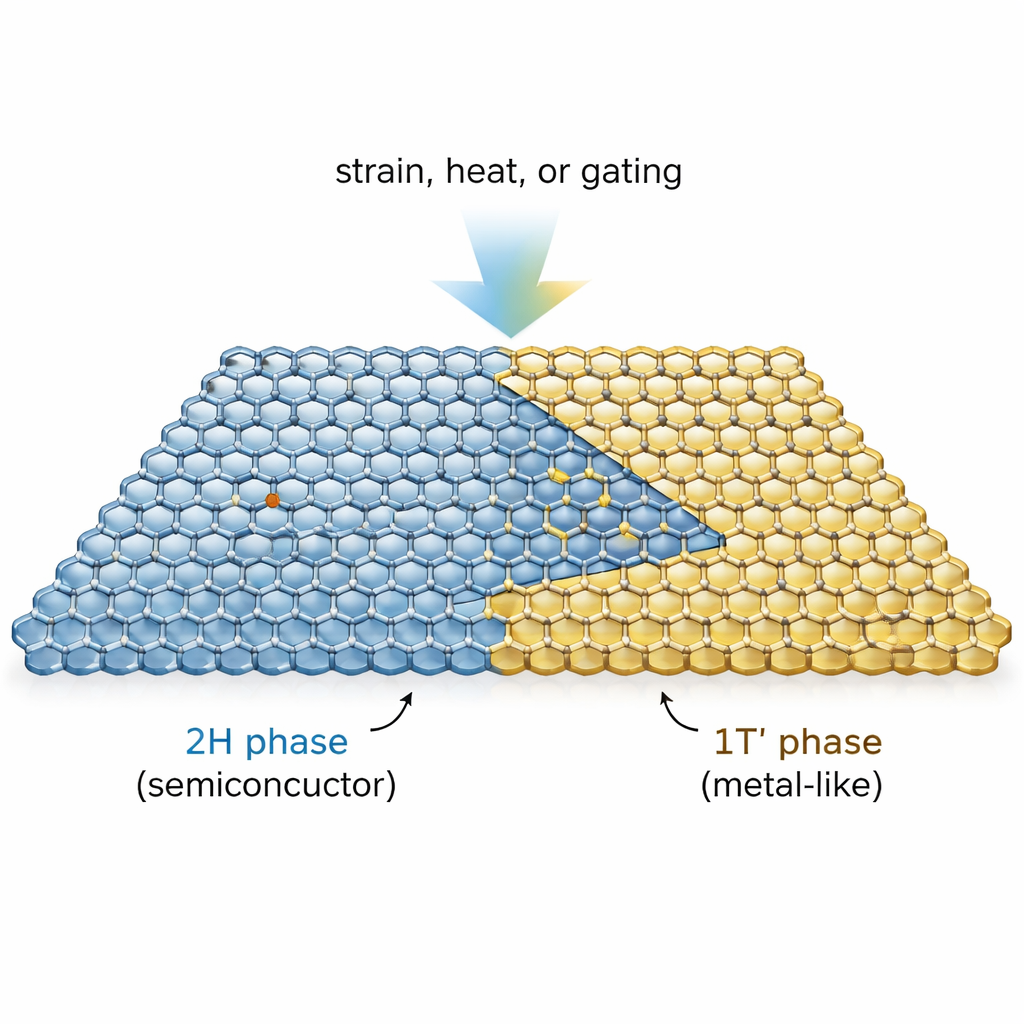
Two faces of a single-atom-thick material
Monolayer MoTe2 can exist in two main atomic arrangements. In the 2H phase it behaves like a regular semiconductor, useful for transistors. In the 1T′ phase it conducts like a metal and can host exotic quantum effects. The energy difference between these phases is small, which means that modest pushes—such as stretching the sheet, heating it, shining light, or applying voltage—can trigger a switch. For practical devices, however, engineers need this transition to be both reversible and controllable, not a one-way breakdown of the material.
How missing atoms start the change
Experiments had already hinted that missing tellurium atoms, called vacancies, are central to the phase change in MoTe2. But the exact atomic dance—how small metal-like regions first appear and grow—was unknown, largely because it unfolds too quickly and at too small a scale to see directly. The authors tackle this by building a highly accurate machine-learning model of atomic forces, trained on thousands of quantum mechanical calculations. This model lets them run large, long simulations where vacancies move, collide, and reshape the crystal, revealing the hidden steps of the transformation.
From scattered flaws to growing metal islands
The simulations show that the initial switch from the 2H to the 1T′ phase happens in two stages: nucleation and growth. First, individual vacancies in the tellurium layer occasionally join to form pairs, or “divacancies,” that can move more easily. When a mobile divacancy meets another vacancy, the local atoms rearrange to create a tiny triangular patch of the 1T′ phase—a seed island embedded in the 2H background. This process is relatively slow and needs a locally high vacancy concentration and a strong external push, such as mechanical strain, to overcome the energy barriers.
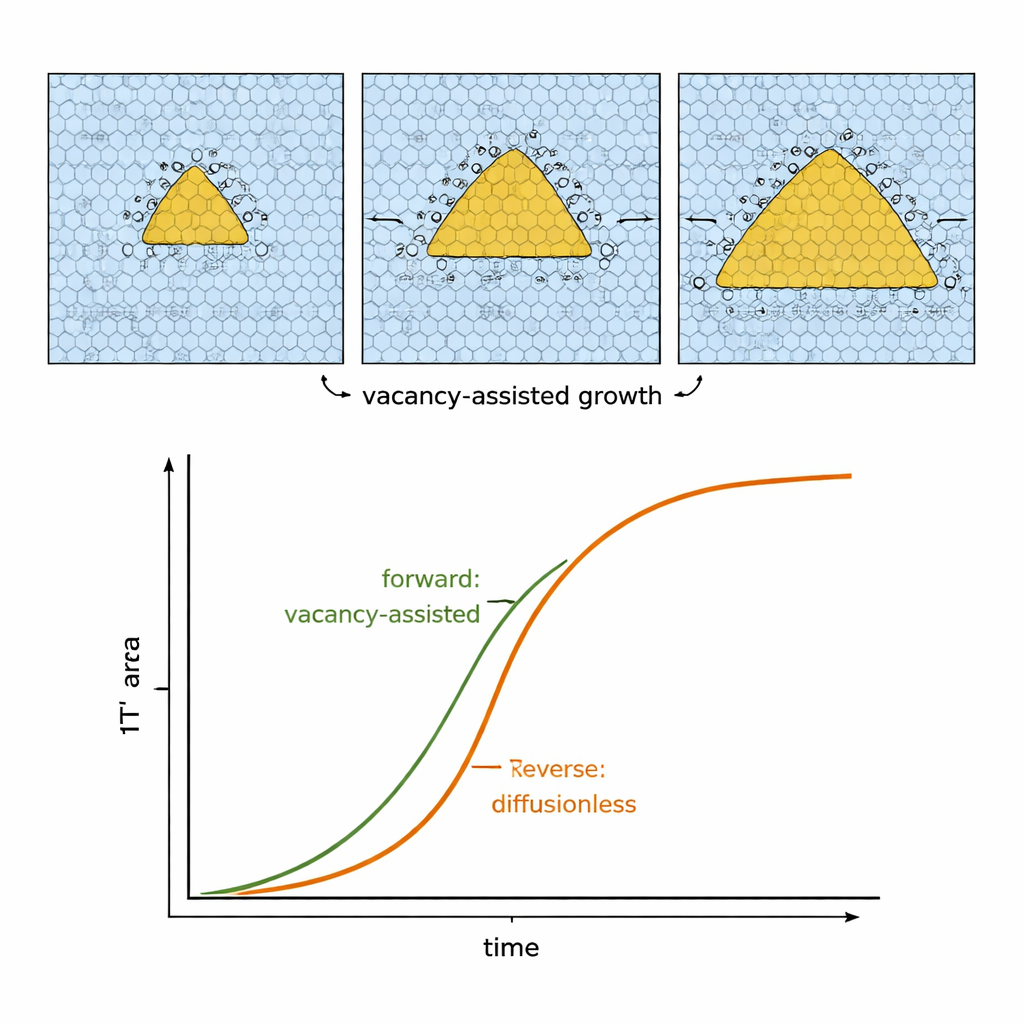
Fast growth, critical size, and a hidden safety switch
Once a 1T′ island forms, it can grow much more quickly by “eating” nearby vacancies along two of its edges. Atoms hop one by one along these edges, turning rows of 2H into 1T′ whenever a vacancy is present in the right spot. The authors combine their atom-by-atom calculations with kinetic models to show how the island expands row by row and how growth speed depends on vacancy density. Below a certain density, very small islands may stall because they see no vacancies at their edges. Above a critical island size—set by how many vacancies are likely to sit along the borders—growth becomes essentially automatic, even when vacancies are relatively rare. They also identify rarer alternative growth paths: a vacancy-free mode that needs higher activation energy, and a mode where divacancies drive growth along a different type of boundary.
A rapid, reversible switch for real devices
Perhaps the most device-relevant finding is what happens when the external push is removed. The 1T′ region shrinks back into the 2H phase through a “diffusionless” reshuffling of atoms, without relying on vacancies to move. This reverse process races inward from the corners of the triangular island and leaves behind three spoke-like lines of vacancies. When the stimulus is applied again, the system switches forward along essentially the same path, using these vacancy lines as ready-made tracks. Subsequent cycles of switching need only mild stimuli and no new defects. To make use of this behavior, the authors propose a two-stage engineering strategy: a one-time, high-power “pre-device” step that creates stable 2H/1T′ patterns and vacancy lines, followed by gentle, fast, fully reversible phase switching during normal device operation.
Citation: Shuang, F., Ocampo, D., Namakian, R. et al. Kinetics of vacancy-assisted reversible phase transition in monolayer MoTe2. Commun Mater 7, 69 (2026). https://doi.org/10.1038/s43246-026-01078-0
Keywords: MoTe2, phase transition, vacancies, 2D materials, memory devices