Clear Sky Science · en
4D Printing of polyoxometalate hydrogels from centrifuged inks for semi-solid lubricants
Smart Slippery Gels for Moving Machines
Keeping machines running smoothly usually depends on oily lubricants that can leak, dry out, or break down under stress. This study introduces a new kind of water-rich “smart gel” made from inorganic clusters and a simple organic helper that can both be 4D‑printed into intricate shapes and work as a long‑lasting, semi‑solid lubricant. The work hints at future engines, robots, and even artificial joints that stay slippery with cleaner, more adaptable materials.
Building Gels from Tiny Metal Clusters
At the heart of the research are polyoxometalates—well‑defined clusters of metal and oxygen atoms that dissolve in water and offer many chemical “handles.” Traditionally, turning these clusters into hydrogels required extra charged polymers or metal ions, which could dull the clusters’ natural behavior and sometimes make the material less water‑friendly. The team instead mixed a common phosphotungstate acid with calcium ions and a long, double‑ended organic molecule in water. Under stirring, these ingredients spontaneously organized into extremely thin, two‑dimensional nanosheets only a few nanometers thick. These sheets carry the polyoxometalate chemistry but are bridged and stabilized by the organic template and calcium, forming a flexible, sheet‑like building block for larger structures. 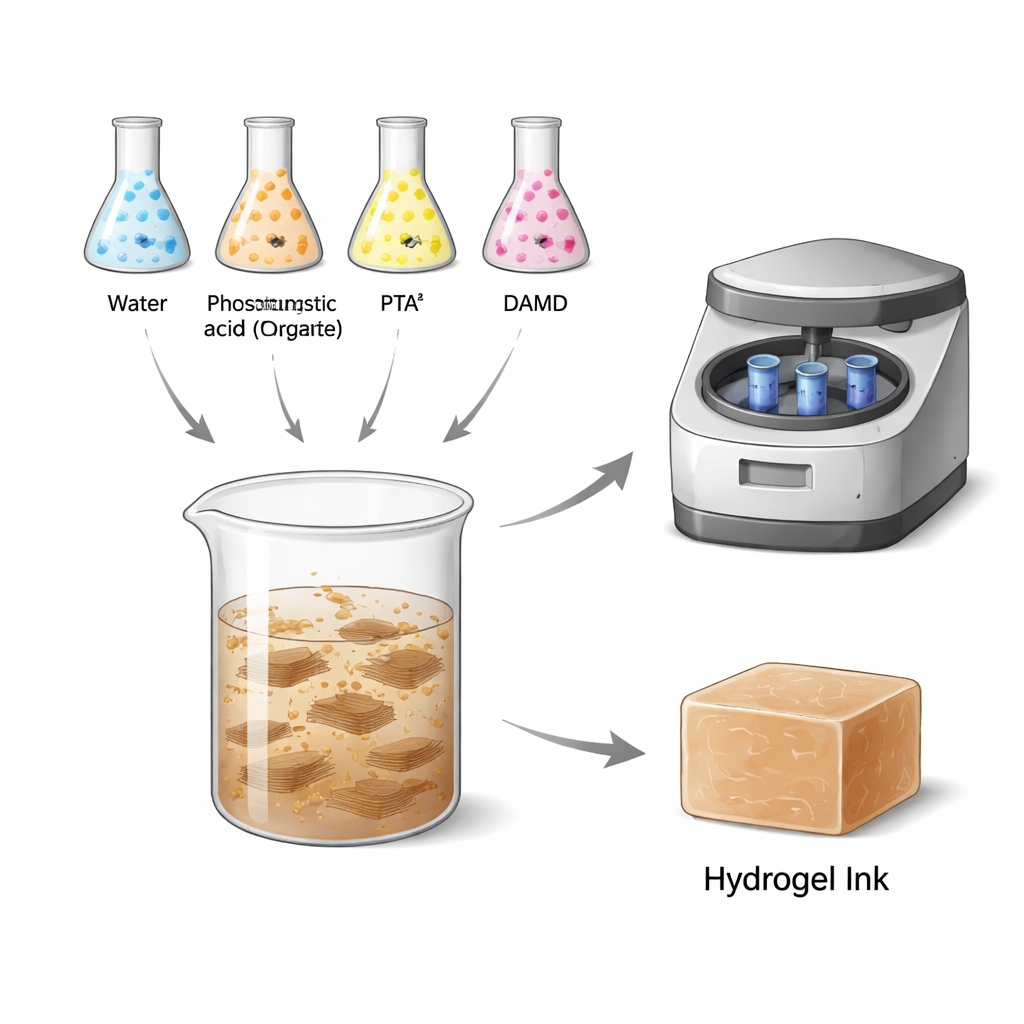
From Liquid Inks to Solid Yet Reversible Gels
The nanosheets, once formed, stay stably dispersed in water at a moderate pH, looking like milky liquids for weeks. When the researchers subjected these dispersions to relatively strong centrifugation—spinning at more than 900 times Earth’s gravity—the sheets packed into a dense, non‑flowing hydrogel at the bottom of the tube. Inside, the sheets form a tightly connected but disordered network. Mechanical tests showed that the resulting gels behave like soft solids: they can bear load, spring back after small deformations, and yet flow when squeezed or sheared strongly. Their viscosity drops smoothly as they are pushed harder, a desirable “shear‑thinning” behavior for squeezing them through nozzles or letting them spread between rubbing surfaces.
Gels That Change Shape with Heat
These new hydrogels are also temperature‑responsive. At room temperature they are firm and hold their shape, but when heated to around 80 °C they partly melt, becoming much softer and more fluid as the nanosheet network loosens. When cooled again, they recover their solid‑like character without significant damage. Leveraging this, the team 3D‑printed colorful structures such as stars, flowers, letters, and cartoon shapes by either molding, coating, or direct extrusion from syringes. Upon heating, the printed shapes swelled, flowed, or morphed into new outlines—an example of 4D printing, where time and temperature trigger programmed transformations in already printed objects.
Acting as Tough, Long‑Lasting Lubricants
Beyond printing, the gels excelled as semi‑solid lubricants between sliding solids such as steel, ceramics, and their combinations. Compared with plain water, which allowed high friction and deep wear tracks, a thin layer of the gel cut friction to about one‑third and dramatically reduced wear for most material pairs. One optimized composition protected steel on steel so well that it maintained a low friction level over 200,000 back‑and‑forth sliding cycles, suggesting durability suitable for industrial use. 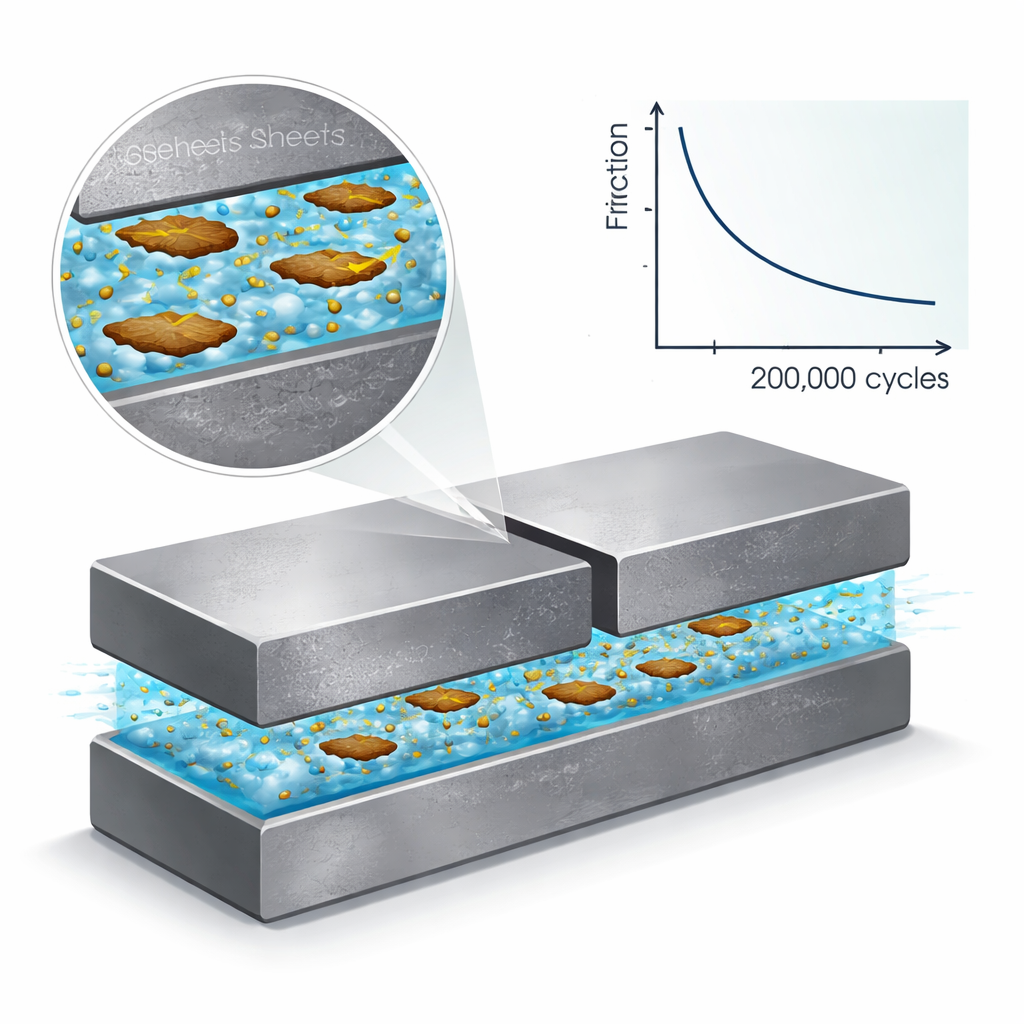
Where These Smart Gels Could Lead
By assembling metal‑oxygen clusters into nanosheets and then compacting them into hydrogels with a simple centrifuge step, the researchers created a single material that can be printed into complex, reconfigurable shapes and also serve as a robust, long‑lived lubricant. Because the gels are mostly water, show limited swelling, and appear relatively gentle to human cells in initial tests, they could one day help build bio‑inspired slippery surfaces such as artificial cartilage or soft robotic joints. More broadly, the work points toward a new class of adaptive “solid‑like” lubricants that can be shaped on demand and keep machinery running smoothly under challenging conditions.
Citation: Xue, B., Yang, Y., Yang, Y. et al. 4D Printing of polyoxometalate hydrogels from centrifuged inks for semi-solid lubricants. Commun Mater 7, 64 (2026). https://doi.org/10.1038/s43246-026-01075-3
Keywords: 4D printing, hydrogel lubricants, polyoxometalate, smart materials, tribology