Clear Sky Science · en
A framework for estimating manure nitrogen balance and recycling potential for current and future conditions in the USA
Turning Farm Waste into a Hidden Resource
Across the United States, huge amounts of animal manure are produced every year as we raise cattle, pigs and poultry for meat and dairy. That manure is rich in nitrogen, a key nutrient that crops need to grow. Yet much of it is wasted, while farmers buy large quantities of synthetic fertilizer made with fossil fuels. This study asks a simple but important question: how much of that manure could realistically be recycled back to fields today and in the future, and what would that mean for food production and pollution?
Why Counting Nutrients Is So Confusing
Researchers have long tried to measure the “manure balance” in farming systems—whether manure supplies more nutrients than crops can use, or far less. But past studies have used different assumptions about what fraction of manure can be collected, how much is lost during storage, and how efficiently crops use nitrogen. As a result, estimates for the United States ranged wildly, from a small shortfall to a huge deficit. The authors of this paper carefully re-ran six of these methods using the same national data, showing that disagreements largely come from inconsistent definitions rather than from the data themselves. This inconsistency makes it hard for policymakers and farmers to know where manure can safely replace fertilizer and where it cannot.
A Clearer Framework for Manure Recycling
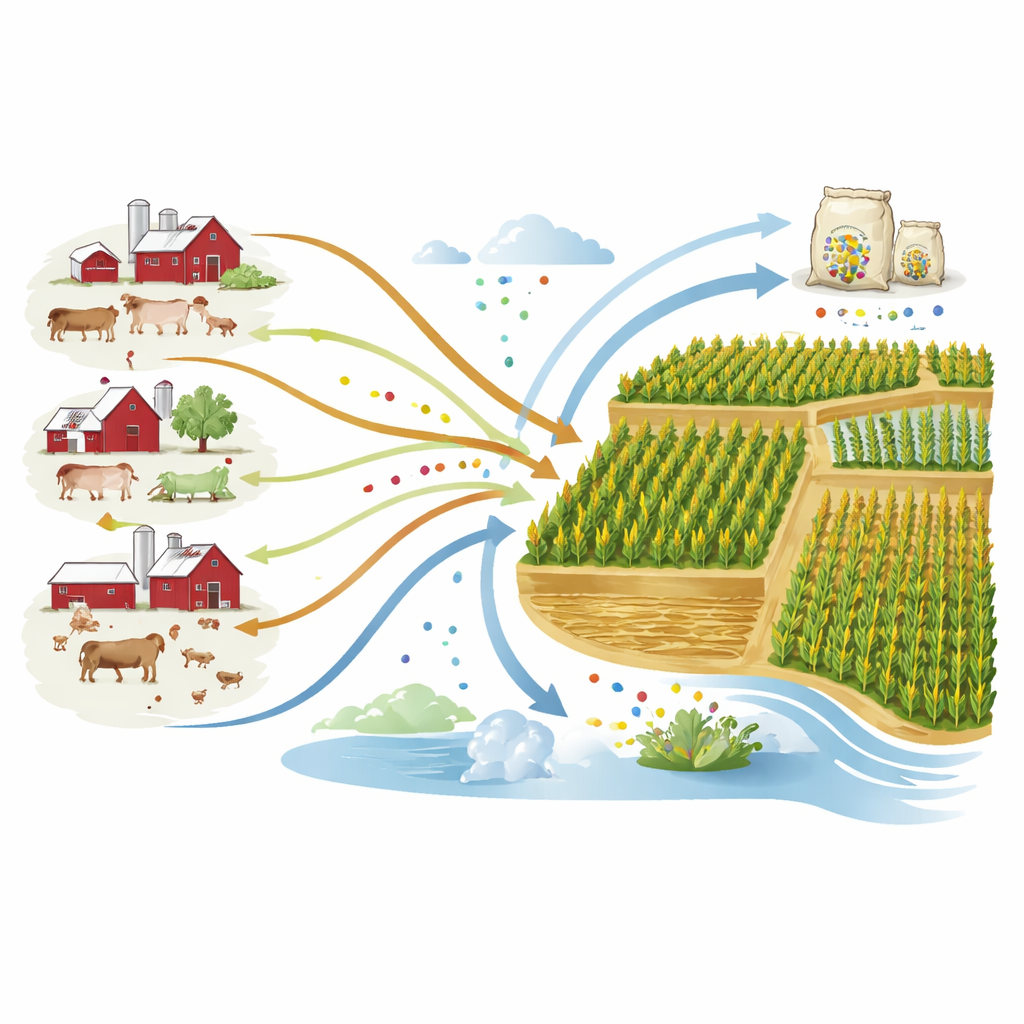
To cut through the confusion, the team proposes a new framework built around a handful of clearly defined metrics. On the manure side, they distinguish between three levels: the total nitrogen excreted by animals in confinement; the portion that could be recovered with current collection and storage technologies; and the smaller amount that surveys show is actually applied to crop fields today. On the crop side, they estimate how much nitrogen crops really need once natural sources such as nitrogen-fixing plants, rain and irrigation water are taken into account. They then calculate crop demand under current farming practices and under an improved scenario where crops use nitrogen more efficiently.
How Big Is the Gap Today?
Applying this framework to the contiguous United States reveals that manure use falls far short of crop needs. Only about one fifth of the nitrogen excreted by confined livestock is currently spread on cropland. When this is compared to what crops require, the country is left with a large deficit, which is now mainly filled by synthetic fertilizer. Even when the authors assume full adoption of today’s best manure-handling systems, the deficit shrinks only slightly, because so much nitrogen is still lost along the way or never collected in the first place. They also find that if farmers tried to supply more nitrogen from manure alone, they would often end up applying too much phosphorus, another nutrient that can cause water pollution when it builds up in soils.
What Could Better Technology and Smarter Farming Do?
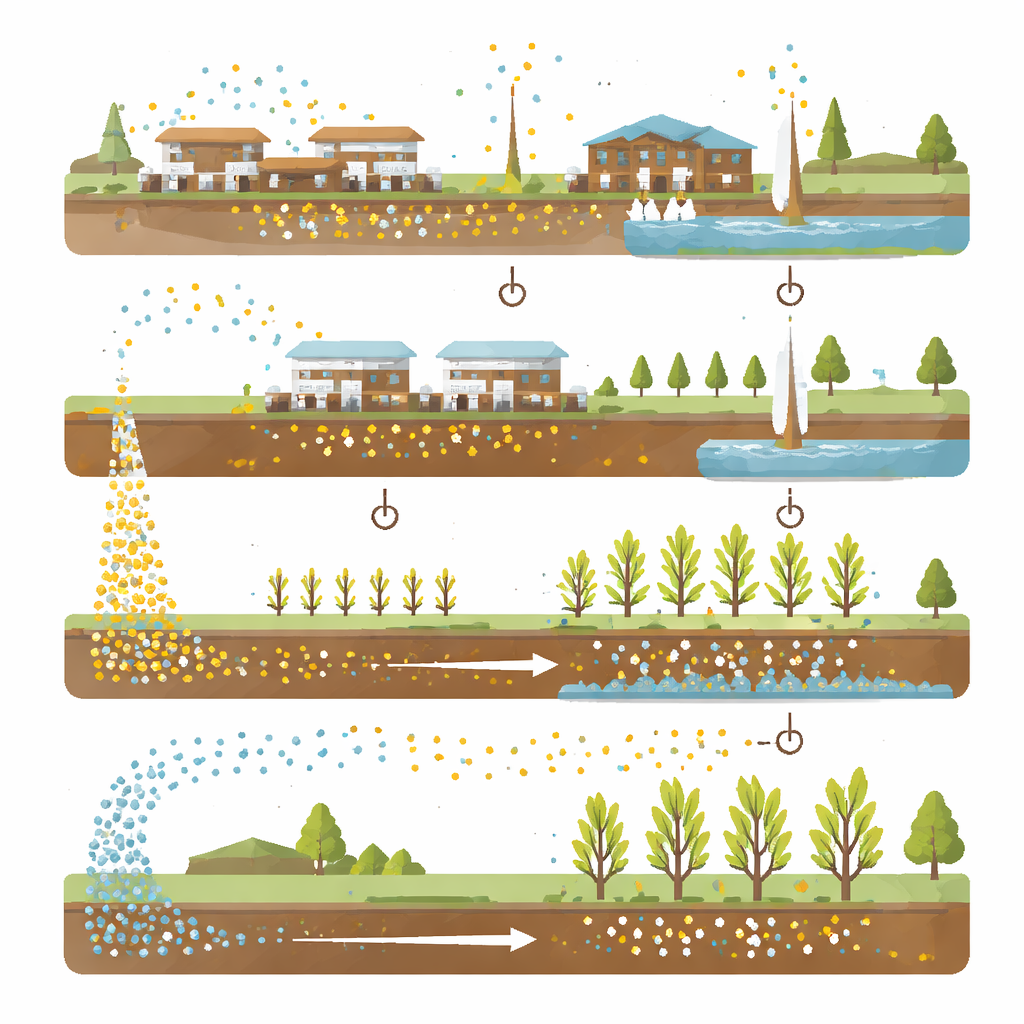
The study then explores what might be possible with both improved manure recovery and better crop management. New or more widely adopted technologies could make it feasible to capture and use nearly all manure from confined animals, sharply increasing the nutrient supply from this source. At the same time, raising how efficiently crops use nitrogen—closer to the levels already achieved in some well-managed systems—would reduce how much nitrogen they need overall. When these two strategies are combined, national use of synthetic nitrogen fertilizer could be cut by more than half. However, because manure often contains more phosphorus than crops require, some of the extra manure would still need special treatment to remove phosphorus or be shipped to other regions.
Different Needs in Different Places
Looking at every county in the country, the authors show that manure challenges are highly local. A small number of counties with dense livestock operations already have more manure nitrogen than their crops can safely use and need to move nutrients out or cap herd sizes. Several hundred other counties could, with better manure collection, transport or crop efficiency, meet all of their crop nitrogen needs locally. Most of the country, though, will continue to depend on some synthetic fertilizer because crop production far outweighs nearby animal numbers. Matching these patterns to specific management options—such as improving storage systems, investing in transport, or redesigning where animals are raised—can help planners and farmers prioritize actions.
A Path Toward Cleaner, More Efficient Farming
For non-specialists, the key message is that manure is both a problem and a missed opportunity. Used carelessly, it leaks nitrogen and phosphorus into air and water, contributing to climate change, smog and dead zones in lakes and coastal waters. Used wisely, it can replace a large share of factory-made fertilizer and support healthier soils. This study offers a transparent way to measure where we stand and how far we can go under current and future conditions. The authors conclude that, with better data, technologies and policies, the United States could turn much more of its animal waste into a valuable resource while cutting fertilizer bills and reducing pollution—but manure alone will not fully replace synthetic fertilizers, so both nutrient recycling and smarter fertilizer use must move forward together.
Citation: Wang, Y., Zhang, X., Spiegal, S. et al. A framework for estimating manure nitrogen balance and recycling potential for current and future conditions in the USA. Nat Food 7, 260–271 (2026). https://doi.org/10.1038/s43016-026-01312-5
Keywords: manure recycling, nitrogen balance, synthetic fertilizer, sustainable agriculture, nutrient pollution