Clear Sky Science · en
Global patterns of commodity-driven deforestation and associated carbon emissions
Why Our Food Choices Matter for the World’s Forests
When you drink a cup of coffee, eat a steak or serve a bowl of rice, it can be hard to imagine the distant forests that may have been cleared to produce those foods. This study reveals, in unprecedented detail, how everyday commodities—from cattle and chocolate to rice and rubber—are linked to the cutting of forests around the globe, and how much climate‑warming carbon those losses release into the atmosphere.
A Global X‑ray of Forest Loss
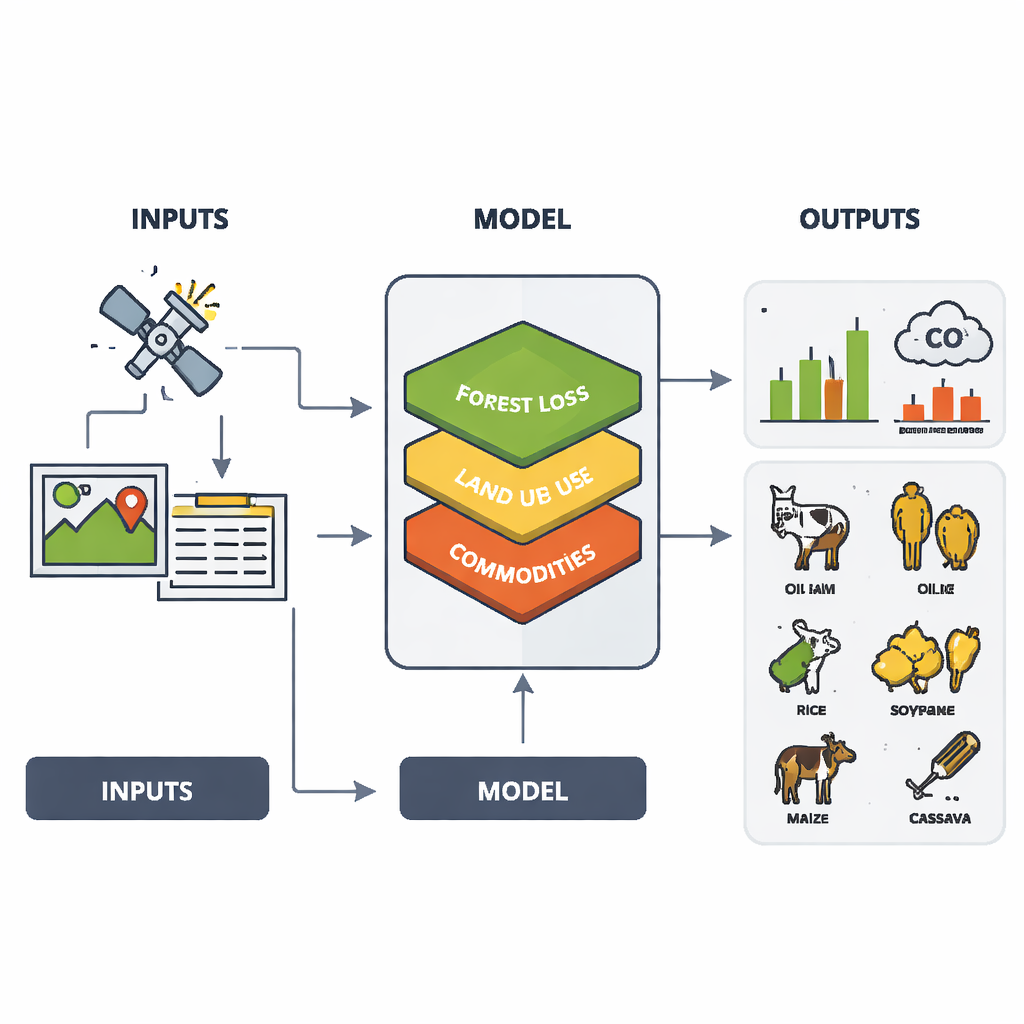
The researchers built a new framework, called DeDuCE, that acts like an X‑ray for the world’s forests and farms. It combines satellite images of where trees have disappeared since 2001 with detailed statistics on what crops and livestock are produced in 179 countries. By layering these data, the model can say not just how much forest was lost, but whether it was likely cleared for pasture, oil palm plantations, rubber trees, rice paddies or other uses, and how much carbon was released as a result.
How Much Forest Is Really Cut for Commodities?
From 2001 to 2022, satellites recorded tree cover loss over an area larger than the European Union. DeDuCE finds that only about a quarter of this loss was true deforestation for new cropland, pasture or forest plantations; the rest was fire, degradation, or the rotation of already managed lands. Even so, that commodity‑driven deforestation totaled about 122 million hectares and produced roughly 41 billion tonnes of carbon dioxide, plus another 3 billion tonnes from drained peatlands—waterlogged soils that release huge amounts of greenhouse gases when dried.
Where Forests Are Falling Fastest
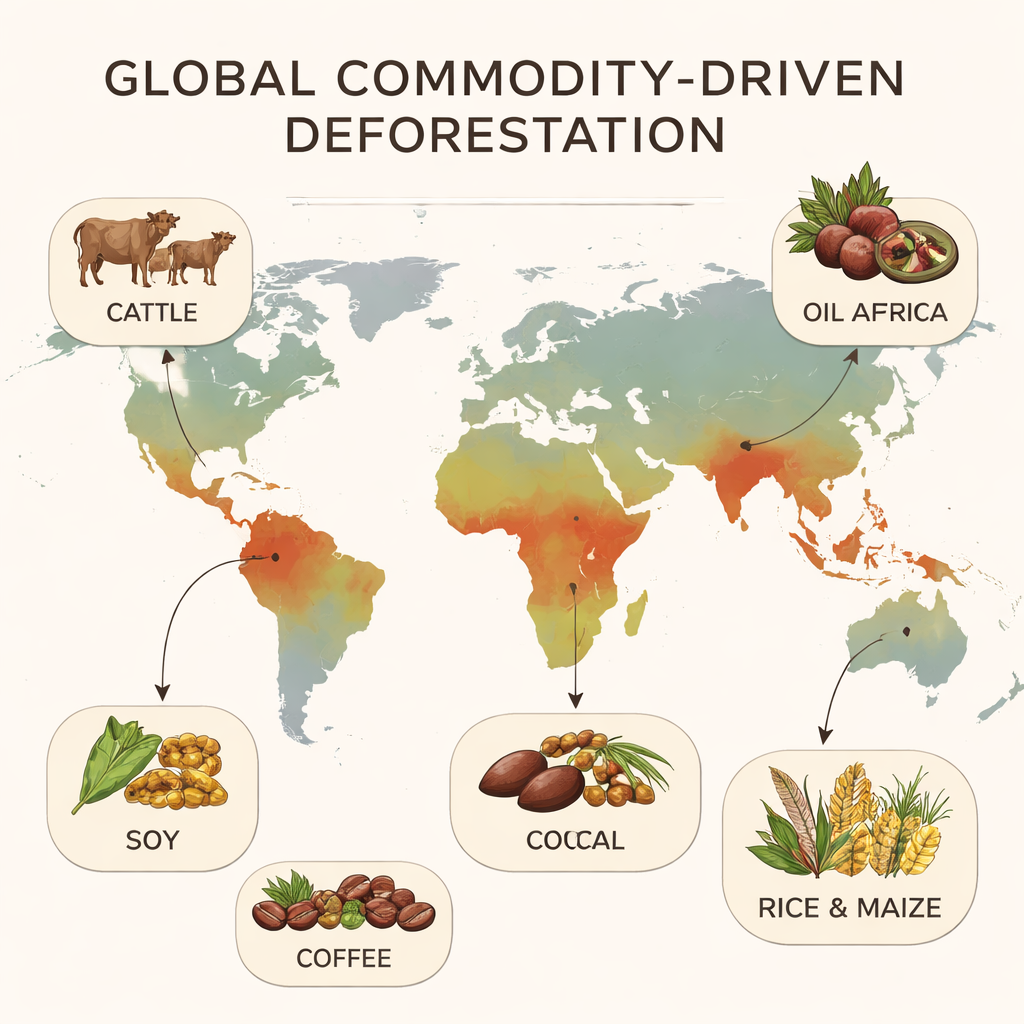
Deforestation is far from evenly spread. South America, Southeast Asia and Africa together account for more than 80% of agriculture‑linked forest loss and almost all of the associated carbon emissions. Brazil, Indonesia and the Democratic Republic of Congo are the three largest contributors, with China and the United States also high on the list in terms of area cleared, though with lower emissions because their forests often store less carbon per hectare.
The Usual Suspects—and the Overlooked Staples
The study confirms that some well‑known culprits deserve their reputation. Expanding pasture for cattle accounts for about 42% of commodity‑driven deforestation and just over half of the related carbon emissions. Oil crops such as palm oil and soybeans add another 16% of the cleared area and 14% of emissions, with oil‑palm plantations in Southeast Asia responsible for more than half of peatland‑drainage emissions. But the analysis also points a finger at everyday staples that rarely feature in deforestation debates: maize (corn), rice and cassava together drive around 11% of global deforestation, more than cocoa, coffee and rubber combined. Unlike luxury crops, these staples are grown and linked to forest loss across many regions, reflecting the basic diets of billions of people.
Making Sense of Uncertainty
Because data quality varies widely between countries and crops, the authors developed an Integrated Quality Index to flag how confident they are in each estimate. Only about 12–15% of deforestation can be tied to specific commodities with high‑resolution maps; the rest relies partly or mostly on national statistics. This index highlights where better maps—especially for pastures, forest plantations and cereals, and for African countries such as the Democratic Republic of Congo and Nigeria—would most improve our understanding of how food production affects forests.
What This Means for Policy and Consumers
By showing which products and places are most closely linked to forest loss, DeDuCE offers a powerful tool for governments, companies and investors trying to clean up global supply chains. It can support new regulations such as the European Union’s rules on deforestation‑free imports, help countries report their land‑use emissions under international climate agreements, and guide corporate climate targets. For ordinary readers, the message is clear: the world’s forests are being cut not just for hamburgers and palm oil, but also for the staple foods that fill our plates. Protecting forests while feeding a growing population will require smarter production, better monitoring and, in many cases, more thoughtful consumption choices.
Citation: Singh, C., Persson, U.M. Global patterns of commodity-driven deforestation and associated carbon emissions. Nat Food 7, 138–151 (2026). https://doi.org/10.1038/s43016-026-01305-4
Keywords: deforestation, food systems, carbon emissions, global agriculture, staple crops