Clear Sky Science · en
Optimizing urban tree species composition to maximize nature-based solutions
Why city trees matter more than ever
Many cities are racing to plant thousands of new trees, hoping to cool streets, clean the air, and soak up stormwater. But this study argues that just counting trees is not enough. Different tree species perform very different jobs, and every neighborhood faces its own mix of heat, flooding, and pollution. By carefully matching the “right trees” to the “right places,” the authors show that cities can squeeze dramatically more benefit from the same amount of green space.
City problems are not the same everywhere
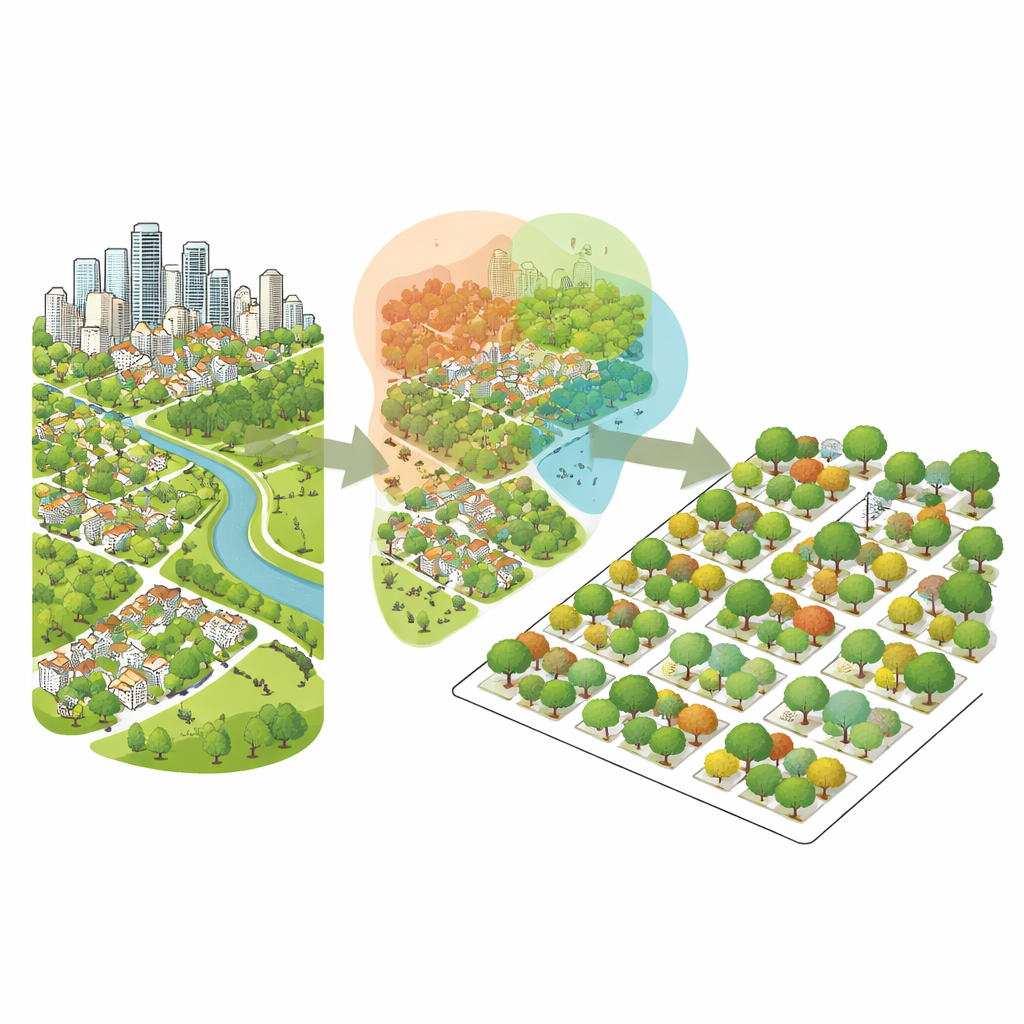
Philadelphia, the focus of this research, illustrates how uneven city conditions can be. Using satellite data, flood reports from residents, air pollution records, and maps of land use, the team divided the city into small grid cells and scored each one for how badly it needed help with stormwater, heat, air quality, and climate-warming carbon. Dense central and southern districts, covered with pavement and older drainage systems, stood out as hotspots for both flooding and extreme heat. Areas near busy roads showed higher demand for cleaner air. In contrast, neighborhoods next to big parks and river corridors generally had lower demand. This patchwork of needs means that a one-size-fits-all tree strategy will inevitably miss opportunities.
Not all trees do the same work
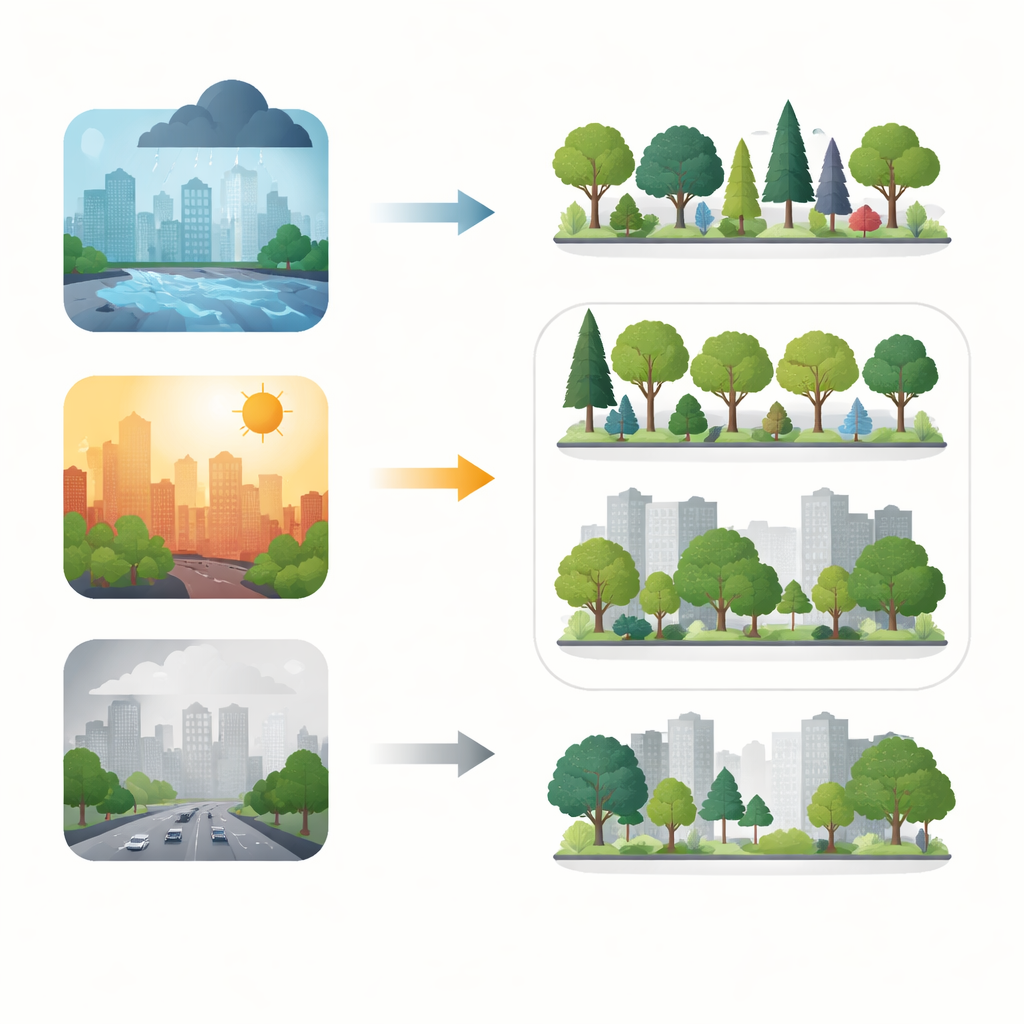
To understand what different trees can offer, the researchers turned to a detailed inventory of Philadelphia’s urban forest and a widely used modeling tool called i-Tree Eco. They examined the 30 most common tree species already growing in the city, estimating how much each could contribute per unit of canopy area to four services: trapping fine particles from the air, capturing carbon, intercepting stormwater, and reducing building energy use by shading and cooling. The differences were striking. Some trees excelled at soaking up rain but were only average at cooling buildings. Others locked away a great deal of carbon but were less impressive at filtering air. Several very common species in Philadelphia, such as London plane and callery pear, turned out to be weaker performers across all four services than other species that are currently rare.
Designing the best mix of trees
Rather than searching for a single “super tree,” the team treated species selection as a balancing act. They applied a multi-objective optimization algorithm, a type of genetic search that explores countless combinations, to find the best mix of nine top-performing species for each grid cell. The algorithm tried to maximize all four benefits at once, while recognizing trade-offs: favoring a species that is wonderful for stormwater, for example, might slightly reduce gains in cooling or carbon. From the many near-optimal solutions it produced, the authors chose a compromise that gave strong results in every category. This solution recommended a citywide mix dominated by a handful of species—especially silver maple, red maple, sweetgum, sugar maple, and tulip tree—which together made up about 85 percent of the ideal planting palette. Importantly, the preferred species shifted from place to place, with some better suited to dense, flood-prone cores and others to greener outer districts where carbon storage could be maximized.
How much more benefit can smarter planting deliver?
To test whether this strategy would really pay off, the researchers simulated what would happen if Philadelphia expanded its tree canopy by the same amount under two different approaches: one using the optimized species mix grid by grid, and one in which new trees were a random assortment of common species. As canopy cover rose, all ecosystem services improved in both scenarios. But the optimized composition did much more with the same space. At a modest 15 percent increase in canopy, the “smart” mix removed about 28 percent more fine particles from the air and stored nearly 38 percent more carbon than the random mix. It provided roughly 20 percent more stormwater reduction and, most dramatically, about 77 percent more building energy savings, highlighting its power to ease urban heat. Overall, depending on the service, better planning boosted benefits by roughly 20 to 80 percent without planting a single extra tree.
What this means for greener, fairer cities
The study concludes that urban tree campaigns should move beyond simple targets like “number of trees planted” or “percent canopy cover.” By mapping where environmental problems are most severe and choosing species whose strengths match those local needs, cities can deliver far more cooling, cleaner air, flood protection, and carbon storage from the same limited planting space. The authors also suggest two broad rules of thumb: use high-carbon species in safer, less stressed areas to build long-term climate benefits, and concentrate species that are especially good at cooling, filtering pollution, or handling water in neighborhoods that face those specific hazards. In short, how and where we plant matters just as much as how much we plant.
Citation: Dong, X., Ye, Y., Su, D. et al. Optimizing urban tree species composition to maximize nature-based solutions. npj Urban Sustain 6, 47 (2026). https://doi.org/10.1038/s42949-026-00361-w
Keywords: urban trees, nature-based solutions, ecosystem services, urban heat and flooding, tree species planning