Clear Sky Science · en
Double circle of density preferences among teleworkers during the COVID-19 pandemic in Tokyo
Why our new work habits change where we want to live
The COVID-19 pandemic turned millions of office workers into teleworkers almost overnight, especially in big cities like Tokyo. Instead of spending most of their waking hours near downtown offices, many people suddenly lived, worked, exercised, and socialized almost entirely in their own neighborhoods. This study asks a simple but far-reaching question: once people have tasted this new way of working, what kinds of neighborhoods do they actually want to live in—and what does that mean for the future shape of large cities?
Life with work moved closer to home
Telework, broadly meaning working from home or other non-office places using digital tools, was once a niche option. During the pandemic, it rapidly became part of the “new normal,” and many workers say they want to keep at least some telework even after health restrictions ease. For residents of major cities, where commutes are long and crowded, telework makes daily life much more centered on the local neighborhood. That shift draws attention away from the prestige of a central business district address and toward everyday qualities such as nearby parks, shops, and quiet streets. Earlier research hinted that teleworkers might favor the suburbs, but also suggested that their desires are more complex than a simple “move out of the city” story.
Taking the pulse of Tokyo’s neighborhoods
The authors focused on Tokyo, one of the world’s largest metropolitan regions and a place where population density ranges from extremely crowded city centers to leafy outer suburbs. They carried out online surveys in mid-2020 and mid-2021, right after major waves of COVID-19. The study followed more than a thousand people who had commuted before the pandemic but then teleworked at least once a week during the first wave. Respondents were asked whether they wanted to relocate and why, with reasons spanning a desire to avoid crowding, find more nature, access better transport, or be closer to family and friends. The researchers then matched each person’s address to official census data describing how many people lived in their neighborhood, giving an objective measure of local crowding.
A surprising double circle of preferences
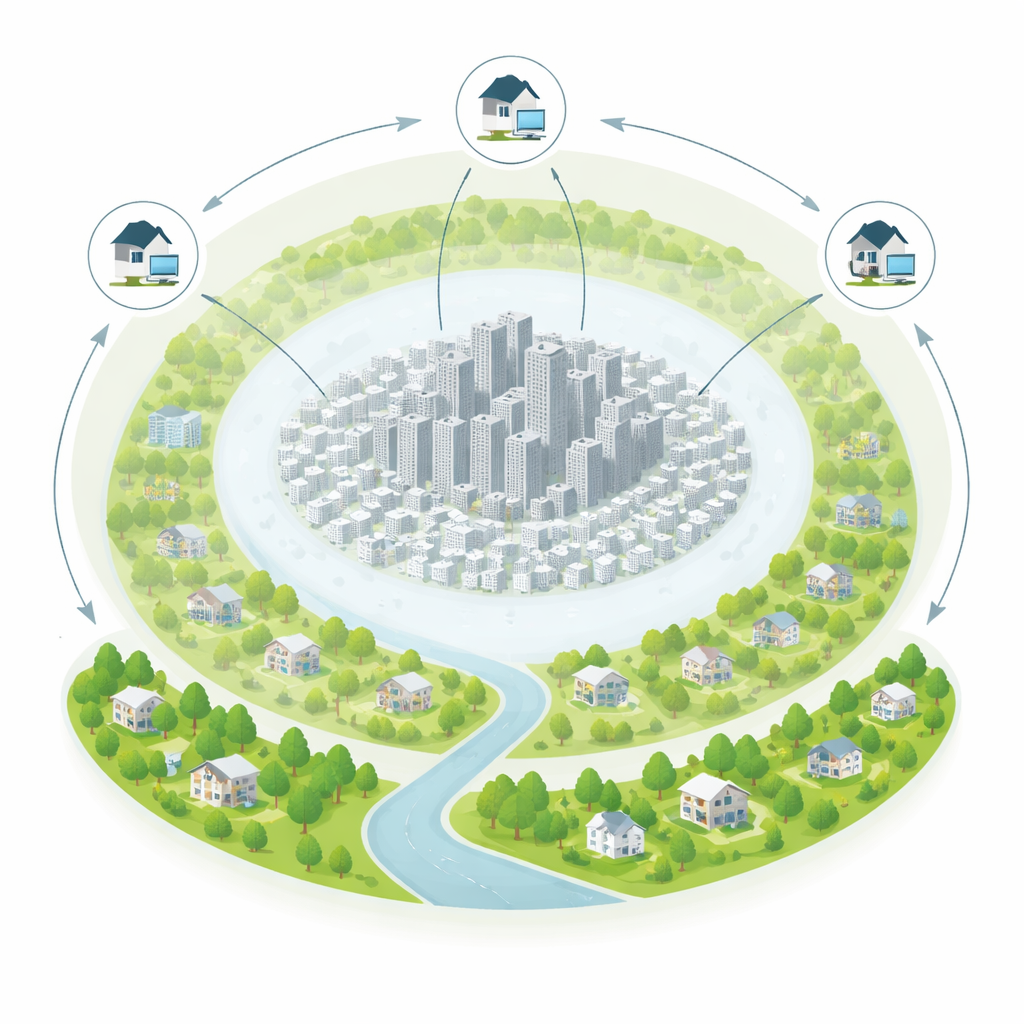
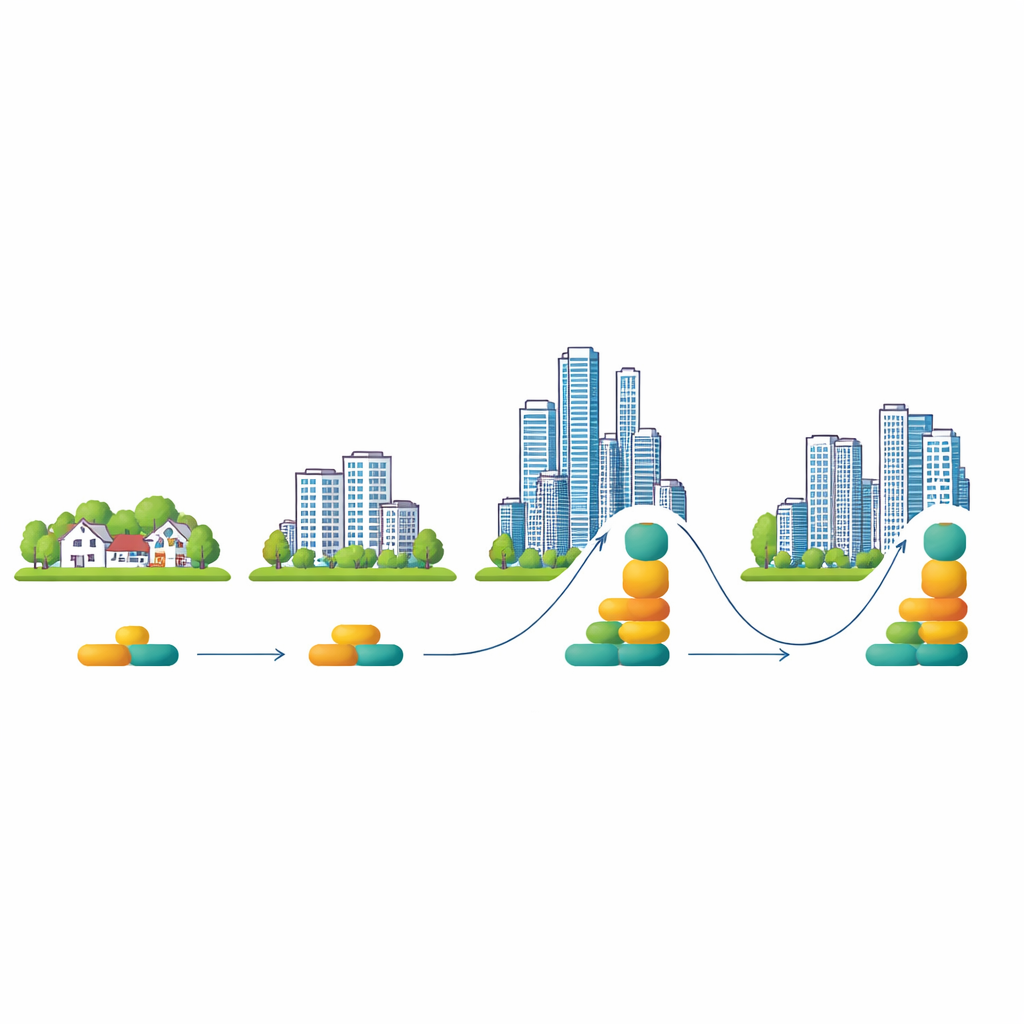
Instead of a straight-line pattern in which people either steadily favor denser cities or steadily favor the suburbs, the analysis revealed a nonlinear “double circle” of preferences. Among teleworkers, the likelihood of wanting to move changed in waves as neighborhood density increased. Relocation intentions tended to be lower in very low-density areas, rose to a peak in moderately dense zones, dropped again in somewhat denser inner suburbs, and then rose once more in very crowded areas. Put in spatial terms for a city like Tokyo—where density typically decreases as you move outward—this means that preferences form rings: lower near the very center, higher in the next band, lower again in the inner suburbs, and higher in the more distant, greener suburbs. By contrast, workers who had gone back to regular commuting did not show this complex pattern, suggesting that telework itself sharpens these preferences.
Why middle-of-the-road areas lose out
The authors argue that different density levels offer different trade-offs, and teleworkers are especially sensitive to those trade-offs. High-density neighborhoods provide excellent public transport, short trips to jobs and services, and the buzz that can stimulate productivity and physical activity. Low-density neighborhoods offer more greenery, quieter streets, and stronger local ties—qualities that matter when home becomes both office and sanctuary. Medium-density inner suburbs around Tokyo, however, often fall between these benefits. They can be too far from city centers to feel truly convenient, but not green or spacious enough to deliver a sense of escape. Past studies of Tokyo’s inner suburbs have also noted aging housing, weaker public transport, and thinner community ties. These “in-between” areas may therefore feel like the worst of both worlds to teleworkers who now spend most of their time at home.
What this means for the future city
For urban planners, the findings suggest that telework-era cities should not simply aim for a smooth, gradual thinning of density from center to edge. Instead, workers appear to favor a clearer contrast between compact, lively hubs and calmer, greener low-density areas. In Tokyo, the study points to roughly 15,000–25,000 people per square kilometer as a good target for lively high-density districts, and under 5,000 for more relaxed areas, while warning against the middling densities that teleworkers tend to reject. Because forcing people to move is unrealistic, the authors argue that cities should instead guide development so that attractive neighborhoods naturally emerge where people most want to live and work. While the exact numbers will differ in other world cities, the underlying lesson is broad: as telework settles in, residential desires are likely to follow a double-circle pattern that reshapes how we should think about “good” urban density.
Citation: Yamazaki, T., Iida, A. & Ohkubo, Y. Double circle of density preferences among teleworkers during the COVID-19 pandemic in Tokyo. npj Urban Sustain 6, 50 (2026). https://doi.org/10.1038/s42949-026-00357-6
Keywords: telework, urban density, Tokyo housing, COVID-19 lifestyle, urban planning