Clear Sky Science · en
Seeking protection in times of turbulence: A methodology to assess and optimise the location of indoor climate shelters
Why safe indoor spaces matter as the planet heats up
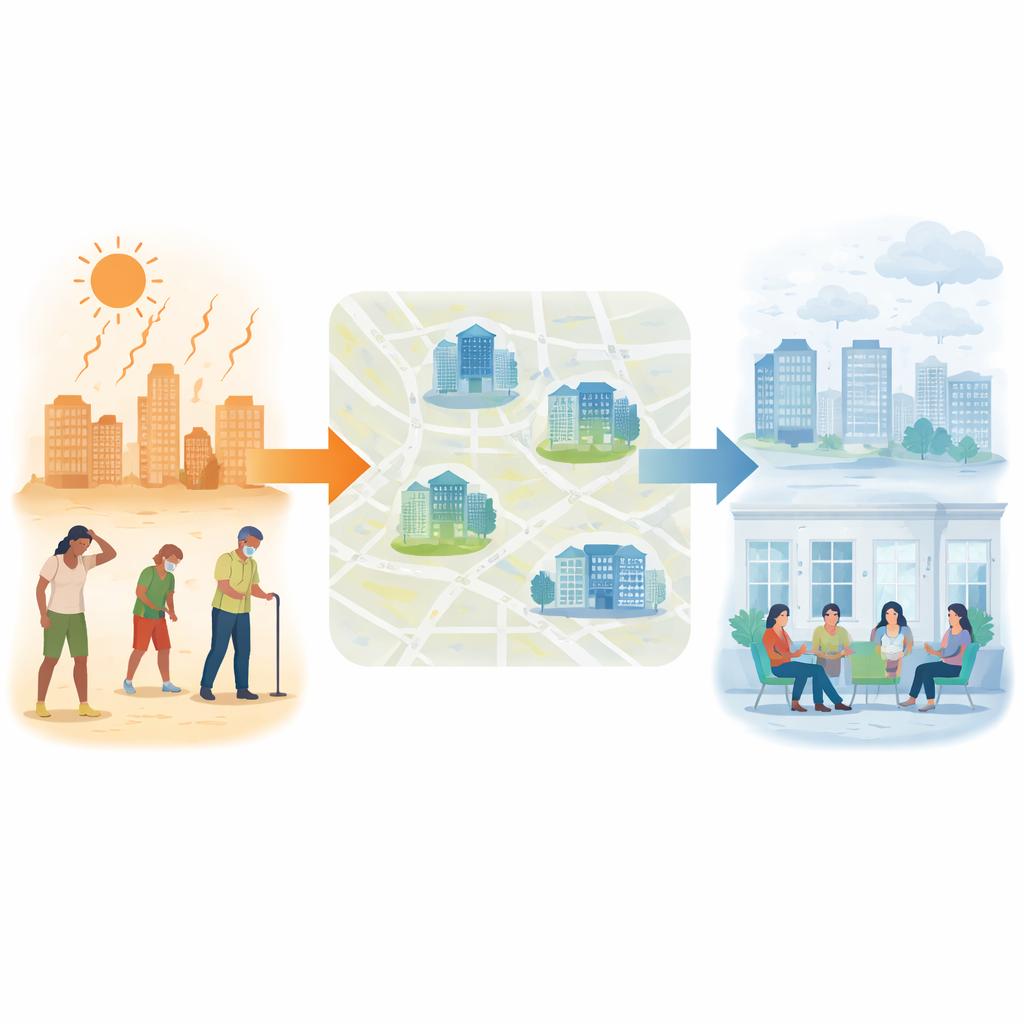
As heatwaves, floods and storms grow more intense, our safety increasingly depends on having nearby indoor places where we can cool down, warm up or simply wait out dangerous weather. This article explores a new way to design and improve networks of such “climate shelters” in cities, using Bilbao in northern Spain as a test bed and then extending the approach to more than a hundred cities around the world.
Everyday buildings as havens from extreme weather
The authors focus on indoor climate shelters: ordinary buildings like libraries, community centers, schools, places of worship, museums or subway entrances that meet basic standards for comfort and free public access. To count as a true shelter, a place must provide a controlled indoor temperature, good air, drinking water, seating, toilets and barrier‑free entry, ideally during the hottest hours and on weekends and holidays. Many cities have started to name such refuges, but they rarely examine how well these spaces are distributed across neighborhoods or when, exactly, they are open. The study sets out to close this gap by treating shelters as essential public infrastructure that should be planned with the same care as transport or health services.
A digital model of a walkable city under stress
To understand who can realistically reach a shelter, the team builds a detailed digital model of Bilbao using open mapping data. They catalog thousands of residential buildings and identify both the indoor shelters already recognized by the city and many additional sites that could serve as refuges. Crucially, they measure walking distances along the street network rather than “as the crow flies,” and they factor in each building’s timetable over the year—winter, summer, holidays and different hours of the day. This allows them to ask a simple but powerful question: at a given hour on a given kind of day, how many homes have at least one shelter within a reasonable walking distance, taken here as 300 meters?
Revealing hidden gaps in protection
The analysis shows that headline figures can be misleading. While official numbers suggested that almost all residents of Bilbao live within 300 meters of a climate refuge, that estimate blended indoor and outdoor spots and ignored real walking routes and opening times. When the authors look only at indoor sites, use the street network and ask whether a shelter is actually open, average coverage drops to about one in five residential buildings over a typical day, and to barely more than one percent in the early hours of the morning. Adding all feasible buildings that could serve as shelters boosts potential coverage dramatically, revealing that the city already has the bricks and mortar needed for a robust network—the challenge is choosing the right mix and hours of operation.
A simple rule with powerful results
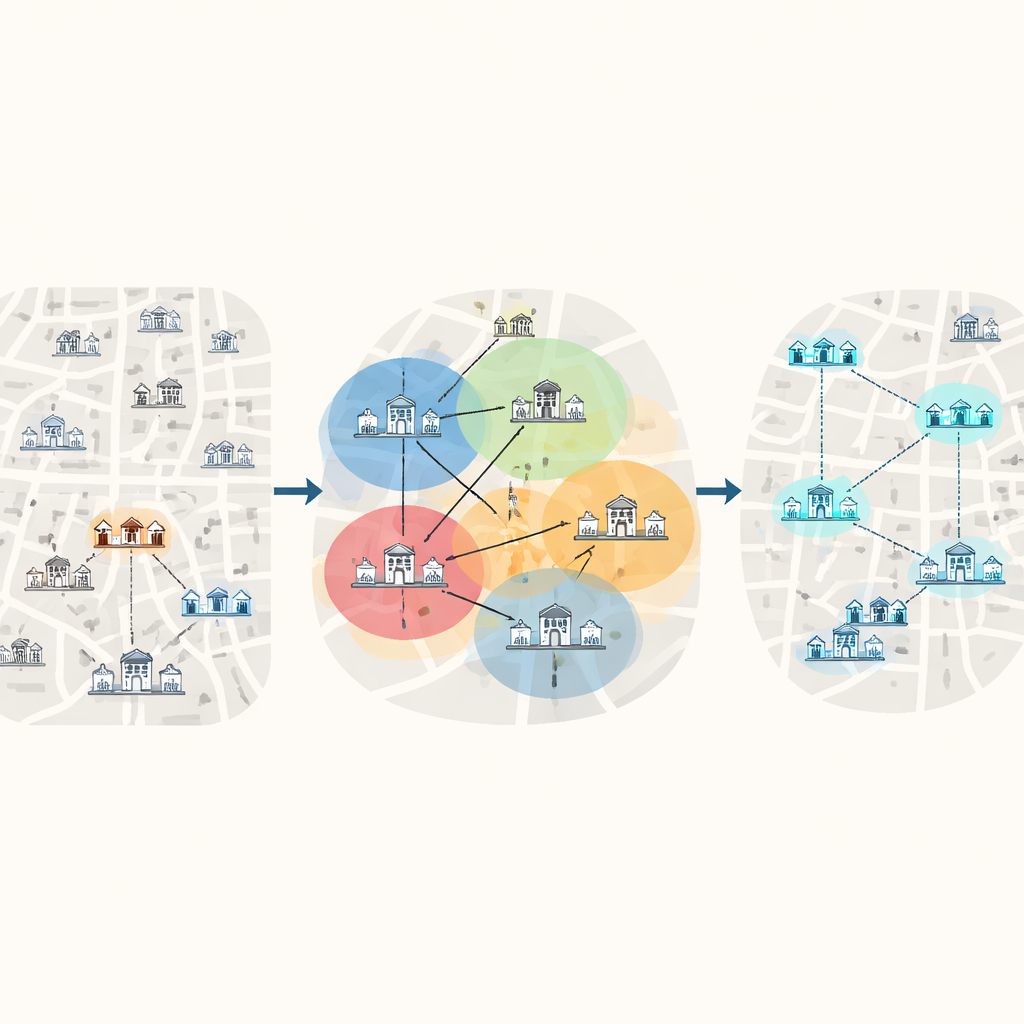
Using an optimisation procedure, the researchers test which types of buildings do the most to close the gaps. In Bilbao, three stand out: places of worship, schools and subway entrances. If these three categories alone were kept open as shelters around the clock during severe weather, coverage would jump from roughly 20% to almost 70% of residential buildings within 300 meters. The authors label this streamlined recipe the “Bilbao Strategy” and then apply it, in purely numerical form, to 131 small and medium‑sized cities on different continents and in diverse climate zones. Even without tailoring, the strategy achieves more than 60% of each city’s theoretical maximum coverage in about three‑quarters of the cases, and more than 40% in almost all of them. Dense, walkable cities benefit most, while car‑oriented and very low‑density places see smaller gains.
What this means for future urban life
The study concludes that cities do not necessarily need to build new, specialized refuges to shield people from climate extremes. Instead, by carefully mapping where people live, which buildings already exist, how streets connect them and when doors are open, local governments can quickly assemble effective shelter networks from familiar public and semi‑public spaces. The Bilbao Strategy is not a one‑size‑fits‑all answer—political, cultural and practical concerns will shape which buildings can be used and when, and future work must consider issues like crowding, staffing and fairness. But the core message is straightforward: with thoughtful planning and cooperation, the city we already have can be re‑wired into a safety net that helps everyone weather an increasingly turbulent climate.
Citation: Divasson-J, A., Macarulla, A.M., Garcia, J.I. et al. Seeking protection in times of turbulence: A methodology to assess and optimise the location of indoor climate shelters. npj Urban Sustain 6, 51 (2026). https://doi.org/10.1038/s42949-026-00356-7
Keywords: climate shelters, urban resilience, heatwaves, walkable cities, Bilbao Strategy