Clear Sky Science · en
Cooling potential of global urban roof greening
Why greener roofs matter for city life
More than half of the world’s people now live in cities, and many of those cities are getting dangerously hot. Heat absorbed by buildings and pavement makes urban areas several degrees warmer than their surroundings, increasing health risks and energy use. This study asks a simple but powerful question: what if we could turn a large share of the world’s rooftops into gardens, and how much would that actually cool our cities?
Turning unused roof space into climate helpers
City streets feel hot partly because there is so little exposed soil and vegetation. Parks, trees, and ponds can cool the air, but ground-level space is scarce in dense downtowns. Rooftops, however, cover roughly a quarter of urban land worldwide and are mostly bare. The idea behind green roofs is to use soil and plants on top of buildings to soak up heat, evaporate water, and shade the surfaces below. Cities like Basel and Toronto have already started requiring vegetation on new buildings, suggesting that large-scale roof greening could be a realistic way to fight urban heat.
Measuring cooling from space
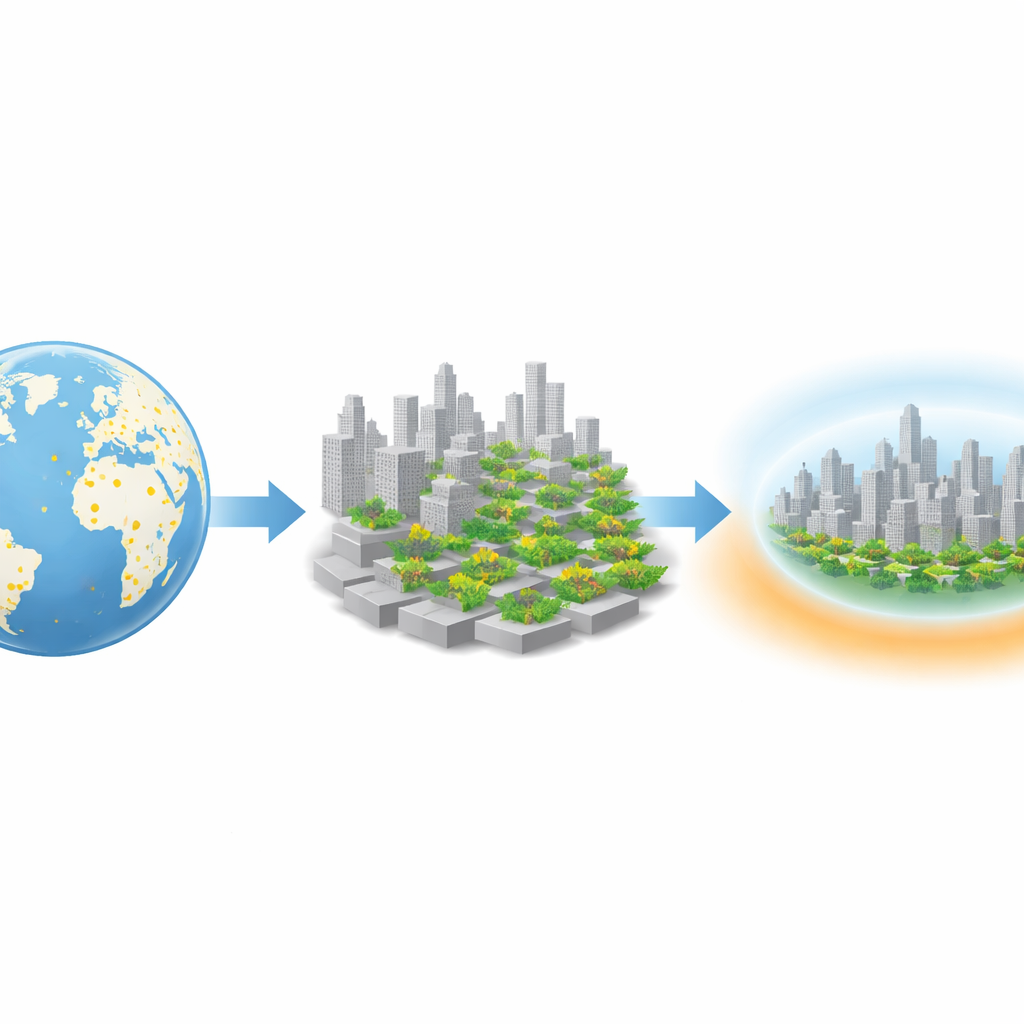
To see what green roofs could do globally, the researchers combined ultra-detailed maps of building footprints with satellite measurements of land surface temperature and vegetation. For nearly five thousand cities, they examined how summer surface temperatures change as the amount of greenery increases, while also accounting for building height, density, materials, and local elevation. They then treated rooftops as potential new green space and tested three levels of greening: covering 20, 40, or 60 percent of each roof with plants, based on existing real-world policies.
How much cooler cities could become
The analysis shows that if cities green even a modest share of their roofs, they can meaningfully lower surface temperatures. Across all cities, average daytime land surface temperatures dropped by about 0.6 °C under the lowest greening scenario, 1.1 °C under medium greening, and 1.6 °C under the most ambitious scenario considered. At night, the cooling was smaller but still noticeable, ranging from about 0.1 to 0.4 °C. Cities near the equator, where sunlight is intense and air is often humid, stood to gain the most, because plants in those climates can drive strong evaporative cooling. Places with more existing vegetation and more rooftop area also showed higher potential benefits, especially during the day.
Who benefits from cooler roofs
The study goes beyond physics to ask how many people would actually feel the difference. By multiplying cooling potential by the number of people living in each urban area, the authors estimated a “cooling benefit” for city residents. Although continents like Oceania and South America have some of the strongest physical cooling potential, the largest human benefits are found in Africa, Asia, and Europe, where cities are more crowded. As greening levels rise from 20 to 60 percent of rooftop area, the number of cities where large urban populations enjoy strong cooling grows quickly, hinting at the public-health value of investing in rooftop plants, especially in hotter, low-latitude regions.
Smoothing out harsh temperature swings
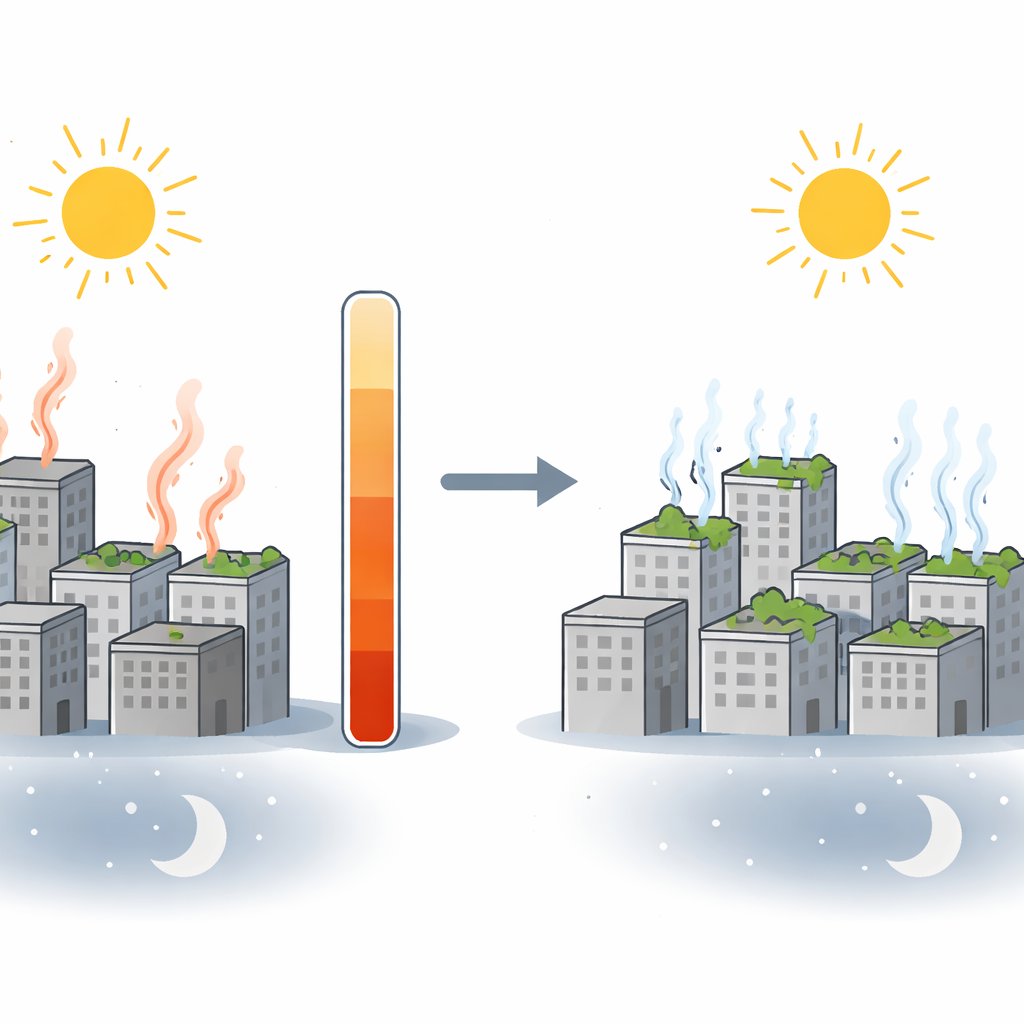
Another key finding is that green roofs can soften the daily whiplash between hot days and cooler nights. Because roof vegetation cools daytime temperatures more than nighttime ones, it reduces the gap between day and night, known as the diurnal temperature range. For hundreds of cities with the most reliable data, this range shrank by about 0.4 °C under low greening and by more than 1 °C under the high scenario. Fewer abrupt temperature swings mean less stress on the human body and potentially lower risks of heat-related illness. The authors estimate that tens of millions of people could experience these reduced day–night extremes if green roofs were widely adopted.
What this means for future cities
The study concludes that turning rooftops green could be a practical and powerful way to cool cities worldwide, especially when combined with careful engineering, smart plant choices, and supportive policies. While not every roof can be safely or affordably retrofitted, even partial coverage offers measurable relief from rising urban heat and helps narrow dangerous day–night temperature swings. In simple terms, the world’s roofs represent an underused surface that, if planted, could make city life safer and more comfortable for hundreds of millions of people living in a warming climate.
Citation: Bai, H., Yu, Z., Nie, S. et al. Cooling potential of global urban roof greening. npj Urban Sustain 6, 49 (2026). https://doi.org/10.1038/s42949-026-00354-9
Keywords: green roofs, urban heat, city cooling, climate adaptation, urban sustainability