Clear Sky Science · en
A 3D target-driven optimisation tool for tree planting location using temporal tree crown geometry development
Why Smarter Tree Planting Matters for City Life
Cities around the world are heating up, and trees are one of the simplest tools we have to keep streets cooler, cleaner, and more pleasant. But in dense urban areas, where space is tight and buildings cast long shadows, planting trees “wherever they fit” often wastes their potential. This paper introduces a new digital tool that helps planners decide exactly where to plant trees so their future crowns grow into the right places—providing shade, cooling, and comfort for decades without clashing with buildings, streets, or other uses.
From Flat Maps to Three-Dimensional Tree Goals
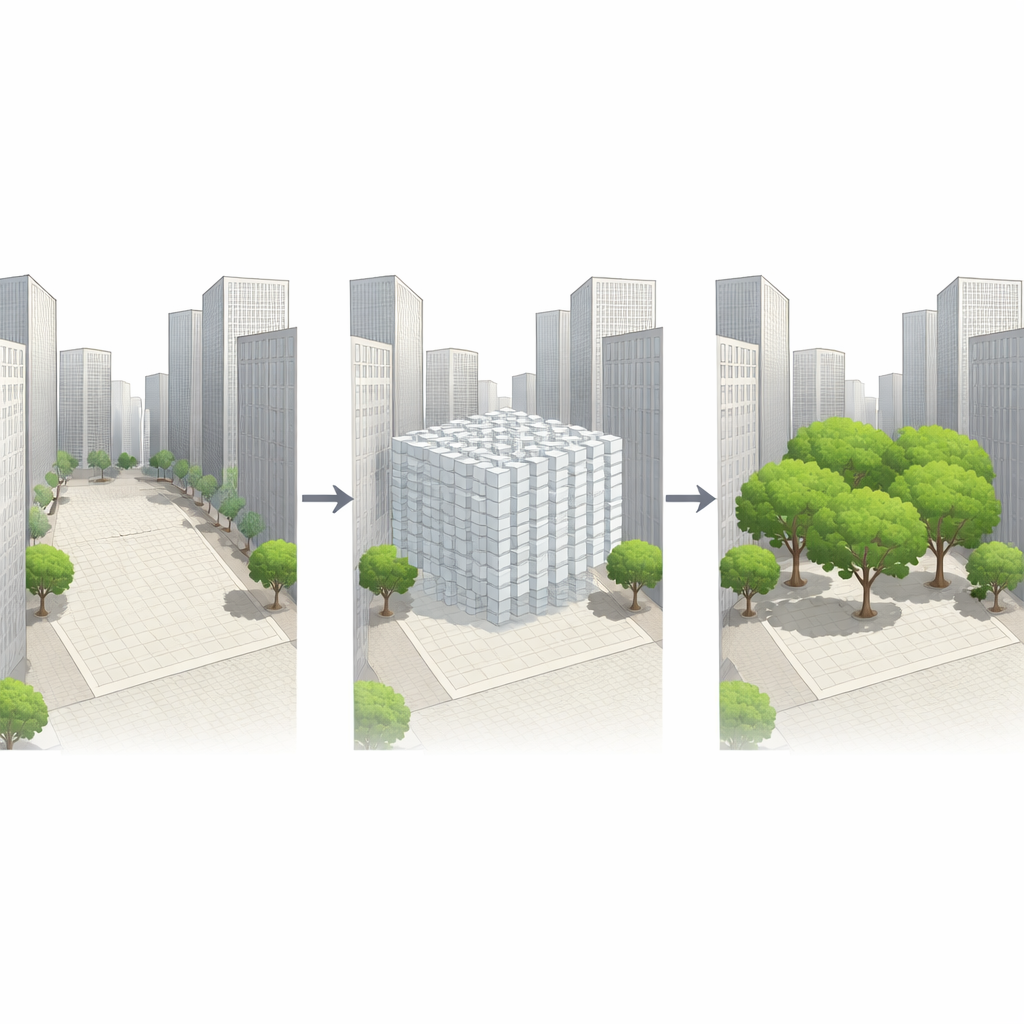
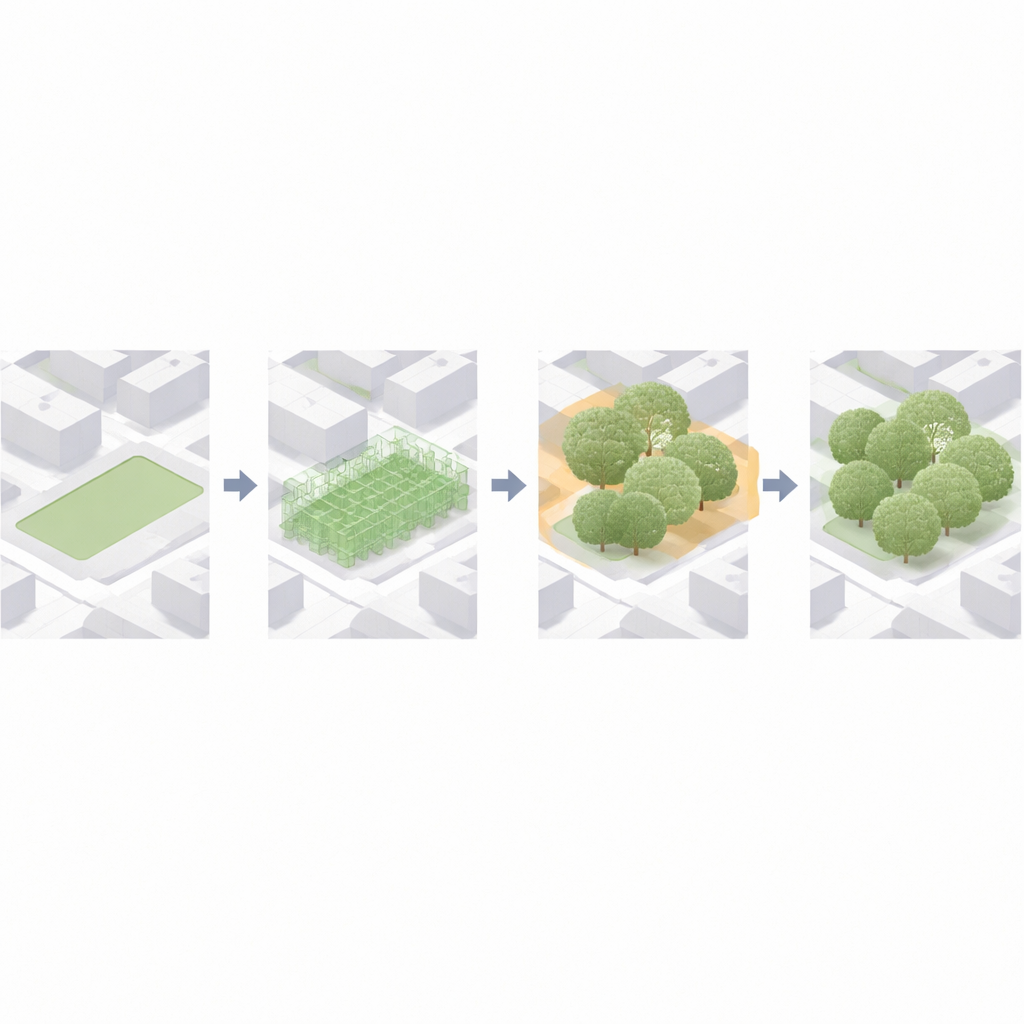
Most past efforts to plan urban trees have treated them like simple circles on a map, focusing on broad goals such as shading sidewalks, cooling parks, or protecting building facades. These methods typically optimize for a single benefit at a time and rely on simplified tree shapes. The new tool, called TreeML-Planter, flips the problem around: instead of asking, “What do we get if we plant trees here?”, it starts with a three-dimensional target—a volume in space where leaves are most useful—and then works backwards to find the best planting spots. This target is represented as a cloud of tiny cubes, or voxels, floating above the ground, indicating where the future canopy should and should not grow.
How the Digital Tree Planner Thinks Ahead
To reach those target voxels, the tool needs to know how real trees will grow in the messy environment of a city. It uses a machine-learning model trained on detailed 3D scans of thousands of urban trees to predict crown size and shape in different directions, depending on the species, age, and nearby buildings or trees. For each possible planting point on a grid, the model estimates how the crown will expand over time—upwards, sideways, and around obstacles. These predicted crowns are then converted into the same cube-based system as the target, making it possible to compare what is desired with what each tree layout would actually produce in space.
Letting the Algorithm Shuffle Trees Around
Once the target canopy and growth predictions are set, TreeML-Planter uses an optimization routine that acts a bit like someone repeatedly nudging trees on a chessboard. It starts with random planting locations inside a defined planting area, ensuring trees are not too close to one another. For a given arrangement, it overlaps the predicted crowns with the target cube cloud and calculates how well they match using a score that rewards filling desired cubes and penalizes canopy spilling into forbidden zones. The algorithm then tests neighboring spots for each tree, keeping changes that improve the score and discarding those that do not. Over many runs, this “hill-climbing” process gradually homes in on tree layouts that best fill the desired canopy volume.
Testing the Tool in a Real Munich Square
The researchers tested their approach in a built-up square in central Munich, surrounded by four-story buildings with a largely open interior. They focused on two common urban species—small-leaved lime (Tilia cordata) and London plane (Platanus × hispanica)—and explored different numbers of trees and target ages, such as five, seven, or nine trees growing to 20, 40, or 60 years. The tool produced optimized planting locations and future crown shapes for each scenario. For lime trees, nine trees aiming for a 40-year crown gave the best match to the target canopy. For plane trees, nine individuals at 20 years performed best, reaching a high score more quickly in time. Interestingly, more trees or older ages did not always yield better results, highlighting how species traits and growth habits interact with the tight geometry of streets and buildings.
Limits, Challenges, and Future Possibilities
While powerful, the current tool has constraints. It demands substantial computing time, was validated only with data from Munich, and focuses on above-ground growth, leaving out the complex effects of roots, soil conditions, and buried infrastructure on tree health and crown shape. It also uses general growth equations that may not fully capture how individual trees respond to local stresses. Even so, the framework is flexible: future work could include more species, other cities, and smarter ways of generating the target canopy itself based on goals like reducing heat, improving comfort, or preserving sun for solar panels.
What This Means for Greener, Cooler Cities
In plain terms, this study shows that we can now design trees in cities not just as points on a map, but as evolving three-dimensional living structures. By setting a clear spatial goal for where leaves should end up and by predicting how different species grow around buildings over time, TreeML-Planter helps planners pick planting spots that deliver long-lasting shade and cooling exactly where they are needed, while avoiding conflicts with streets, views, and infrastructure. If combined with climate and comfort simulations, such tools could guide the next generation of urban forests—making cities cooler, healthier, and more livable with every carefully placed tree.
Citation: Yazdi, H., Chen, X., Rötzer, T. et al. A 3D target-driven optimisation tool for tree planting location using temporal tree crown geometry development. npj Urban Sustain 6, 44 (2026). https://doi.org/10.1038/s42949-026-00350-z
Keywords: urban trees, microclimate cooling, tree planting design, 3D canopy modeling, urban sustainability