Clear Sky Science · en
From dominant edge expansion to increasing infilling: the driving forces behind built-up area fragmentation in Chinese cities
Why the Shape of Cities Matters
Across the globe, cities are spreading into surrounding countryside. But it is not just how much land they cover that matters—it is how they grow. This study looks at the expansion of built-up areas in 366 Chinese cities from 1995 to 2018 and asks a simple but important question: which kinds of growth make urban areas more chopped up and less friendly to nature and people, and which kinds help cities stay more compact and efficient?
Three Ways a City Spreads
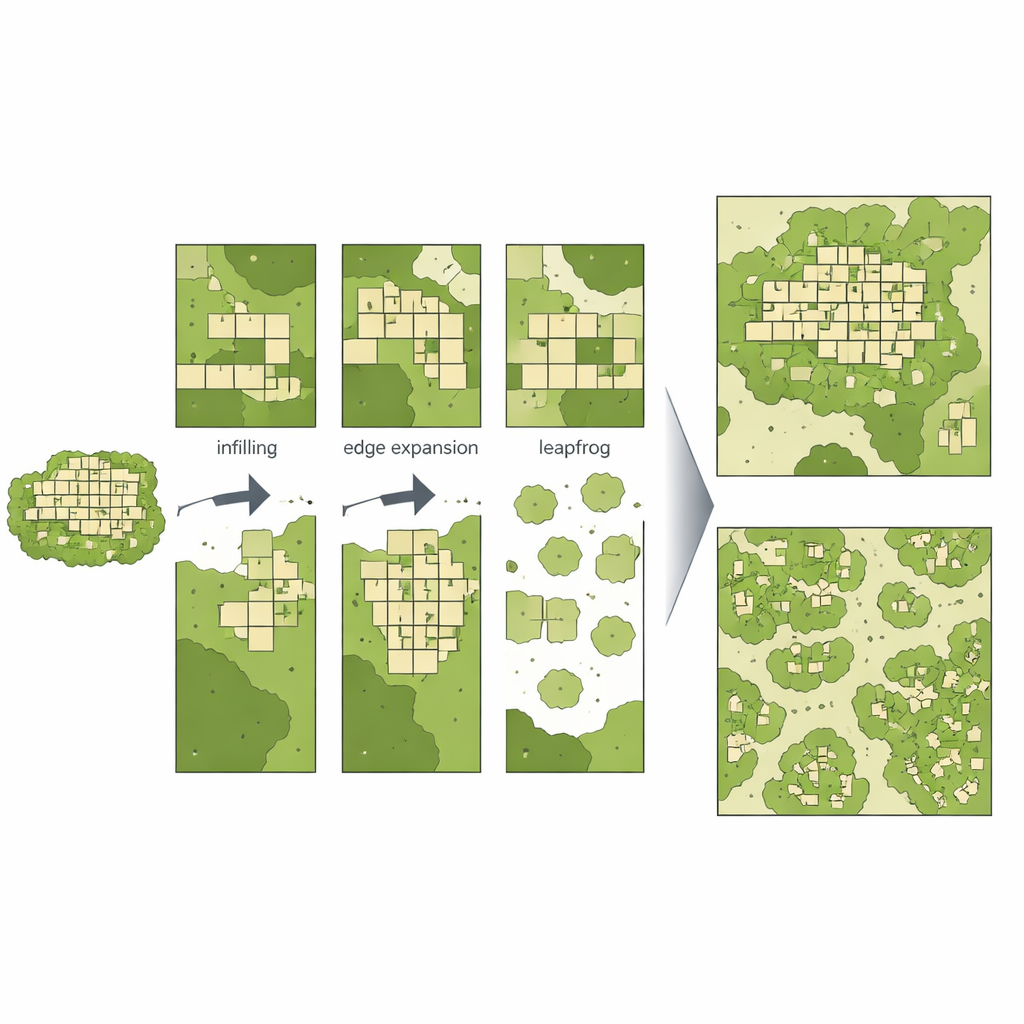
The authors focus on three basic patterns of city growth. In “infilling,” new buildings occupy empty pockets within existing urban areas, knitting separate parts together. “Edge expansion” adds development along the outer rim of the city, extending the urban fringe. “Leapfrog” growth is the most scattered: new built-up patches pop up far away from the main city, like islands in a rural sea. Using satellite images and nighttime light data, the researchers mapped these patterns for every city over more than two decades, tracking not only how big the built-up area became, but also how it broke into patches and how compact or irregular those patches were.
China’s Building Boom in Space and Time
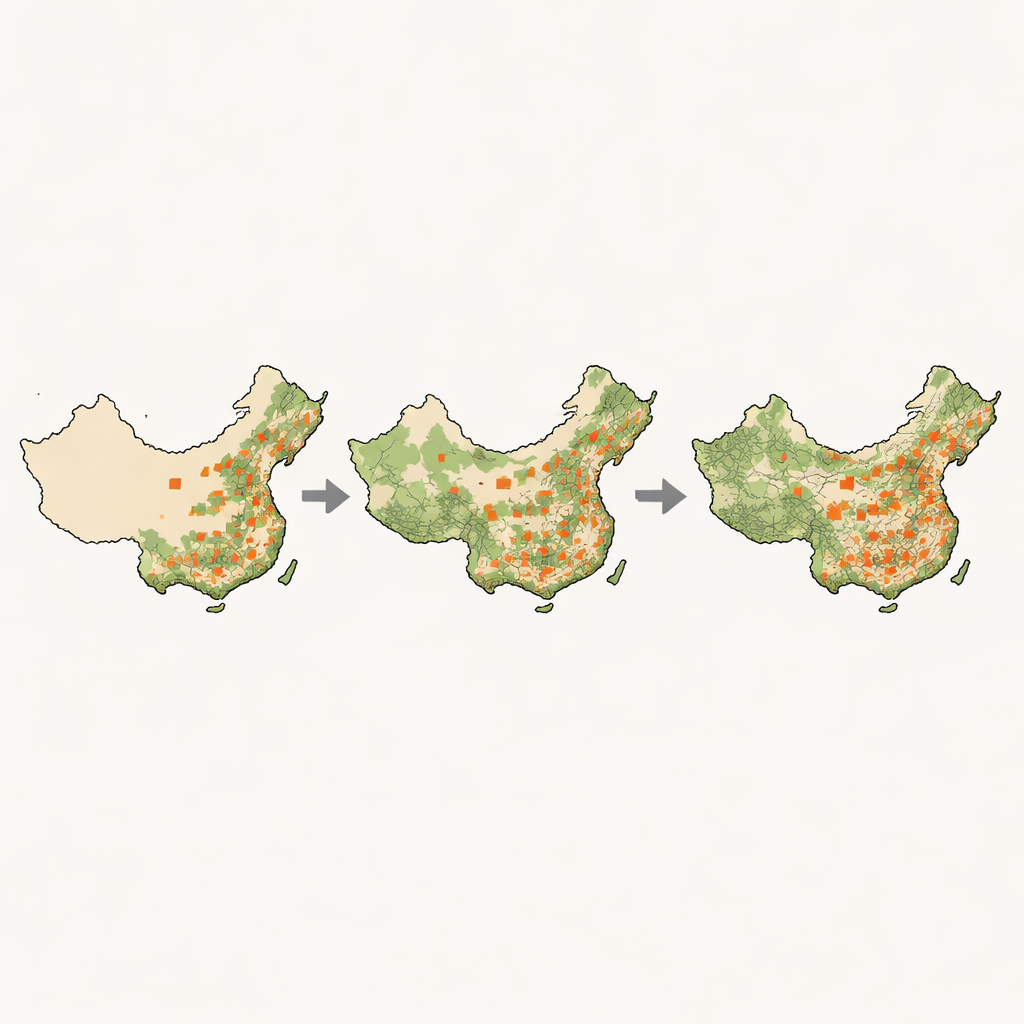
China’s built-up area nearly tripled during the study period, rising by about 148,000 square kilometers. Early on, especially between 1995 and 2000, growth was dominated by leapfrog and edge expansion. Cities tended to push outward in scattered fashion, creating many separate urban patches. From 2000 to 2010, edge expansion took the lead, reflecting more continuous growth around city fringes, while infilling slowly gained ground in larger, more developed cities. After 2010, a shift became clear: infilling rose sharply, especially in big eastern cities where land became scarce and policies began to favor denser, more efficient use of space. Leapfrog growth declined for a time, though it later rebounded somewhat in smaller and less regulated cities.
How Fragmented Landscapes Take Shape
This rapid growth was accompanied by a marked rise in fragmentation. The number of separate urban patches in an average city more than quadrupled, and the density of patches per square kilometer climbed as well. At the same time, the overall shape of built-up areas became less compact and more irregular, even though the largest central urban patch in each city remained relatively stable. In other words, cities kept their core areas but surrounded them with an increasing scatter of small, disconnected built-up spots. Eastern coastal cities, which urbanized earlier and faster, showed the strongest signs of this fragmented pattern.
What Drives Scattered Versus Compact Growth
To untangle what was causing these patterns, the authors used a statistical technique that separates direct and indirect influences. They found that infilling generally reduced fragmentation: where more growth filled gaps inside existing cities, the number and density of patches tended to fall and built-up areas became more compact. Leapfrog growth had the opposite effect, strongly linked to more and smaller urban patches and to looser, more scattered forms. Edge expansion played a milder role, slightly helping cohesion. Natural features like elevation and rugged terrain limited how widely cities could spread, often keeping forms more compact. In contrast, dense road networks made it easier for leapfrog growth to occur, opening up distant land to development. Economic size and population pushed cities to expand, but in larger cities they also encouraged infilling, which partly offset the damage from sprawl.
Guiding Cities Toward Smarter Growth
For non-specialists, the key takeaway is that not all urban growth is equal. The study shows that how cities expand—whether by filling in, stretching at the edges, or jumping outward in leaps—has a powerful impact on how fragmented the surrounding landscape becomes. Infilling can help keep cities more compact and connected, while leapfrog growth scatters development and strains ecosystems and infrastructure. By steering future development toward infilling and carefully managed edge expansion, and by limiting scattered building along new roads, planners and policymakers can support urban growth that is both economically strong and more sustainable for nature and everyday urban life.
Citation: Hu, Y., Hu, T., Xue, F. et al. From dominant edge expansion to increasing infilling: the driving forces behind built-up area fragmentation in Chinese cities. npj Urban Sustain 6, 39 (2026). https://doi.org/10.1038/s42949-026-00346-9
Keywords: urban expansion, landscape fragmentation, China cities, urban sprawl, sustainable planning