Clear Sky Science · en
Growing together: how urban green spaces enhance social participation and alleviate loneliness in older adults
Why parks matter for growing older
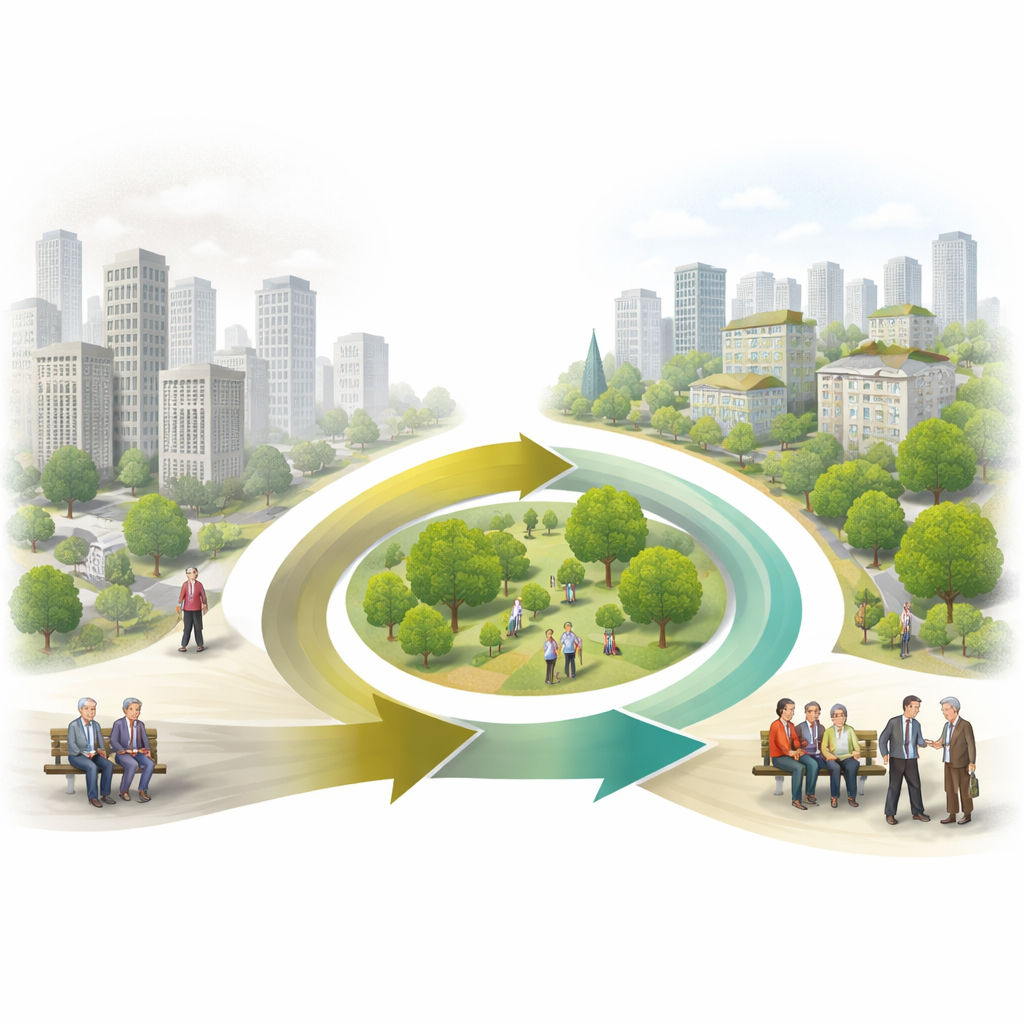
As cities in China grow taller and denser, millions of older adults are spending more time indoors and often alone. This study asks a simple but important question: can trees, parks, and other green spaces in cities help older people feel less lonely? By following thousands of older Chinese adults over several years, the researchers explore how city greenery, air pollution, and chances to join social activities all connect to feelings of loneliness. Their findings offer clues for how urban design might support healthy, connected aging in rapidly changing societies.
City life, aging, and feeling alone
China is aging at an unprecedented pace. Families are smaller, many older parents live apart from their adult children, and traditional support systems are under strain. In this setting, loneliness is no longer just a private feeling; it has become a public health concern linked to worse health, higher stress, and reduced quality of life. At the same time, cities are reshaping the daily environment for older adults. Some neighborhoods offer tree-lined streets and parks, while others are dominated by concrete and traffic. The study focuses on whether the amount of greenery in a city can help protect older residents from feeling isolated, and whether this pattern differs for people with different health conditions or living in different types of communities.
Following older adults over time
The research team used data from the China Health and Retirement Longitudinal Study, which tracks the lives of older adults across the country. They focused on over 11,700 people aged 60 and above who were surveyed in 2011, 2013, and 2015. Each participant reported how often they felt lonely, how satisfied they were with life, their health problems, and whether they joined social activities such as clubs, groups, or informal gatherings. The researchers matched this information with city-level data on how much of each built-up area was covered by vegetation, as well as typical levels of fine particle air pollution (PM2.5). Using statistical models designed for repeated observations, they examined how changes in city greenness were linked to changes in loneliness, while accounting for age, income, marital status, health, and other factors.
What greener cities seem to offer
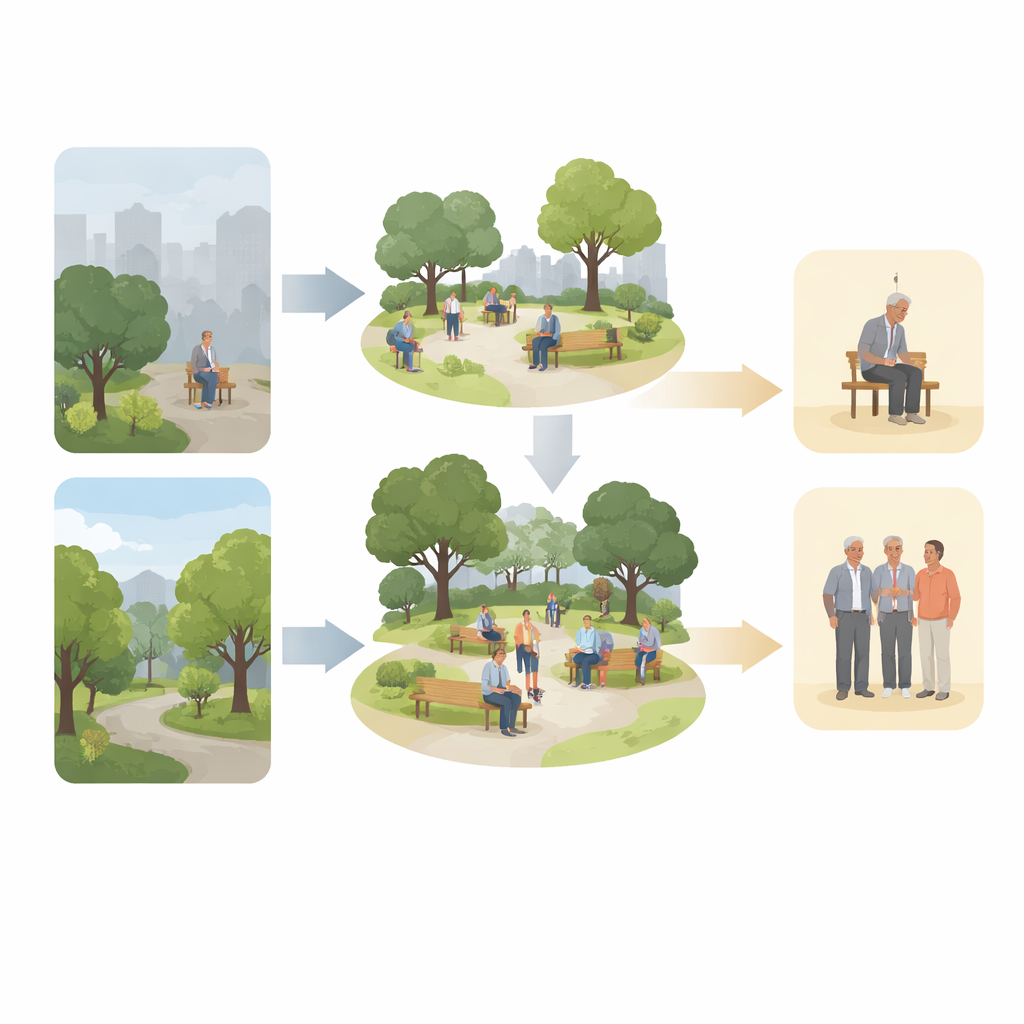
The results show a modest but consistent pattern: older adults living in cities with more green coverage tended to report slightly lower loneliness scores. This small protective effect remained even after adjusting for many other influences, including health status and air quality. However, the impact of greenery was far smaller than that of core social factors. Being married, having better self-rated health, and having fewer difficulties with daily tasks all showed much stronger links to lower loneliness than city greenness did. The study also suggests that green spaces may encourage older adults to get out and take part in social activities, which in turn can help reduce feelings of isolation. Yet this indirect pathway was small—only a tiny share of the greenness–loneliness link—and it weakened in cities with higher air pollution, where going outside may feel less appealing or safe.
Who benefits most from greenery
Not all older adults seemed to benefit in the same way. The negative link between green coverage and loneliness was clearest for people in their sixties, and for those without serious chronic illnesses such as diabetes or heart disease. For those with major health problems or severe mobility limits, the association was weaker and often uncertain. This suggests that simply living in a greener city is not enough; older adults also need the physical ability and confidence to use outdoor spaces. The study found broadly similar small benefits for both urban and rural residents, hinting that greenery matters across different settings but rarely transforms people’s emotional lives on its own.
Limits of the evidence and what should change
The authors stress that their data cannot prove that greenery directly causes lower loneliness. Greenness was measured at the city level, not at the scale of specific parks or sidewalks that people actually use, and the surveys did not capture how often or how long older adults visited green spaces. It is also possible that healthier, less lonely people are more likely to move to greener cities. Even so, the consistency of the results across several measures of vegetation suggests that greenness is a meaningful part of the wider context shaping later-life well-being. The findings also highlight that air pollution can blunt the social and emotional value of green spaces, underscoring the need to consider environmental quality as a whole.
Small boosts that add up
For lay readers and policy makers, the take-home message is nuanced. Greener cities are linked to slightly lower loneliness among older adults, but they are no substitute for strong relationships, good health care, and social support programs. Parks, trees, and inviting streets can provide gentle encouragement to go outside, bump into neighbors, and feel part of a shared community—especially when the air is clean enough to enjoy them. As societies age, combining urban greening with efforts to improve air quality and create inclusive social activities may offer a practical way to help older adults feel a little less alone, even if the effect of greenery on its own is modest.
Citation: Chen, Y., Yin, C. & Ye, Y. Growing together: how urban green spaces enhance social participation and alleviate loneliness in older adults. npj Urban Sustain 6, 57 (2026). https://doi.org/10.1038/s42949-026-00343-y
Keywords: urban green space, older adults, loneliness, China, air pollution