Clear Sky Science · en
Grounding Urban wetlands as nature-based solutions: enhancing accessibility to nature in Concepción, Chile
Why hidden wetlands matter to city life
For many city dwellers, a short walk in a green place can ease stress, improve health, and create a sense of belonging. Yet in fast-growing cities, especially in the Global South, not everyone can easily reach a park. This article explores how often-overlooked urban wetlands in Concepción, Chile, can act as everyday nature close to home, helping narrow long‑standing gaps in who benefits from green spaces.
City nature beyond traditional parks
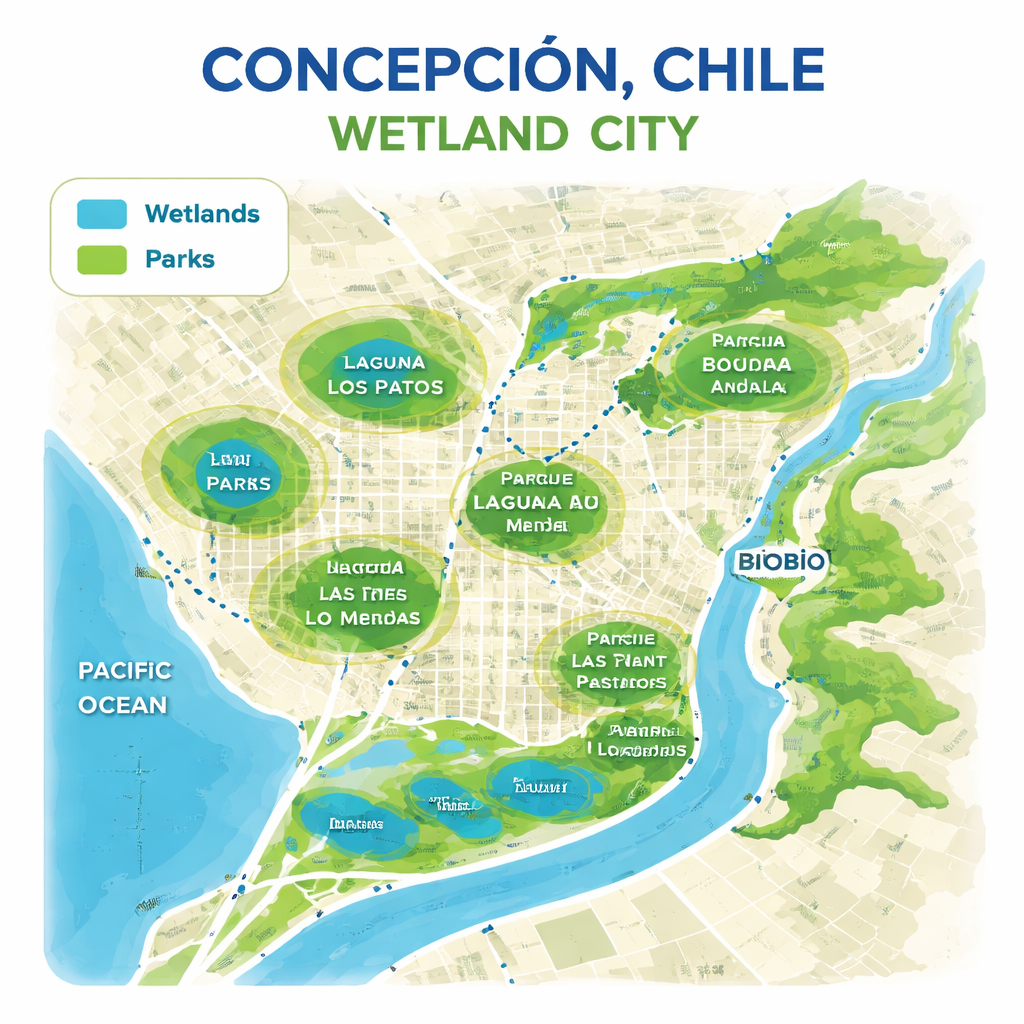
City greenery is usually imagined as lawns, trees, and formal parks laid out by planners. But many cities are also threaded with natural features such as rivers, lagoons, and marshy lowlands. In Concepción—a coastal metropolitan area of about one million people—wetlands weave through both central and edge neighborhoods. Despite offering beauty, wildlife habitat, and cooler microclimates, most of these wetlands are not officially recognized as public green spaces. That means they are rarely counted when officials measure access to nature, and they often lack paths, signs, or basic care, which can fuel a sense of neglect or insecurity among residents.
Measuring real‑world access on foot
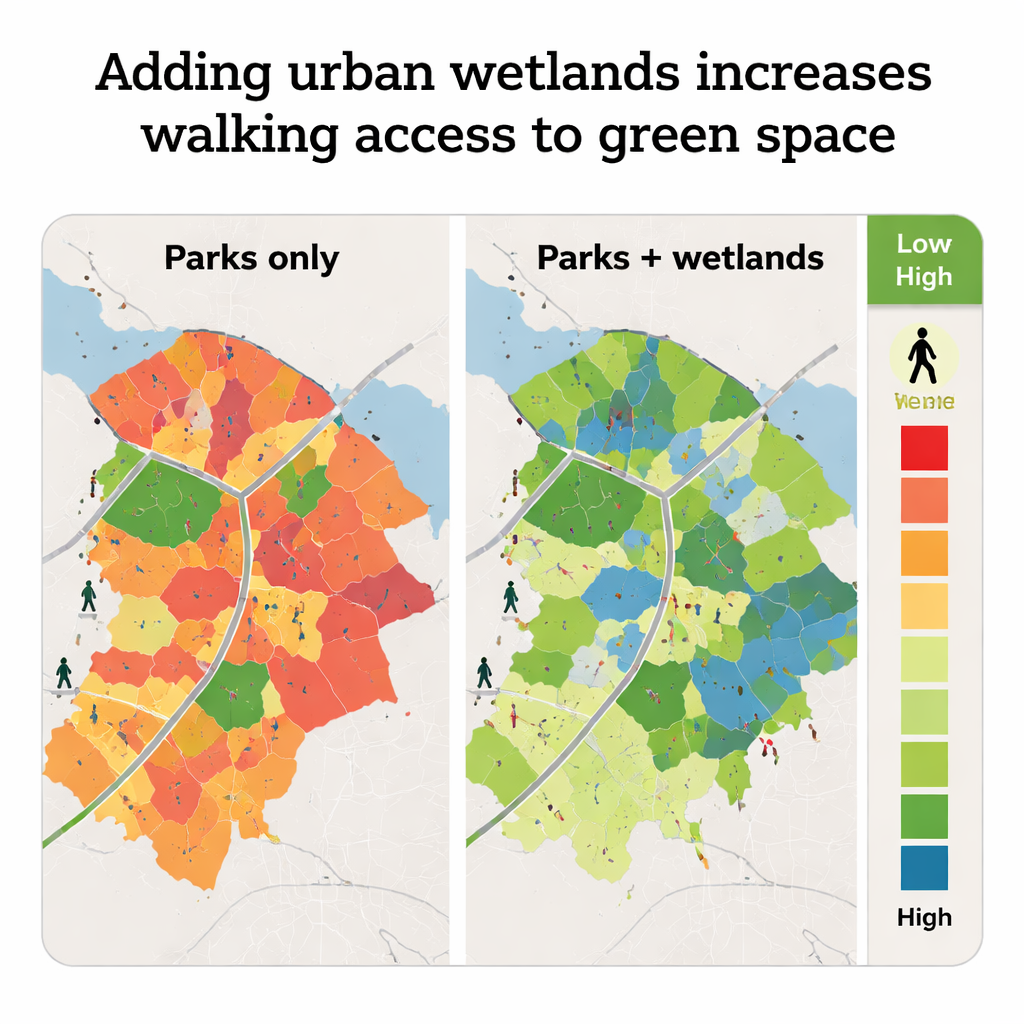
The researchers set out to see how nature access would change if wetlands were fully included in the city’s green network. Rather than simply drawing circles around parks on a map, they used detailed travel survey data from tens of thousands of daily trips made by local residents. Focusing only on walking trips, they asked how far different kinds of people usually walk and which green areas fall within a 5–10 minute stroll. They compared two scenarios: one with only formal parks and small green squares, and another that also treated urban wetlands as reachable destinations for everyday visits, such as a quick walk, a chat with neighbors, or time spent watching birds and water.
Who gains when wetlands count
To unpack differences in people’s lives, the team built a set of “profiles” combining age, gender, job status, and whether someone had a driver’s license—a stand‑in for broader mobility and independence. Using a machine‑learning method called Random Forests, they estimated the size of green areas each profile could realistically reach on foot. Across the city, they found sharp inequalities. People who were unemployed, older, and without a driver’s license—especially women—were stuck with the smallest accessible green surfaces. By contrast, employed adults with licenses could get to much larger areas of nature. When wetlands were added to the picture, accessible green space increased for nearly all profiles, but the gains were most meaningful for residents who depend on walking and live in park‑poor neighborhoods at the urban fringe.
Wetlands as neighborhood lifelines
The maps produced by the study show that wetlands work as “grounded” nature‑based solutions: they are already present in the landscape and, when treated as public spaces, they can rebalance who has nature nearby. In several peripheral districts of Concepción, wetlands sit close to housing where formal parks are scarce. Once counted, these areas substantially enlarge the green territory reachable on foot for vulnerable groups, including unemployed adults, women without access to cars, and many older residents. The effect is not uniform—some high‑mobility groups benefit more, and better‑off profiles still enjoy greater choice—but wetlands clearly help close some of the starkest gaps in green access.
What this means for fairer, greener cities
For non‑experts, the key takeaway is simple: the way we draw city maps changes who we see as having nature in their lives. In Concepción, treating wetlands as part of the public green system turns overlooked marshes into everyday refuges that support health, social contact, and climate resilience. The study shows that planning rules, paths, and protections that formally include wetlands can help extend the benefits of nature to people who walk the most and own the fewest resources. While wetlands alone cannot erase deep social inequalities, they offer a practical, place‑based tool for making rapidly growing cities more inclusive, livable, and environmentally robust.
Citation: Quezada, C.R., Páez, A., Fuente, H.d.l. et al. Grounding Urban wetlands as nature-based solutions: enhancing accessibility to nature in Concepción, Chile. npj Urban Sustain 6, 32 (2026). https://doi.org/10.1038/s42949-026-00339-8
Keywords: urban wetlands, green space access, nature-based solutions, Concepción Chile, walking mobility