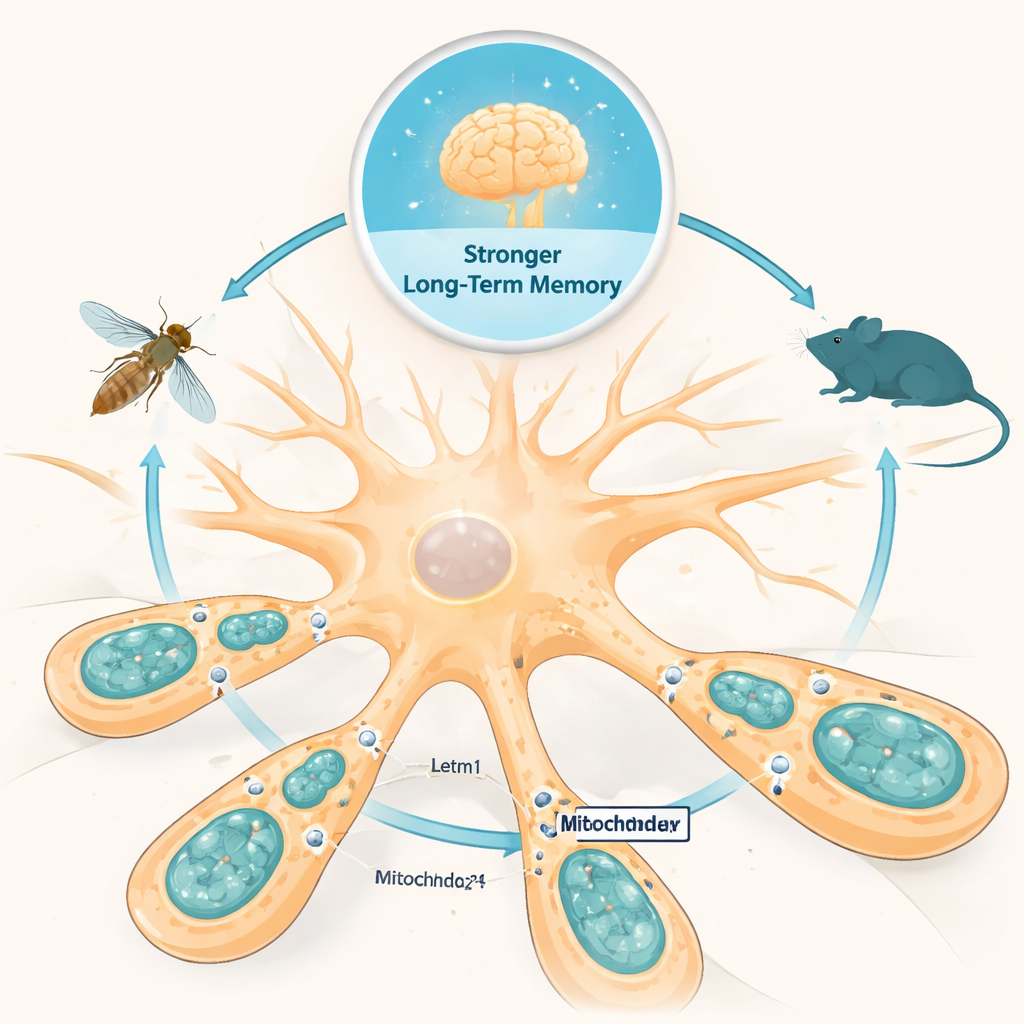
Remembering a first day at school or the smell of a dangerous food depends on long-term memories, which are surprisingly expensive for the brain to form. This study asks a provocative question: if memory needs a lot of energy, what happens if we deliberately boost the energy-making machinery inside key brain cells? By following the same molecular switch from fruit flies to mice, the authors show that gently turning up neuronal metabolism can make long-term memories stronger and longer lasting.
Power Stations Inside Nerve Cells Figure 1.
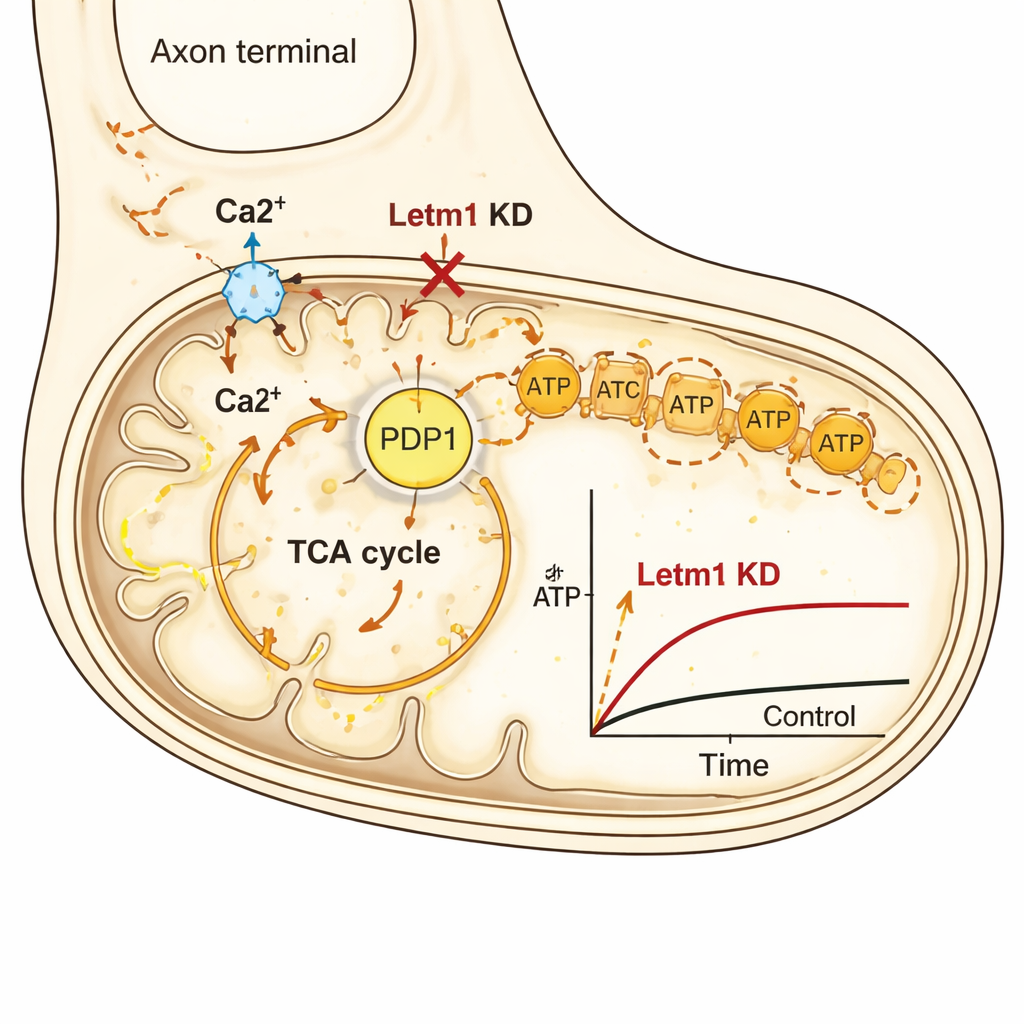
Every neuron is packed with mitochondria, tiny “power stations” that convert nutrients into the energy molecule ATP. When a neuron fires, calcium ions briefly flood parts of the cell and also slip into mitochondria. That calcium pulse tells mitochondria to ramp up fuel burning so the synapse has enough ATP to keep signaling. Once firing stops, calcium must leave the mitochondria again, or metabolism would stay revved up unnecessarily. The protein Letm1 sits in the inner mitochondrial membrane and helps pump calcium back out in exchange for protons, acting as a kind of exhaust valve that cools metabolism down after activity.
Slowing the Calcium Exit to Store More Fuel
The researchers asked what happens if this exhaust valve is partially closed. In rat hippocampal neurons, they reduced Letm1 using genetic tools and watched mitochondrial calcium and ATP in individual synapses. Neurons without normal Letm1 cleared calcium from their mitochondria much more slowly, even though calcium entry and baseline levels stayed normal. As a result, mitochondria in these axons kept running hot after activity and accumulated roughly twice as much ATP as in control cells. Experiments and computer models agreed that this ATP surplus appears whenever neurons fire at realistic brain-like rates, and that it depends on a calcium-sensitive enzyme, PDP1, which turns up the pyruvate dehydrogenase complex at the front end of the cell’s main fuel-burning cycle.
From Stronger Metabolism to Stronger Memories
To see whether this metabolic boost affects behavior, the team moved to living animals. In fruit flies, a single pairing of an odor with a mild electric shock normally produces only a short-lived memory. The authors selectively lowered Letm1 in mushroom body neurons, the fly’s central memory hub. After the same one-shot training, these neurons showed prolonged metabolic activation, and the flies formed robust 24-hour memories without altering their basic sensitivity to odors or shock. Intermediate, shorter-lived memories were unchanged, suggesting that Letm1 specifically gates the costly step of stabilizing long-term traces.
A Conserved Memory Switch in Mice Figure 2.
The story held up in mammals. Using viruses, the researchers reduced Letm1 only in excitatory neurons of the mouse hippocampus, an area critical for episodic and odor-based memories. Biochemical tests showed that these neurons had lower phosphorylation of pyruvate dehydrogenase, consistent with chronically higher mitochondrial activity. In an aversive odor-conditioning task, both normal and Letm1-deficient mice remembered the bad-tasting odor a day after training. But ten days later, only the Letm1 group still avoided it. Their movement, thirst, and basic responses to the odors were otherwise normal, pointing again to a selective strengthening of long-term memory storage.
Energy as a Hidden Gatekeeper of Memory
Taken together, the work reveals an evolutionarily conserved mechanism by which neurons tune the length of time they remember. By modestly slowing the exit of calcium from mitochondria, cells keep their internal engines running a bit longer after important experiences, stockpiling extra ATP and related metabolic signals that support the many hours of protein and synapse remodeling required for long-term memory. While such an enhancement might sound attractive, it also underscores why evolution usually keeps this valve more open: constantly encoding long-lasting memories is energetically costly and could lock in unhelpful associations. Still, the findings highlight mitochondrial calcium handling—and Letm1 in particular—as a potential handle for correcting memory loss in disorders where brain energy production falters.
Citation: Amrapali Vishwanath, A., Comyn, T., Mira, R.G. et al. Mitochondrial Ca2+ efflux controls neuronal metabolism and long-term memory across species.
Nat Metab8, 467–488 (2026). https://doi.org/10.1038/s42255-026-01451-w
Keywords: mitochondrial metabolism, neuronal calcium, long-term memory, Letm1, synaptic energy