Clear Sky Science · en
Sequential buckling in fluid-filled cylindrical shells
Why squashed drink cans matter
If you have ever stepped on a full drink can and watched neat rings appear around its middle, you have seen a surprisingly rich physics problem at work. Cylindrical shells, from soda cans to rocket bodies, are prized because they are light yet strong—but when they buckle, they can fail suddenly and dramatically. This study uses everyday beverage cans to uncover how liquid-filled metal shells develop a series of orderly corrugations under compression, and connects those patterns to a powerful mathematical framework for understanding patterns in nature.
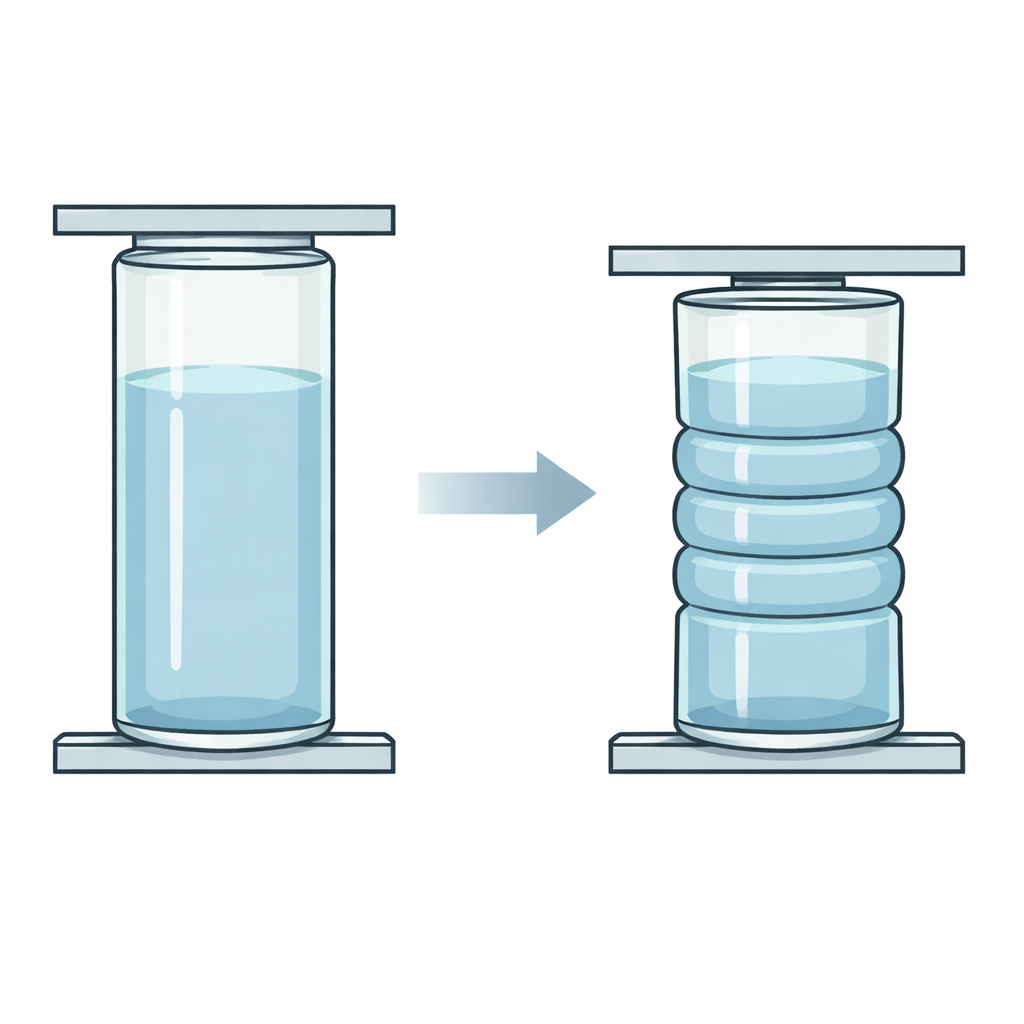
From smooth walls to ringed patterns
The researchers focus on thin metal cylinders that are at least partly filled with nearly incompressible liquid, like water or soda. In many classic studies, empty shells or shells with solid cores buckle all at once into diamond-shaped or evenly spaced patterns when pushed hard enough. By contrast, the buckling of liquid-filled shells has been largely ignored, even though such containers are common in industry and daily life. Here, the authors show that when a full can is squeezed along its length, it does not collapse everywhere at once. Instead, smooth walls give way to a series of ring-like folds that appear one after another along the cylinder.
Watching rings appear one by one
In the lab, the team compressed unopened and water-filled beverage cans of various sizes at different speeds, while measuring the force and filming the can profiles from the side. Regardless of whether the cans started pressurized (with carbonated drink) or at normal pressure (refilled with water), they displayed the same striking behavior. A first axisymmetric buckle usually emerged near the middle of the can at a modest strain of only a few percent. As compression increased, this initial ring grew to a fixed height, after which new rings appeared next to it, gradually marching along the can until almost the entire surface was covered. Each new buckle caused an abrupt drop in the measured force, followed by a rise as that buckle grew, leading to a sawtooth-like force–strain curve that mirrored the visual sequence of ring formation.
Measuring the rhythm of the pattern
By analyzing images of many tests, the authors extracted the distance between neighboring peaks of the rings and averaged it for each can geometry. They found that this spacing grows in proportion to the square root of the product of can radius and wall thickness, a classic length scale known from earlier work on wrinkling of pressurized shells. This scaling held for both initially pressurized and unpressurized cans, confirming that what really matters is that the interior behaves almost like an incompressible fluid. In other words, the liquid content prevents large volume changes and helps set the wavelength of the emerging corrugations, while the metal shell decides where and how they localize.
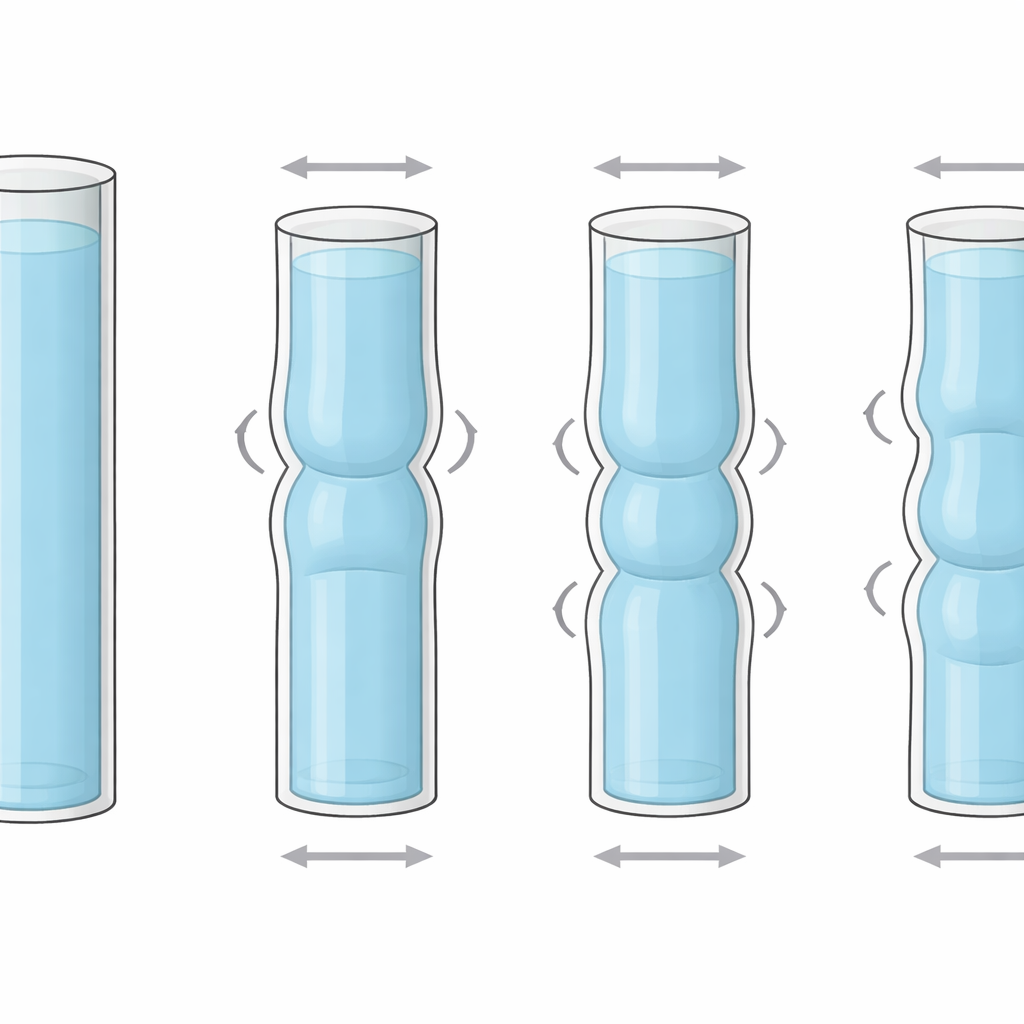
A mathematical lens on buckling
To uncover the underlying mechanism, the researchers built a simplified mathematical model of the can as a shallow cylindrical shell with axisymmetric deformations. They first measured how strips of the can’s metal respond when stretched around the circumference and bent along the axis. These tests showed that the material is anisotropic and nonlinear: it first softens and then stiffens as strain increases. They encoded this behavior in a reduced set of equations that, after some approximations, closely resemble the well-known Swift–Hohenberg equation, a central model in the study of pattern formation. Solving these equations numerically, with additional conditions that enforce nearly fixed volume and length, revealed many coexisting, spatially localized solutions that look like a few ripples confined to part of the cylinder.
Snaking through many possible shapes
The model predicts that as the applied compression increases, solutions appear in a sequence: first with one prominent undulation, then with more undulations spreading outward while each maintains a similar height and spacing. This behavior, known as homoclinic snaking, has been explored in idealized mathematical settings but rarely tied so directly to a real, everyday object. The predicted critical force and strain at which the first buckle forms agree reasonably with experiments, and the computed ring spacing matches the measured values. The analysis further shows that the key to sequential buckling is the combination of softening and re-stiffening in the hoop stress around the cylinder, rather than details of the internal pressure or imperfections alone.
What this means for cans and beyond
For a non-specialist, the main takeaway is that the orderly rings on a squashed full can are not just a curiosity—they are an example of a general way that patterns can localize and grow in complex materials. The work links simple compression tests on drink cans to a broad mathematical theory of how localized structures emerge and proliferate. Practically, the findings suggest that manufacturers might one day pattern filled containers into stronger, corrugated shapes without using dies or molds, by carefully harnessing material nonlinearities and internal fluid constraints. More broadly, the study offers a blueprint for re-examining other systems—such as thin films peeling from substrates or flexible structures in engineering—where similar step-by-step buckling may quietly be at work.
Citation: Jain, S., Box, F., Quinn, M. et al. Sequential buckling in fluid-filled cylindrical shells. Commun Phys 9, 114 (2026). https://doi.org/10.1038/s42005-026-02589-5
Keywords: buckling, cylindrical shells, fluid-filled structures, pattern formation, structural stability