Clear Sky Science · en
Finite integration time can shift optimal sensitivity away from criticality
Why timing matters for sharp decisions
Our brains, senses, and even many artificial devices face the same challenge: they must spot tiny differences in the world and turn them into reliable decisions, often in a fraction of a second. A popular idea in physics and neuroscience is that such systems work best when they sit right at the edge of a sudden change in their behavior, a so‑called critical point. This study asks a simple but overlooked question: if you only have limited time to observe a system’s response, is that edge really the best place to operate?
The sweet spot is not always at the edge
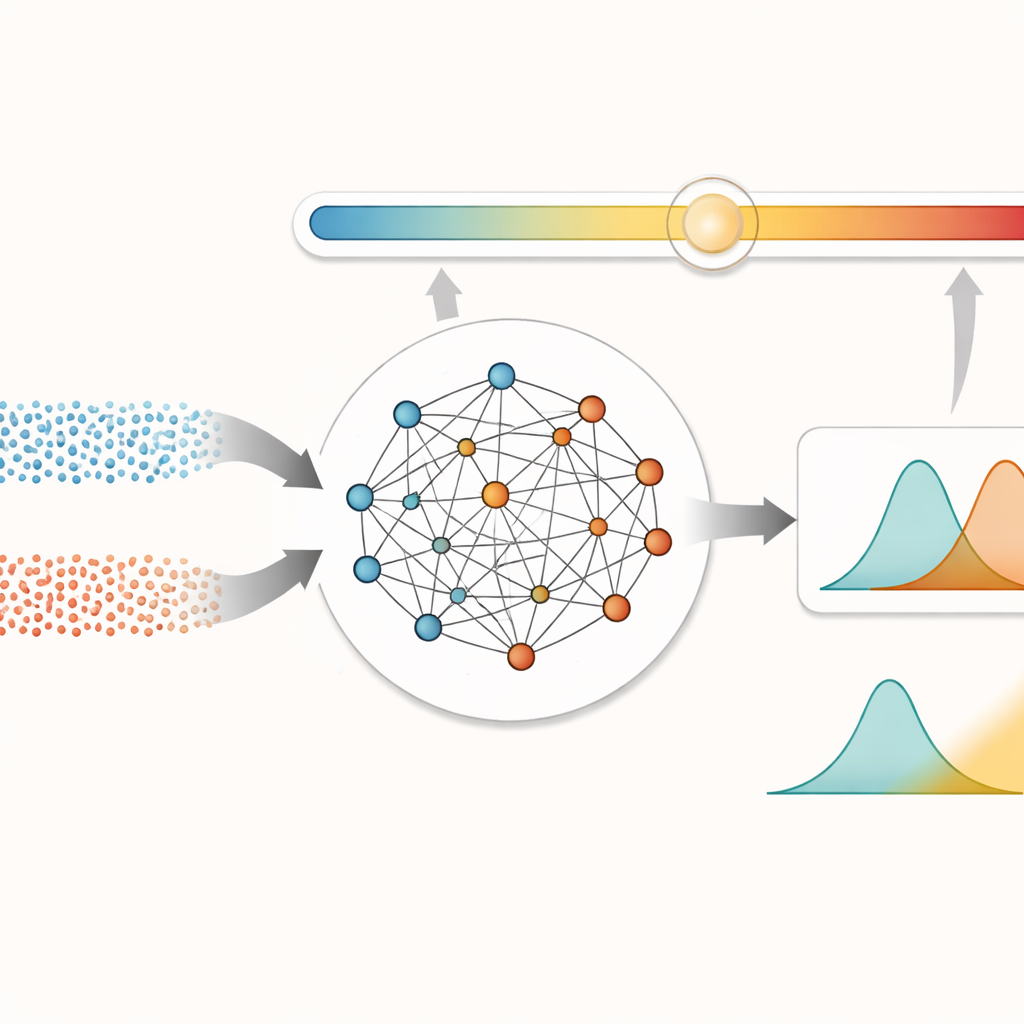
The authors study a simplified model of a brain‑like circuit: a large network of spiking units that excite one another in a loop. A small subset of units receives an external signal, such as the strength of a scent or a sound, and another subset provides the output. A separate readout unit does not react instantly; instead, it averages the output spikes over a chosen time window, much like a leaky bucket that slowly fills and drains. Two knobs control the system. One sets how strongly the units excite one another, which in turn sets how close the network is to a critical point where activity would explode or die out. The other sets how long the readout collects spikes before making a judgment.
When more sensitivity brings more confusion
Close to the critical point, the network becomes extremely sensitive to small changes in input, which is usually considered beneficial. But in this regime, the activity also fluctuates strongly and more slowly over time. The authors show that these internal jitters can scramble the signal if you only look for a short while. To quantify this, they define how easily an ideal observer could tell apart two different input strengths just by seeing the output, and they count how many distinct inputs can be reliably distinguished while keeping the probability of error below a chosen threshold. They then generalize the classic “dynamic range” measure, which describes the span of input intensities a system can encode, so that it explicitly accounts for these noisy fluctuations.
Time‑limited observers favor calmer networks
Using exact mathematics in two extreme limits—instantaneous readout and infinitely long averaging—together with extensive computer simulations in between, the authors chart how discrimination performance depends on both network coupling and readout time. For every finite observation time, they find that the best performance does not occur exactly at the critical point. Instead, there is an optimal “subcritical” setting where the network is still sensitive but its fluctuations are more contained, allowing the readout to form a clearer picture within the available time. As the integration window grows longer, this optimal point moves closer to criticality, because the readout has enough time to average over the wild fluctuations and benefit from the extra sensitivity.
Implications for brains and machines
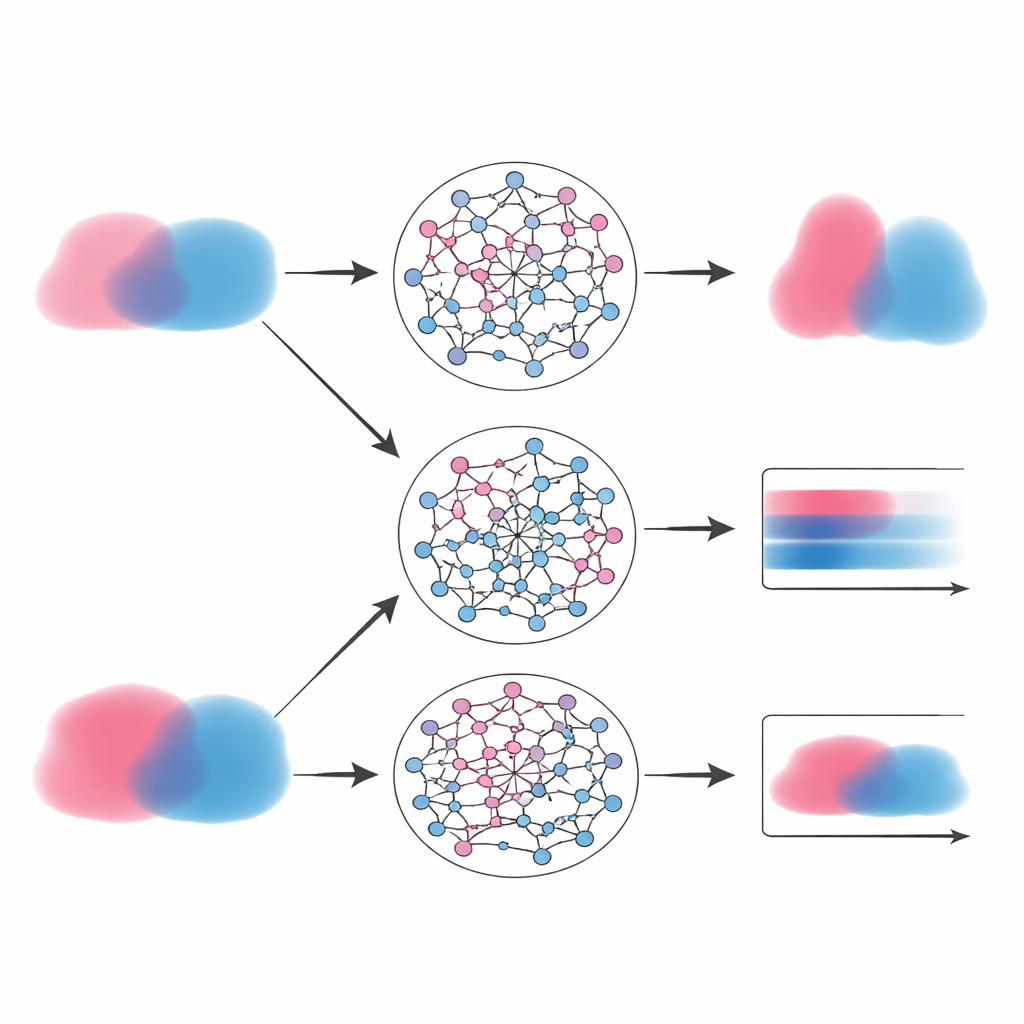
This trade‑off between sensitivity and reliability appears whenever a noisy system with strong internal interactions has to make decisions quickly. The authors argue that their findings help explain why measurements from real brains show finite processing timescales rather than infinitely slow, perfectly critical behavior. Many perceptual decisions in animals occur in well under a second, so networks that sit slightly away from criticality may offer a better compromise between speed and accuracy. The results also suggest design rules for artificial systems, such as recurrent neural networks and physical “reservoir computing” devices: if the readout is nearly instantaneous, the internal network should stay farther from criticality; if the readout can integrate over longer periods, the device can be tuned closer to the edge to gain sensitivity without sacrificing reliability.
Finding balance instead of perfection
In everyday terms, the study shows that “turning the volume up to eleven” on sensitivity is not always wise when you must decide quickly and cope with noise. For finite observation times, there is a sweet spot slightly below the most excitable state, where signals remain strong enough to notice but not so jittery that they blur together. This balance between being responsive and being trustworthy may be a general principle for how living and artificial systems tune themselves to the demands of real‑world tasks.
Citation: Azizpour, S., Priesemann, V., Zierenberg, J. et al. Finite integration time can shift optimal sensitivity away from criticality. Commun Phys 9, 119 (2026). https://doi.org/10.1038/s42005-026-02584-w
Keywords: criticality, neural networks, dynamic range, information processing, integration time