Clear Sky Science · en
Observation of higher-order exceptional points using frequency-dependent gain
Listening to Tiny Changes with Super-Sensitive Circuits
Many modern sensors, from medical implants to structural monitors, rely on tiny shifts in oscillating electrical circuits to detect changes in the world. This paper shows how to make such circuits dramatically more sensitive without resorting to complicated or noisy electronics. By cleverly using how a measurement device feeds energy back into a circuit, the authors boost a special kind of sensitivity known as a higher-order exceptional point, paving the way for sharper, more reliable sensing across electronics, photonics, acoustics, and mechanics.

What Makes These Circuits So Sensitive
The work builds on the idea of exceptional points, places where several natural oscillation modes of an open system collapse into one. Near an exceptional point, even a tiny disturbance can cause a disproportionately large change in the oscillation frequency, which is attractive for sensing. Most experiments so far have used relatively simple, second-order exceptional points and often relied on carefully balanced gain and loss in paired resonators. To reach even higher sensitivity, researchers have tried to engineer more complex setups or to use nonlinear amplifiers, but those routes can be fragile, noisy, and hard to tune in real devices.
A New Way to Feed Energy into the Circuit
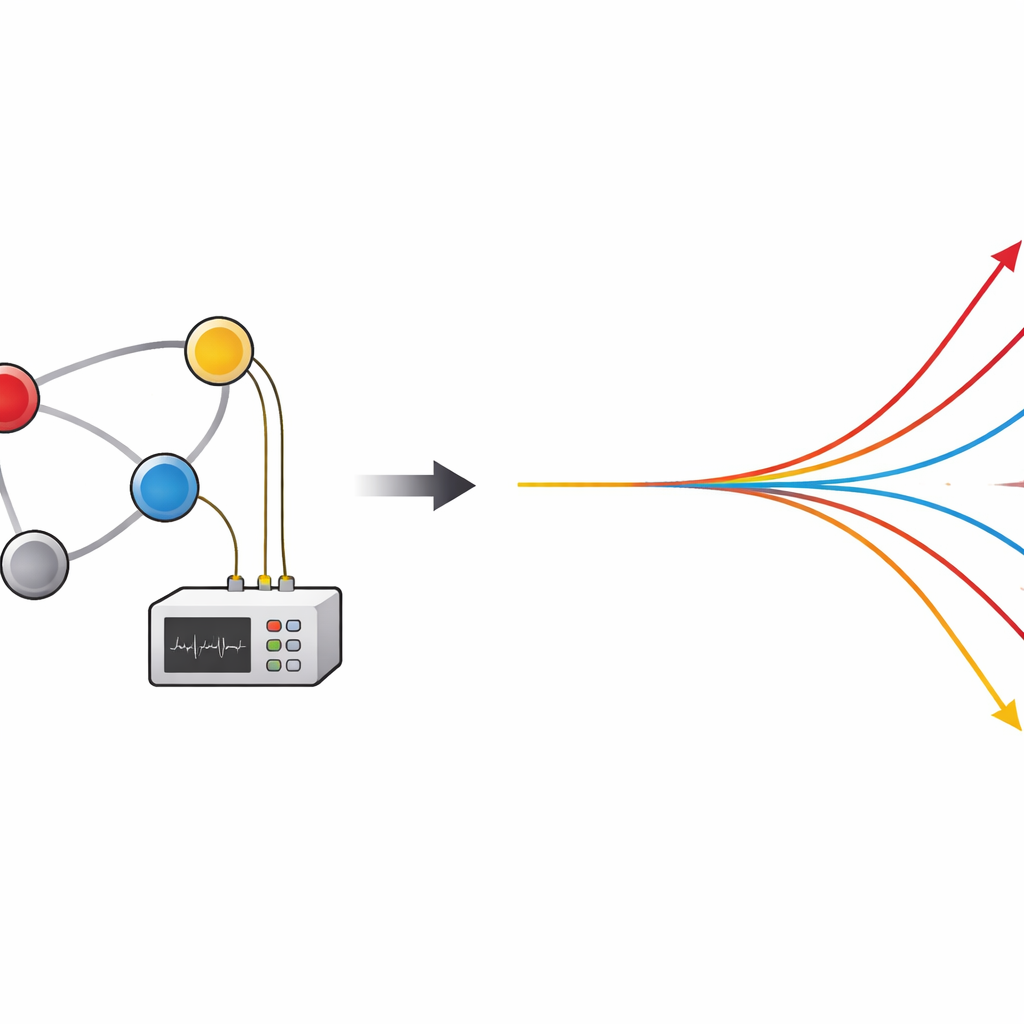
The central idea of this study is to replace the usual fixed gain, which pushes energy into the circuit at the same strength across all frequencies, with a gain that automatically changes with frequency. The authors recognize that this frequency dependence is already hidden in the measurement instrument itself, such as an impedance analyzer or vector network analyzer, which both drives the circuit and senses its response. Instead of searching for a minimum in reflected signal—the standard approach—they focus on the points where the imaginary part of the input impedance crosses zero. These zero-crossings correspond to conditions where the effective gain is purely real and varies with frequency, and this extra flexibility raises the mathematical order of the exceptional point that the circuit can realize.
Turning Theory into Working Hardware
To make the concept concrete, the researchers first study a simple pair of inductance–capacitance resonators that exchange energy, one with gain and one with loss. Under the traditional fixed-gain method, this setup supports a second-order exceptional point, where the frequency response scales like the square root of a tiny perturbation. When they instead use the impedance-based, frequency-dependent gain condition—by watching where the input impedance’s imaginary part becomes zero—the same physical hardware effectively hosts a third-order exceptional point. In this case, the relevant frequency shift grows with the cube root of the disturbance, and the observable mode remains sharply defined, avoiding the broadened spectral lines that can blur measurements.
Pushing to Even Higher Orders
The authors then extend their method to a slightly more complex circuit with three coupled resonators arranged so that two form a special kind of balanced loss pair, a configuration known as anti-parity-time symmetry. By perturbing only one of the lossy resonators and again enforcing the real-gain, frequency-dependent condition via impedance observation, they design the system so that five oscillation modes collapse into a single point. Around this fifth-order exceptional point, the frequency shift follows a one-fifth power law of the perturbation, giving an even steeper response to small changes. Importantly, this design achieves such a high order using only three tuning parameters, making it more practical than many previously proposed schemes that require many more knobs to adjust.
Why This Matters for Future Sensors
By showing that the measurement tool itself can act as a smart, frequency-dependent gain source, this work opens a path to higher-order exceptional points without resorting to nonlinear, self-oscillating electronics. The method yields real, narrow frequency lines, provides a clear way to lock precisely onto the exceptional point by counting impedance zero-crossings, and naturally fits into existing test equipment. In practical terms, it suggests that future sensors—electrical, optical, acoustic, or mechanical—could gain orders-of-magnitude higher sensitivity simply by rethinking how they are driven and read out, rather than by adding complicated new hardware.
Citation: Zhang, X., Zhu, Z., Hao, Y. et al. Observation of higher-order exceptional points using frequency-dependent gain. Commun Phys 9, 97 (2026). https://doi.org/10.1038/s42005-026-02561-3
Keywords: exceptional points, frequency-dependent gain, non-Hermitian circuits, ultrasensitive sensing, impedance spectroscopy