Clear Sky Science · en
Search for thermodynamically stable ambient-pressure superconducting hydrides in the GNoME database
Why Room-Temperature Superconductors Matter
Superconductors are materials that can carry electricity with zero loss, promising ultra-efficient power grids, powerful medical scanners, and levitating trains. The catch is that today’s best superconductors usually work only when cooled to extremely low temperatures or squeezed under immense pressures. This article explores whether a special class of hydrogen-rich materials, called hydrides, can become superconducting under everyday, room-pressure conditions—an essential step toward practical devices.

Hunting for Needles in a Crystal Haystack
Over the past decade, scientists have discovered hydrides that superconduct at temperatures close to those in a warm room, but only when they are compressed between diamond anvils at pressures more than a million times that of the atmosphere. Such conditions are unrealistic for real-world cables or electronics. At the same time, theory has hinted that some hydrides might superconduct at much lower pressures, even at normal atmospheric pressure, but many of these promising phases appear too unstable to exist outside the computer. The central question of this work is whether there are hydrides that are both thermodynamically stable at room pressure and capable of superconductivity high enough to be interesting for technology.
Letting a Smart Database Do the Heavy Lifting
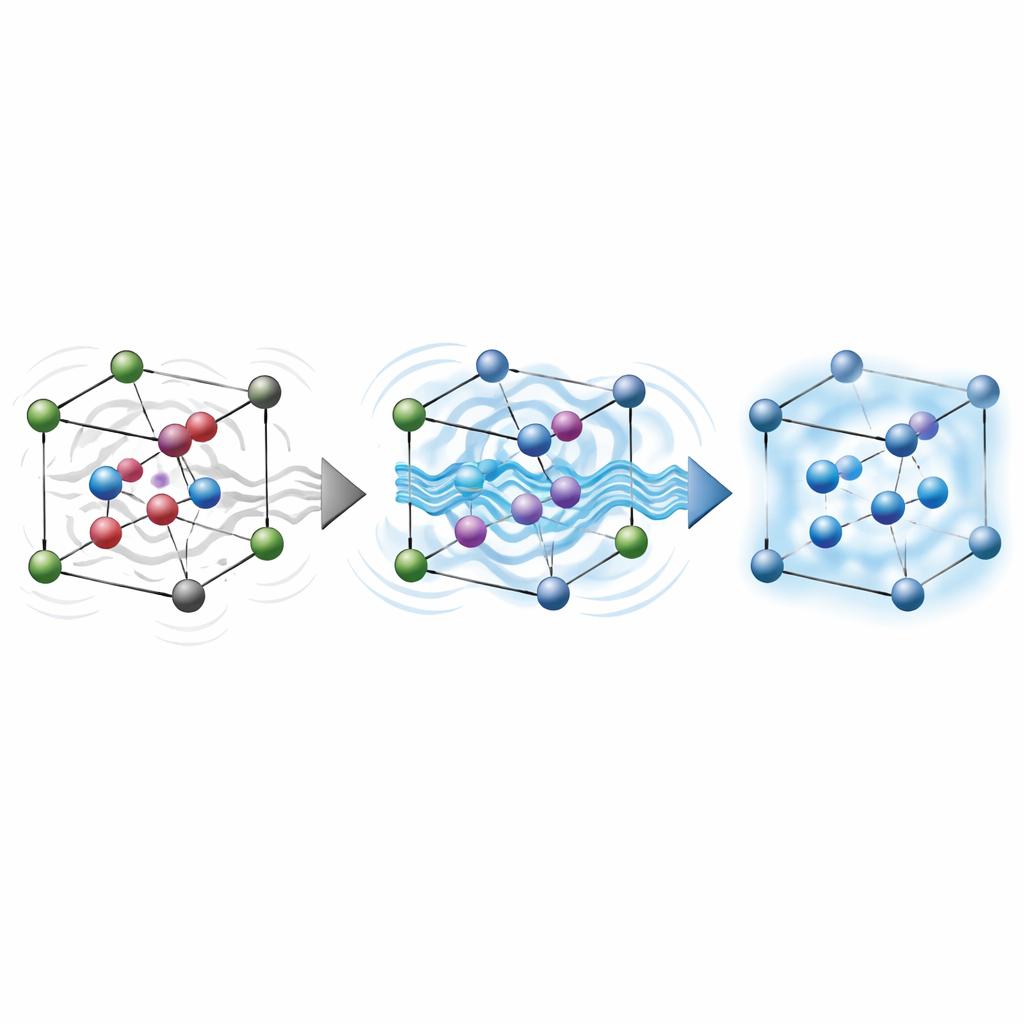
The authors turned to a recently released resource called the GNoME database, a massive collection of computer-predicted crystals judged to be stable at absolute zero. Among more than 300,000 candidates, they first filtered out materials that were not metallic and focused on those with cubic crystal shapes, a pattern already known to favor superconductivity in hydrides. This produced a manageable set of a few hundred hydrides. To avoid the immense computational cost of analyzing each one in full detail, they used a machine-learning model—an advanced neural network trained on known superconductors—to quickly estimate the transition temperature at which each material would become superconducting.
From Fast Guesses to Careful Calculations
Only the most promising candidates from the machine-learning stage were passed on to more exacting quantum-mechanical calculations. These high-precision simulations treated how electrons in a material interact with vibrations of the crystal lattice, which is the key conventional mechanism behind superconductivity. In this second stage, the researchers computed more reliable transition temperatures and identified 25 hydrides that should superconduct at temperatures above the boiling point of liquid helium (4.2 kelvin). Most of these fall between 5 and 10 kelvin, similar to some commercial superconducting alloys, but crucially they are predicted to be thermodynamically stable at ambient pressure, making them more realistic targets for experimental synthesis.
A Standout Candidate and Its Inner Workings
One compound, a cubic hydride called LiZrH6Ru, emerged as the star of the survey. Initial estimates suggested a transition temperature above 20 kelvin, already remarkably high for a stable, ambient-pressure hydride. The team then subjected this material to a battery of advanced theoretical tests, including methods that account for quantum motion of hydrogen atoms, subtle electron–electron repulsion effects, and the possibility of different electronic bands contributing differently to superconductivity. These increasingly sophisticated treatments lowered the best estimate of the transition temperature to around 17 kelvin but also strengthened confidence that the prediction is realistic. They further showed that squeezing the material moderately could raise its transition temperature even more, while still remaining far below the colossal pressures seen in record-breaking hydrides.
Promise, Limits, and Next Steps
Although none of the discovered hydrides come close to room-temperature performance at ambient pressure, this study delivers an important message: when the requirement of true thermodynamic stability is strictly enforced, the most realistic superconducting hydrides at normal pressure are expected to have modest, but still technologically relevant, critical temperatures in the tens of kelvin at best. The authors argue that their carefully vetted list of 25 candidates, especially LiZrH6Ru, offers experimentalists a concrete and achievable set of targets. Confirming these predictions in the laboratory would both advance potential applications and sharpen the tools used to search the vast space of possible superconducting materials.
Citation: Sanna, A., Cerqueira, T.F.T., Cubuk, E.D. et al. Search for thermodynamically stable ambient-pressure superconducting hydrides in the GNoME database. Commun Phys 9, 94 (2026). https://doi.org/10.1038/s42005-026-02552-4
Keywords: superconductivity, hydrides, machine learning, materials discovery, ambient pressure