Clear Sky Science · en
Batch Bayesian optimization of attosecond betatron pulses from laser wakefield acceleration
Why Faster X-Ray Flashes Matter
Our ability to watch electrons move inside atoms and materials is limited by how fast we can take "snapshots" of them. Attosecond X-ray flashes—bursts a billion times shorter than a billionth of a second—could let scientists follow these motions in real time, revealing how chemical bonds break, how new materials respond to stress, or how biological molecules change shape. This paper explores how to make such tiny X-ray flashes dramatically brighter using a compact, laser-driven setup, potentially bringing ultrafast X-ray science to many more laboratories.
A Tiny Accelerator in a Puff of Gas
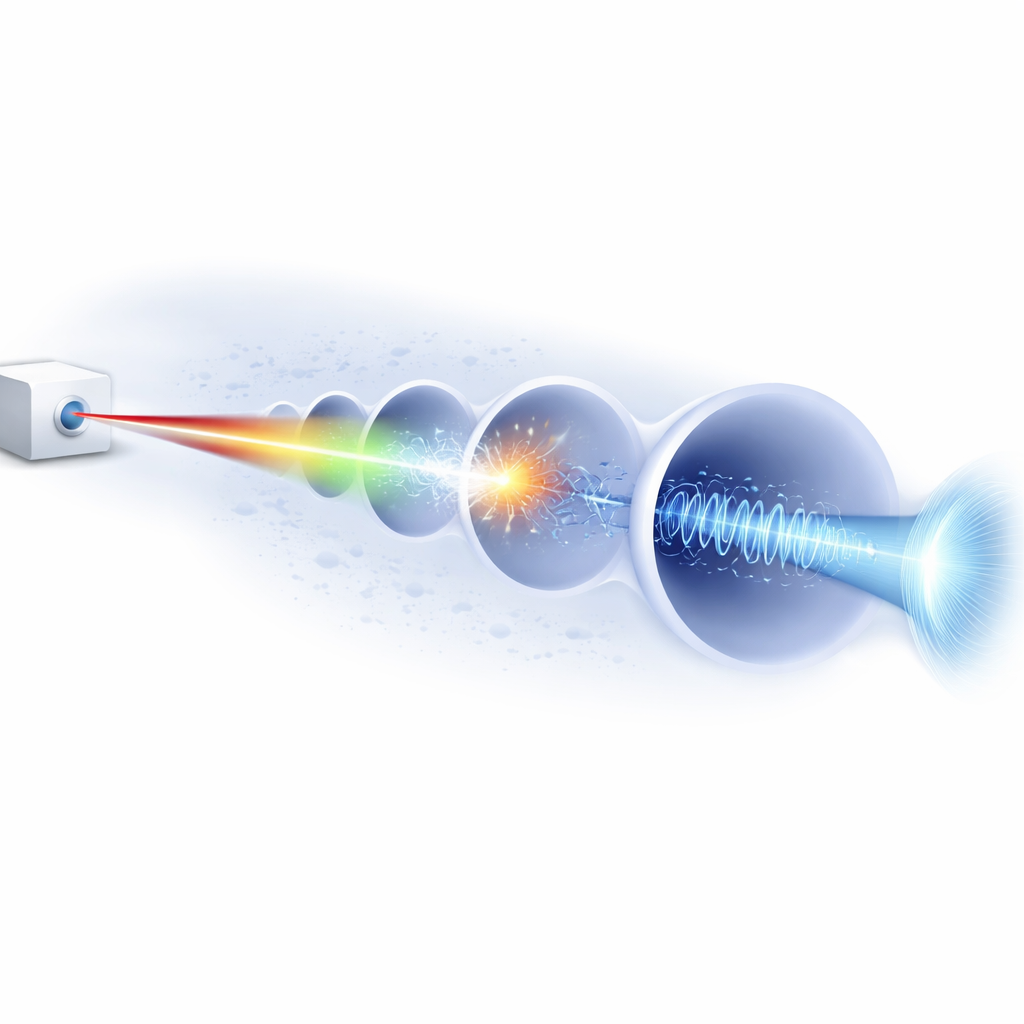
Instead of the huge, circular machines used in conventional X-ray facilities, the authors focus on a tabletop approach called laser wakefield acceleration. A powerful, ultrashort laser pulse is shot into a thin gas that has been turned into plasma. As the laser plows through, it pushes electrons aside and leaves behind a series of hollow “bubbles” in its wake. Inside these bubbles, electrons are pulled forward and side-to-side at nearly the speed of light, a motion that makes them radiate X-rays, much like electrons in a giant synchrotron, but on a length scale no larger than a human hair.
Making Brighter Flashes with a Sharp Bump
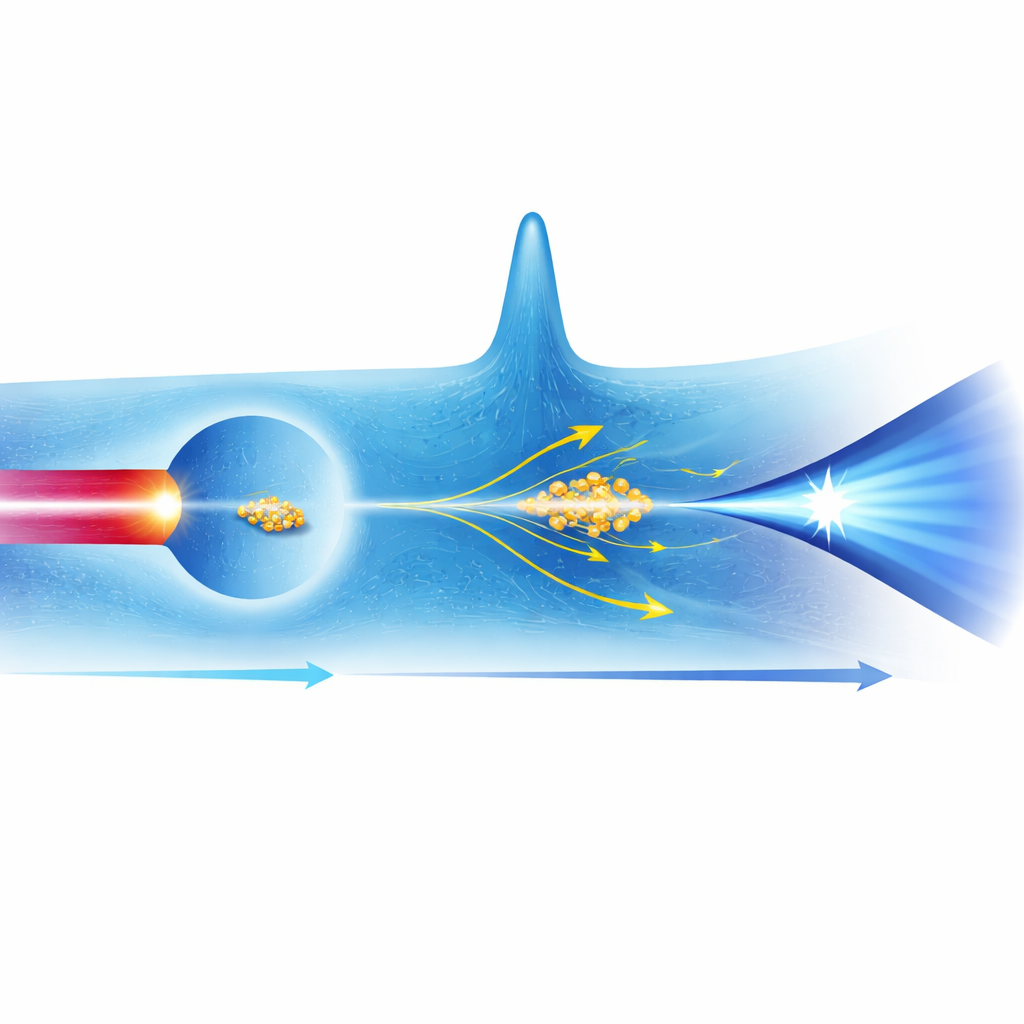
The central idea of this work is that the brightness and color of the X-ray pulse depend strongly on how many electrons are trapped in the bubble, how energetic they become, and how violently they wiggle. Rather than adjusting just a single setting, the researchers deliberately reshape the plasma itself by adding a sharply localized spike in density further along the laser’s path. This spike briefly squeezes the bubble, shoving electrons toward the region of strongest acceleration and triggering a second, more intense injection of electrons. The result is a high-charge, ultrashort electron bunch that radiates a much stronger attosecond X-ray flash than in a uniform plasma.
Letting the Computer Hunt for the Sweet Spot
Finding the best shape and position for the density spike is not straightforward: three different parameters—the distance from the initial injection, the length of the spike, and how dense it becomes—interact in a complicated way. Each trial requires a demanding three-dimensional simulation of the laser and plasma, followed by a separate calculation of the resulting X-ray emission. To navigate this maze efficiently, the team uses batch Bayesian optimization, a machine-learning strategy that builds a probabilistic model of how input settings influence the outcome, then proposes new, promising parameter combinations to test in parallel. This approach lets them explore the most informative regions of the design space using only a few dozen expensive simulations.
Sharper, Stronger, and Still Ultra-Fast
Using this guided search, the authors identify a regime where the plasma density spike is placed just a few micrometers after the initial injection region, extends over roughly one tenth of a millimeter, and reaches four times the base density. Under these conditions, the main X-ray burst becomes more than 25 times stronger at its peak and more than six times higher in energy content within its central half, while its effective duration shrinks to just a few tens of attoseconds. The spectrum also shifts so that more photons reach higher energies, into the range useful for probing heavier elements and dense matter. Detailed analysis of the simulated plasma shows that the enhancement comes specifically from the second electron injection triggered by the spike, which builds a powerful new electron bunch that even starts to drive its own wakefield.
What This Means for Future X-Ray Tools
In plain terms, this study demonstrates a recipe for turning a modest laser and a shaped gas target into a much brighter attosecond X-ray source. By carefully sculpting the plasma and letting a smart optimization algorithm home in on the best settings, the researchers show that compact, low-cost setups could someday deliver X-ray flashes intense and fast enough for advanced imaging and spectroscopy—without needing a kilometer-scale facility. While the exact configuration may not be globally perfect, the work proves that combining physical insight with machine learning can uncover powerful operating regimes and guide future experiments toward next-generation ultrafast X-ray tools.
Citation: Maslarova, D., Hansson, A., Luo, M. et al. Batch Bayesian optimization of attosecond betatron pulses from laser wakefield acceleration. Commun Phys 9, 92 (2026). https://doi.org/10.1038/s42005-026-02542-6
Keywords: attosecond X-rays, laser wakefield acceleration, betatron radiation, Bayesian optimization, plasma accelerators