Clear Sky Science · en
Efficient spin-orbit torque switching in a magnetic insulator via ultrathin Pt and light metal overlayers
Turning Electricity into Tiny Magnetic Pushes
Modern technologies, from data centers to smartphones, rely on flipping tiny magnetic bits to store and process information. Doing this quickly while wasting as little energy as possible is a central challenge for future electronics. This study explores how ultrathin layers of common metals, arranged just a few atoms thick on top of a special magnetic insulator, can convert ordinary electrical currents into powerful microscopic pushes on magnetism—potentially leading to cooler, faster, and more efficient memory and logic devices.
A New Way to Nudge Magnetism
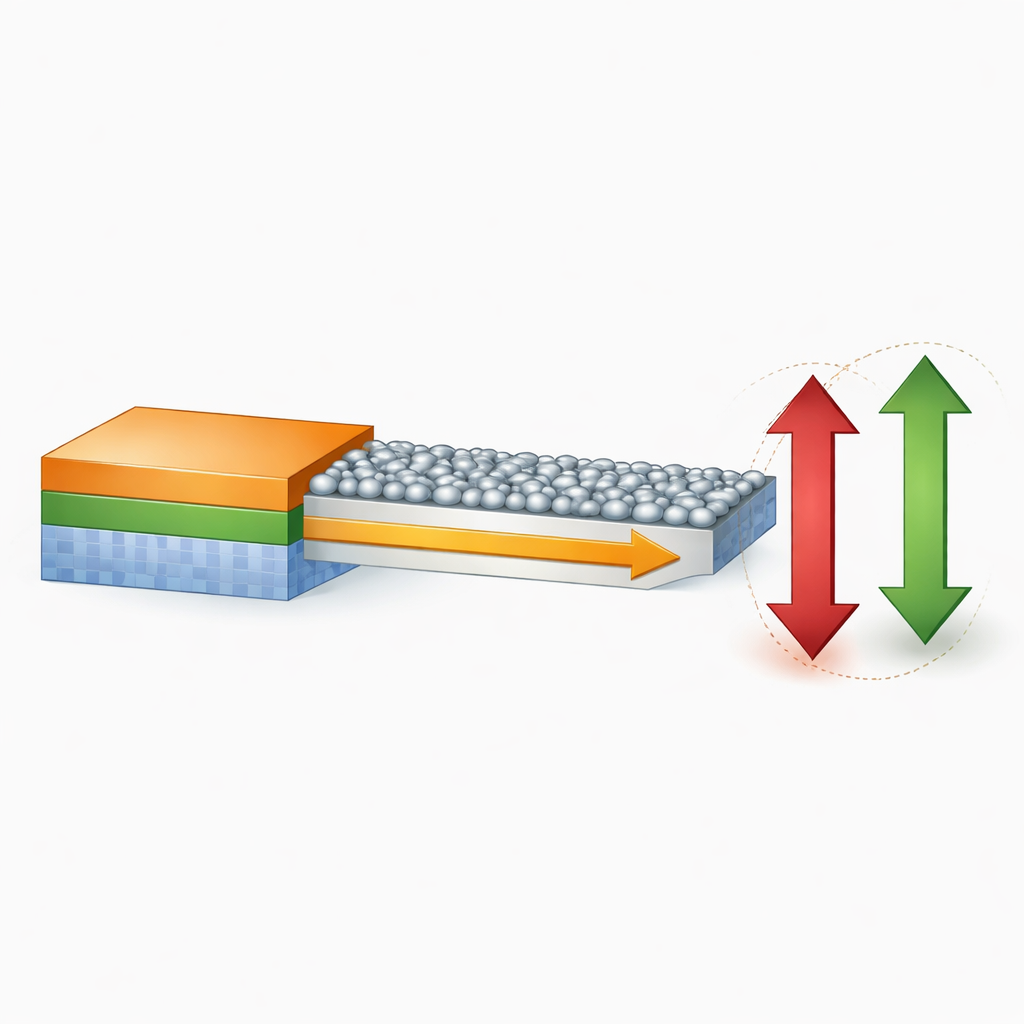
In today’s spin-based electronics, or “spintronics,” electrical currents do more than carry charge: they can also carry angular momentum that twists nearby magnets. This twisting action, known as a torque, usually arises from heavy metals like platinum, which are prized because they naturally convert charge currents into “spin currents.” The conventional view is that thick, uniform platinum films are ideal for this conversion. Here, the authors challenge that picture by studying platinum films that are far thinner than a nanometer—only a few atomic layers—placed on a magnetic insulator made of terbium iron garnet. Surprisingly, they find that these ultrathin, structurally irregular platinum layers can switch the magnetization of the insulator as efficiently as much thicker films, even though there is much less material to work with.
Granular Metals: Islands that Help Rather than Hurt
High-resolution electron microscopy reveals that these ultrathin platinum films are not smooth sheets but rather mosaics of nanoscale grains separated by narrow gaps. As more platinum is added, isolated islands gradually grow and merge until a continuous film forms around a nominal thickness of about one nanometer. Electrical measurements show that this granular structure strongly affects how current flows: at the thinnest limits, the resistance is high and current takes tortuous paths through the connected grains. Counterintuitively, the magnetization switching becomes more efficient in this ultra-granular regime. The authors argue that scattering of electrons at grain boundaries boosts the effectiveness of converting charge flow into angular momentum, and also concentrates current in certain regions, both of which amplify the microscopic torques acting on the magnetic layer beneath.
Light Metals Add Orbital Muscle
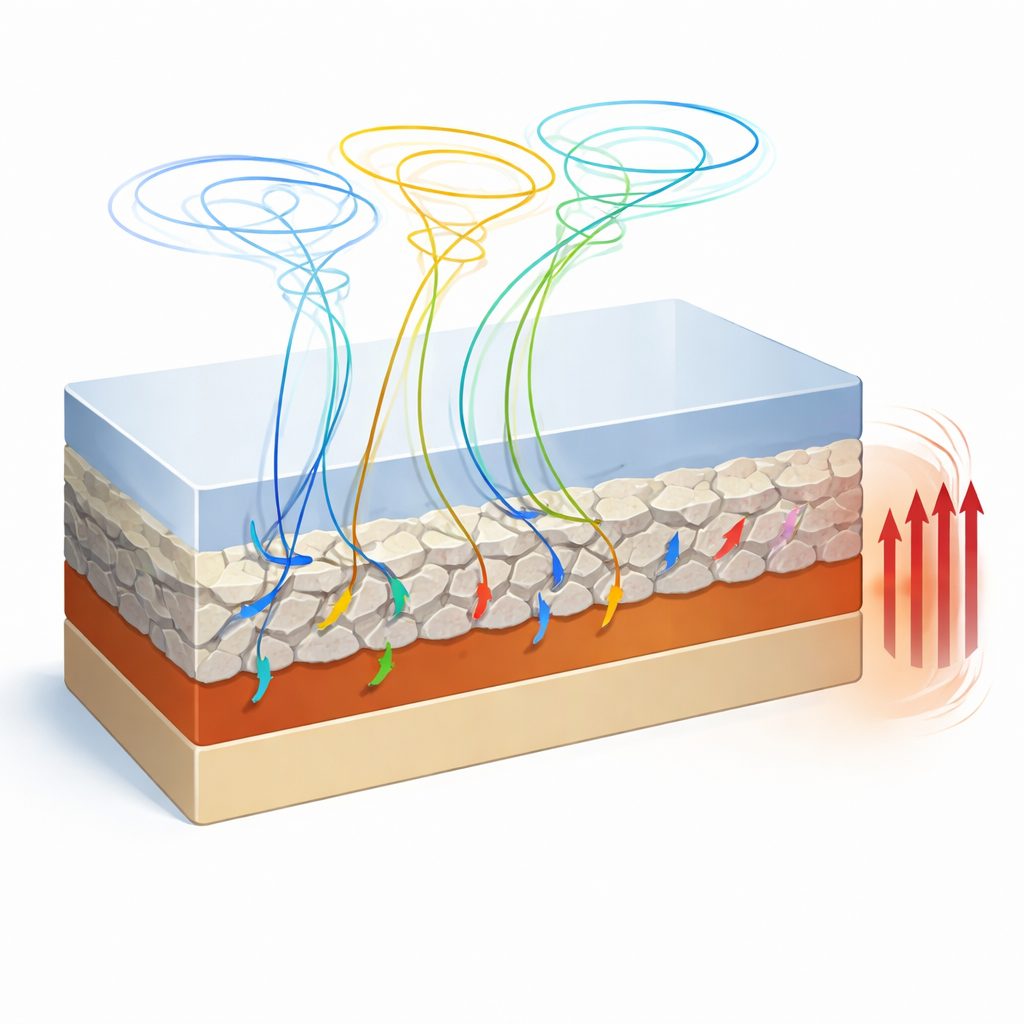
The team then asks whether “light” metals, which are more abundant and have weaker conventional spin interactions, can still help drive magnetic switching. They place titanium or manganese on top of a thin platinum layer and repeat their tests. Although titanium partly mixes with the underlying layers and slightly damages the magnetic interface, the overall current needed to flip the magnet drops by nearly an order of magnitude as the titanium cap is thickened. The authors connect this to a newer concept: the orbital Hall effect, in which currents of orbital angular momentum—rather than spin—are generated in light metals. These orbital currents travel into platinum, where they are converted into spin currents that act on the magnet. Manganese caps also lower the switching current and appear to strengthen magnetic behavior near the interface, further supporting the idea that light metals can actively contribute to the torque.
Engineering Structure Rather Than Just Materials
To test whether the unusual behavior can be traced back to film structure, the researchers simulate how platinum grains grow as more material is deposited. Their model reproduces three clear regimes: discontinuous islands, a percolating network where grains begin to connect, and finally a fully continuous film. When they compare these simulated morphologies with measured electrical resistance, they find a one-to-one match between structural regime and transport behavior. This agreement strengthens the case that nanoscale grain structure, and the resulting non-uniform current distribution, are central to the enhanced torque efficiency they observe in the thinnest films.
What This Means for Future Devices
Overall, this work shows that the microscopic shape and connectivity of metal layers can be just as important as the choice of material in designing efficient spin-based electronics. Nanogranular platinum, despite being extremely thin and structurally disordered, can deliver strong torques to a magnetic insulator, lowering the current needed for switching. Adding light metals such as titanium or manganese introduces an extra orbital channel that further reduces energy use. For a general reader, the key message is that by carefully engineering how metals grow and how different layers share angular momentum, researchers can build magnetic memory and logic elements that switch reliably using less power—opening pathways to more sustainable, high-performance computing hardware.
Citation: Fedel, S., Avci, C.O. Efficient spin-orbit torque switching in a magnetic insulator via ultrathin Pt and light metal overlayers. Commun Phys 9, 99 (2026). https://doi.org/10.1038/s42005-026-02539-1
Keywords: spintronics, magnetic memory, ultrathin metals, orbital Hall effect, energy-efficient switching