Clear Sky Science · en
Effects of stochastic games on evolutionary dynamics in structured populations
Why changing rules matter for cooperation
From climate agreements to shared fisheries and even online communities, our ability to work together often decides whether groups thrive or fail. Yet the social situations we face are rarely fixed: rewards, risks, and the very “rules of the game” shift over time as resources fluctuate, technologies emerge, or people react to one another’s choices. This article asks a deceptively simple question: when the rules keep changing in unpredictable ways, does that help or hurt cooperation in complex social networks?
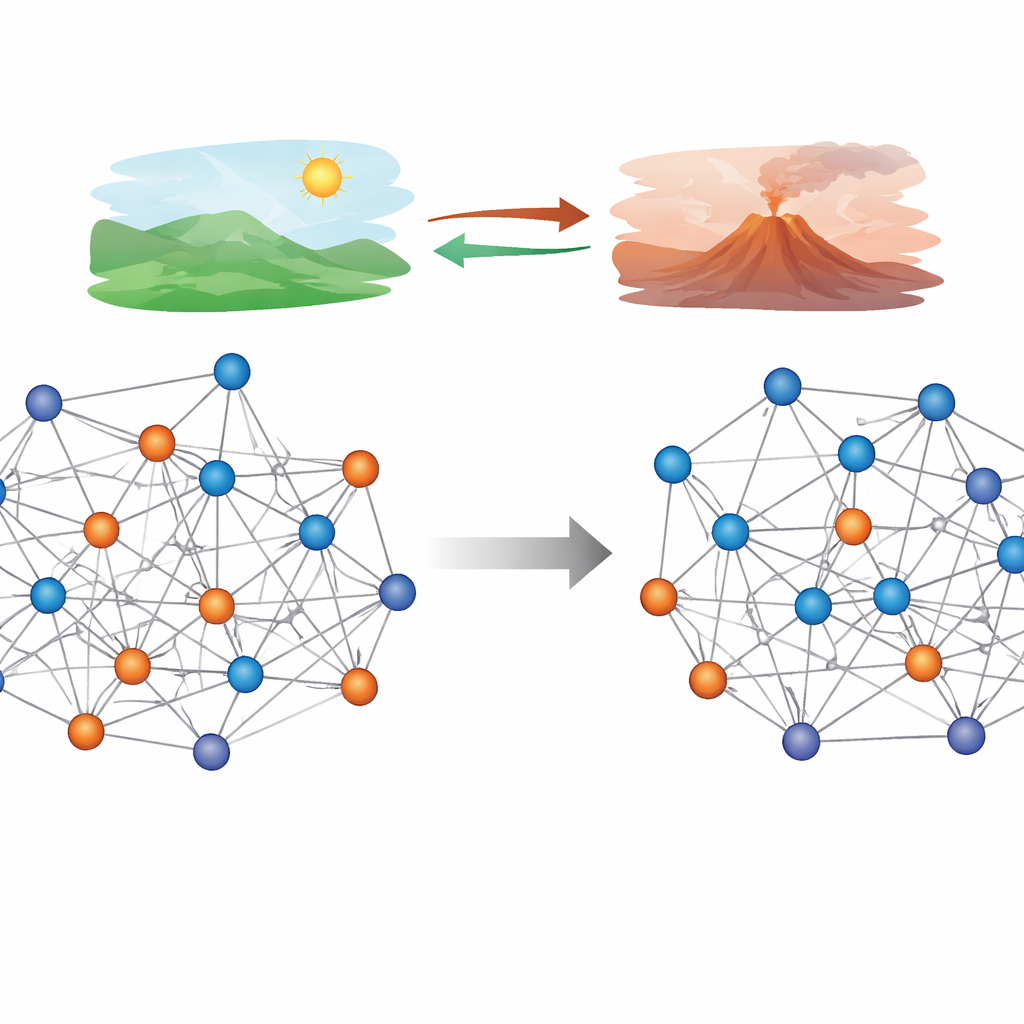
People on networks playing different kinds of games
The authors study a population represented as a network: dots stand for individuals and links stand for who interacts with whom. Each individual can either cooperate, paying a personal cost to help others, or defect, avoiding the cost while still reaping any shared benefits. On every link between two individuals, they repeatedly play one of several classic “social dilemma” games. These include donation-like situations, where one person directly helps another; public-goods situations, where contributions are shared; and snowdrift-like situations, where both benefit but prefer that the other shoulder more of the effort. Real societies mix these patterns, and the network itself can be highly uneven, with some individuals much more connected than others.
When the environment reshuffles the stakes
In many settings, outside forces change the incentives for cooperation. For example, climate conditions or market prices can suddenly make helping more or less rewarding. To capture this, the authors first analyze exogenous changes, where the game being played on each link switches randomly, independent of how people behave. Using a general mathematical framework valid for virtually any network, they calculate how often the environment needs to favor more profitable cooperative opportunities for cooperation to take hold. They show that if the random switches spend more time in generous settings, the threshold for cooperation drops; if the switches dwell in harsher settings, the threshold rises. Interestingly, when different game types alternate—such as donation and snowdrift games—even structures that normally cannot sustain cooperation, like star-shaped or fully connected networks, can sometimes be rescued by this environmental mixing.
When behavior itself rewrites the rules
Real environments often react to behavior: widespread cooperation can improve shared resources, while widespread defection degrades them. To model this feedback, the authors next study endogenous game changes, where the game on a link shifts depending on how its two players acted. Mutual cooperation makes the next interaction more profitable, while unilateral cooperation or mutual defection shifts the link toward a less rewarding setting. By translating this time-varying process into an “effective game,” they derive when cooperation can spread on complex networks. They find a striking asymmetry: in donation-like situations, this kind of feedback strongly supports cooperation, lowering the benefit that each cooperative act must provide to succeed. In public-goods and snowdrift settings, however, the same feedback can actually make cooperation harder, raising the bar instead of lowering it.
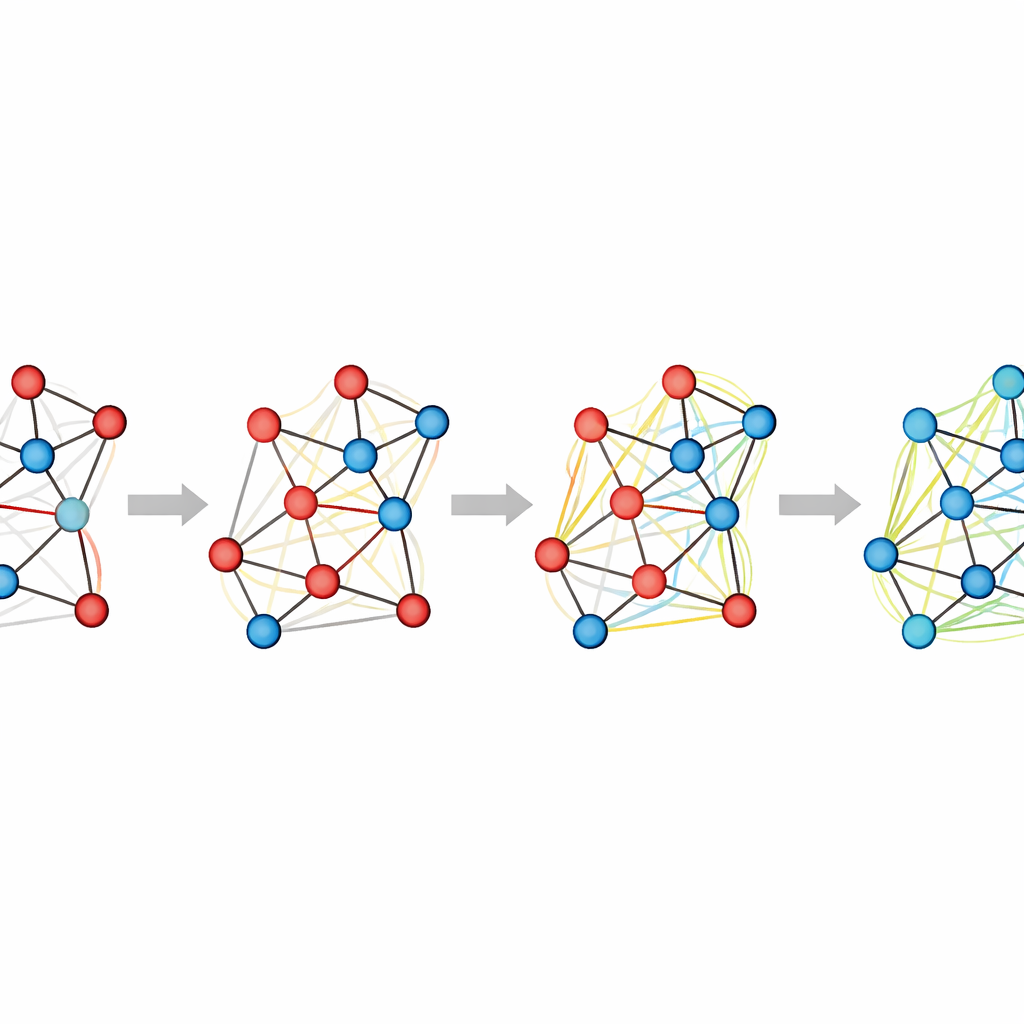
Networks from nature and society under changing games
To test how robust these patterns are, the researchers apply their theory to both idealized networks and real social data, including grooming networks of primates, association networks of beetles and dolphins, and friendship networks among humans. Across these diverse cases, the same theme appears: dynamic game changes reliably promote cooperation in direct helping scenarios but often suppress it when payoffs come from shared public goods or snowdrift-like situations. They also explore how adjusting the costs instead of the benefits—making cooperation cheaper after mutual help, for instance—can paradoxically shrink the conditions under which cooperation survives.
What this means for designing fairer systems
For a general reader, the key takeaway is that “changing the rules” is not a universal fix for social dilemmas. In some settings—especially when help is directed from one individual to another—linking better environments to past cooperation can dramatically expand the space where altruistic behavior flourishes, even in highly uneven networks. But in group or snowdrift-like dilemmas, the same strategy can backfire, unintentionally rewarding patterns that undercut cooperation. By providing a general mathematical toolkit that works on realistic, heterogeneous networks, this work offers guidance for designing policies and mechanisms—such as reward schemes, sanctions, or adaptive resource rules—that genuinely support cooperation instead of merely shifting the problem elsewhere.
Citation: Zhang, Y., Feng, M., Li, Q. et al. Effects of stochastic games on evolutionary dynamics in structured populations. Commun Phys 9, 101 (2026). https://doi.org/10.1038/s42005-026-02536-4
Keywords: evolution of cooperation, stochastic games, social networks, game transitions, social dilemmas