Clear Sky Science · en
Revisiting self-seeding mechanism by generating vector ultraviolet $${{{\rm{N}}}}_{2}^{+}$$ lasing
Lighting Up the Air Around Us
Imagine turning the air itself into a laser, creating bright ultraviolet beams that can travel long distances through the atmosphere. Such “air lasers” could someday help us remotely sense pollution, monitor climate gases, or probe dangerous environments from far away. But to harness them reliably, scientists must first understand exactly how these unusual light sources switch on. This paper tackles a long-standing puzzle about one of the best-known air lasers and shows that its power comes from a subtle, self-organizing glow rather than from an internal spark of laser light.
How Air Can Behave Like a Laser
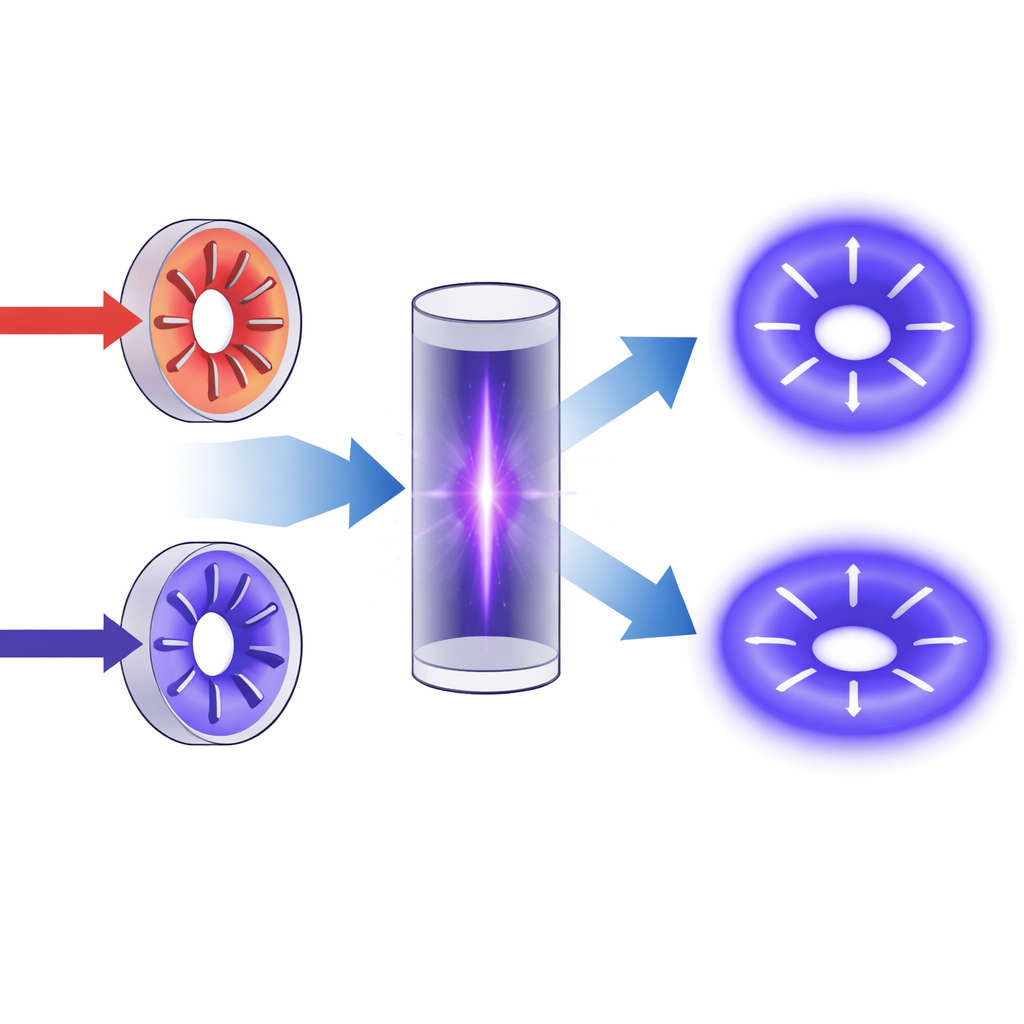
When an intense, ultrashort pulse from an 800-nanometer (near-infrared) laser travels through low‑pressure nitrogen gas, it rips electrons from molecules and creates a thin thread of plasma called a filament. Under the right conditions, this filament emits a bright, narrow band of ultraviolet light at 391 nanometers from ionized nitrogen (N+2). For over a decade, researchers have debated whether this emission behaves like a traditional laser that is “seeded” by a tiny initial signal at the same color, or whether it is a pure amplified spontaneous emission—a glow that builds up from random microscopic flashes. The distinction matters, because a seeded laser can be easier to control and synchronize, while an unseeded one depends more delicately on the medium itself.
The Suspected Hidden Spark
Two natural suspects have been proposed as internal seeds. One is self‑phase modulation, a nonlinear stretching of the pump pulse’s spectrum into a “white light” supercontinuum that could leak down to 391 nanometers. The other is second-harmonic generation, where the plasma’s uneven charge distribution converts part of the 800-nanometer light into its 400‑nanometer counterpart, close enough to the 391‑nanometer line to act as a trigger. At the low gas pressures and moderate pulse energies where the nitrogen air laser is strongest, self‑phase modulation is known to be weak and unable to reach such short wavelengths. That left second-harmonic generation as the dominant working hypothesis—until this study put it to a direct and stringent test using a special kind of tailored light.
Twisted Polarization as a New Test Tool
The authors used cylindrical vector beams, whose electric field points either radially outward (like spokes on a wheel) or tangentially around a circle (like arrows on a racetrack). These patterns strongly affect how the plasma’s electron density gradients line up with the driving field and therefore how efficiently second-harmonic light can form. In nitrogen, both radial and azimuthal beams produced bright ultraviolet emission at 391 nanometers with similar doughnut-shaped profiles and matching polarization patterns, meaning the air lasing faithfully inherited the structure of the pump. But when the team switched to argon gas—chosen so that only second-harmonic light, not line emission, would appear—the difference was striking: radially polarized beams generated a clear second-harmonic signal, while azimuthally polarized beams produced essentially none.
Watching the Phase to Track the Origin
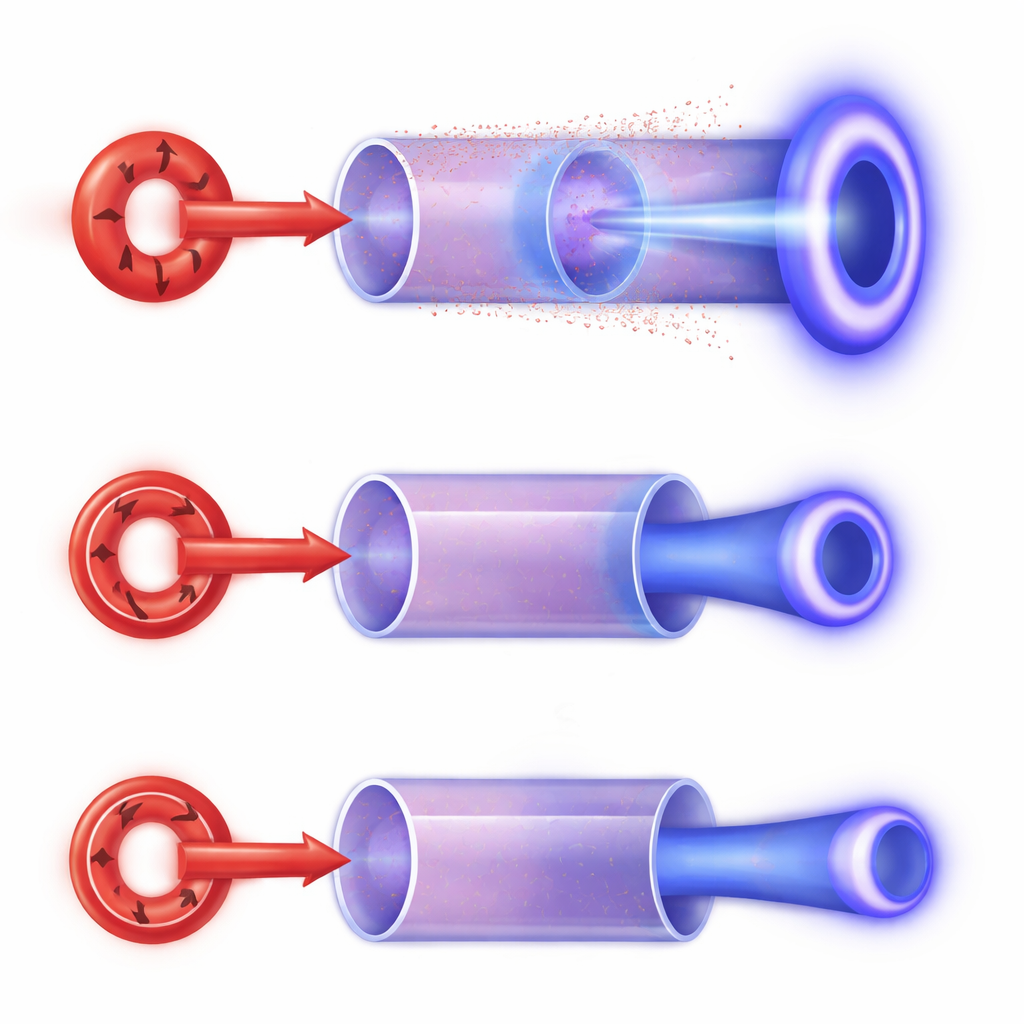
To further probe the mechanism, the researchers examined the spatial phase—the way the light’s wavefront varies across the beam—using a cylindrical lens. In a seeded process, the amplified light should preserve the phase structure of its seed; in a typical second-harmonic process, the phase would effectively double. The measurements showed that the 391‑nanometer emission stayed synchronized with the original 800‑nanometer pump, not with any doubled pattern. Numerical simulations backed this up and also showed how many tiny, random spontaneous flashes within the plasma can, in an anisotropic gain medium shaped by the pump’s polarization, self‑organize into a coherent, cylindrically polarized beam. In other words, the gain geometry and molecular alignment steer the random glow into a well-structured output without needing a sharp seed pulse.
What This Means for Future Air Lasers
The combined evidence—absence of a useful continuum seed, presence of lasing with and without second-harmonic light, mismatch between second-harmonic beam shapes and the observed air lasing, and direct phase measurements—points to a clear conclusion: under the commonly used conditions of low gas pressure and multi‑cycle 800‑nanometer pulses, the 391‑nanometer nitrogen air laser is powered by amplified spontaneous emission, not by self-seeding second harmonics. This insight not only settles a central debate about how this air laser turns on, but also shows that carefully shaped laser beams can imprint their structure onto ultraviolet light generated meters away in a gas. That opens the door to remote, vector-structured ultraviolet sources that could be tailored for advanced sensing, spectroscopy, and ultrafast studies of the atmosphere.
Citation: Gao, J., Wang, Y., Mei, H. et al. Revisiting self-seeding mechanism by generating vector ultraviolet \({{{\rm{N}}}}_{2}^{+}\) lasing. Commun Phys 9, 103 (2026). https://doi.org/10.1038/s42005-026-02535-5
Keywords: air lasing, ultraviolet plasma, cylindrical vector beams, second harmonic generation, amplified spontaneous emission