Clear Sky Science · en
Probing orbital currents through inverse orbital Hall and Rashba effects
Electrons with a New Kind of Motion
Most of today’s information technology already relies on the charge and spin of electrons. This work explores a third, less familiar property: the way electrons whirl around atoms, known as their orbital motion. The authors show that this hidden motion can carry information and even outperform spin-based effects in common metals and semiconductors. Their experiments reveal how to generate, guide, and detect these “orbital currents,” opening paths toward faster and more efficient electronic devices.
From Spintronics to Orbitronics
For two decades, spintronics has used the tiny magnetic orientation of electrons to store and move data, but it typically needs heavy elements with strong relativistic effects to work well. Orbitronics broadens this concept by using the electron’s orbital motion, which can exist even in lighter materials such as titanium, copper, and germanium. Theoretical studies predicted that orbital currents could be very strong and might even exceed familiar spin currents. Until recently, however, these orbital flows were hard to isolate and measure, because spin and orbital motions are often intertwined inside solids.
Layered Structures as Orbital Current Factories
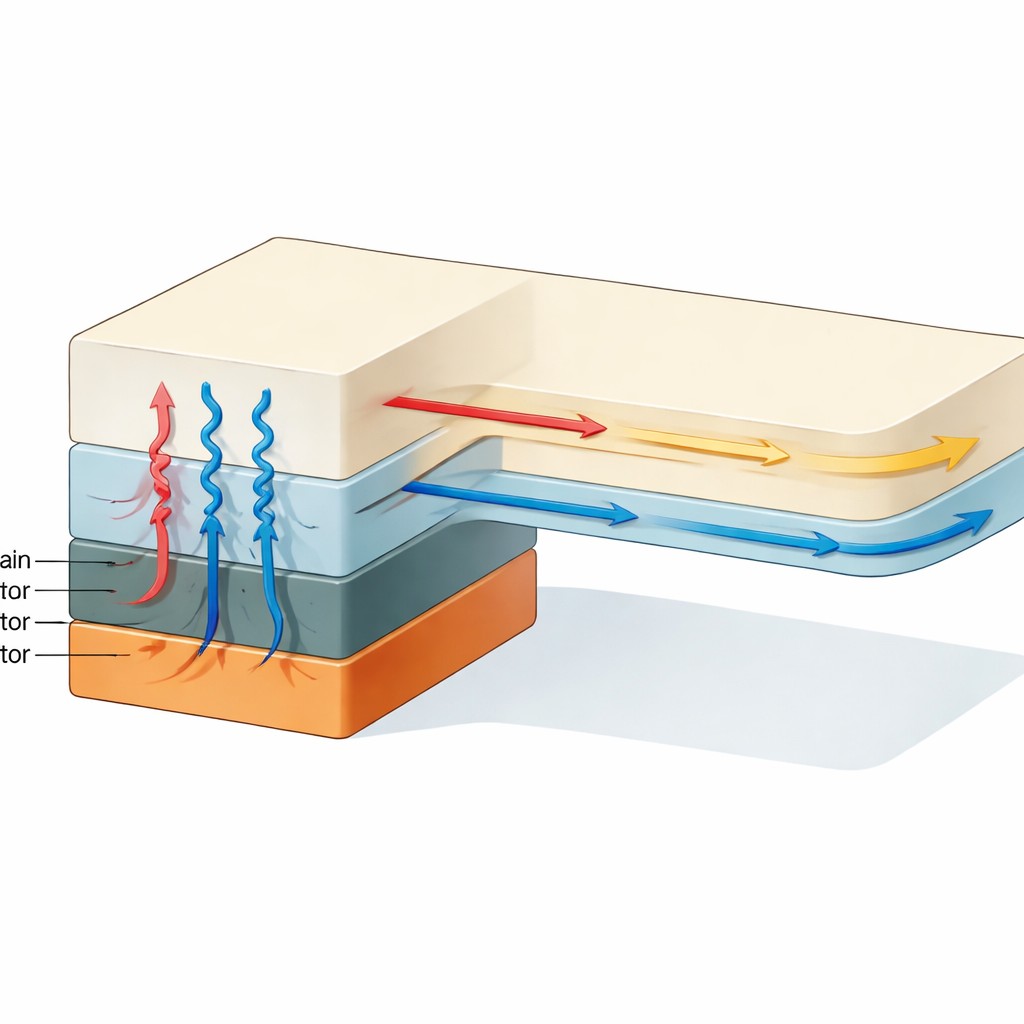
The researchers built carefully designed stacks of thin films, each only a few billionths of a meter thick. A common structure places a magnetic insulator called yttrium iron garnet at the bottom, a very thin layer of platinum in the middle, and a third metal or semiconductor layer on top. By exciting the magnet with microwaves (spin pumping) or a temperature difference (the spin Seebeck effect), they drive a flow of angular momentum into the platinum. There, strong internal forces partly convert spin motion into orbital motion, which then leaks into the top layer and is turned into an ordinary electric current that can be measured at the edges of the sample.
Interfaces that Supercharge Orbital Signals
One striking discovery is that a naturally oxidized copper layer placed on platinum produces a dramatic boost in the measured signals. The authors link this to a special interfacial effect: at the boundary between copper oxide and platinum, electron orbitals from copper and oxygen hybridize in a way that strongly favors orbital motion along the surface. This “orbital Rashba” effect efficiently converts orbital currents into measurable charge flow. By comparing stacks with and without the oxidized copper, and by changing which layer is on top, they show that this enhancement is truly interfacial and largely independent of current direction, as long as orbital motion reaches that boundary.
Light Materials with Strong Orbital Responses
The team then turns to bulk orbital transport in titanium, germanium, gold, and other metals. When titanium films are added on top of the platinum, the detected currents grow far beyond what is expected from spin effects alone, pointing to a strong orbital Hall effect: orbital motion is deflected sideways to produce a transverse current. Germanium behaves in the opposite way. Its orbital response has the reverse sign, so adding a germanium layer partly cancels the platinum contribution and can nearly extinguish the signal. Gold shows a weaker but still detectable behavior. By fitting these trends with a diffusion model, the authors extract key quantities such as how far orbital information can travel and how efficiently it is turned into charge, finding that orbital effects dominate over spin in these systems.
Zooming In on Orbital Flow Through Metals
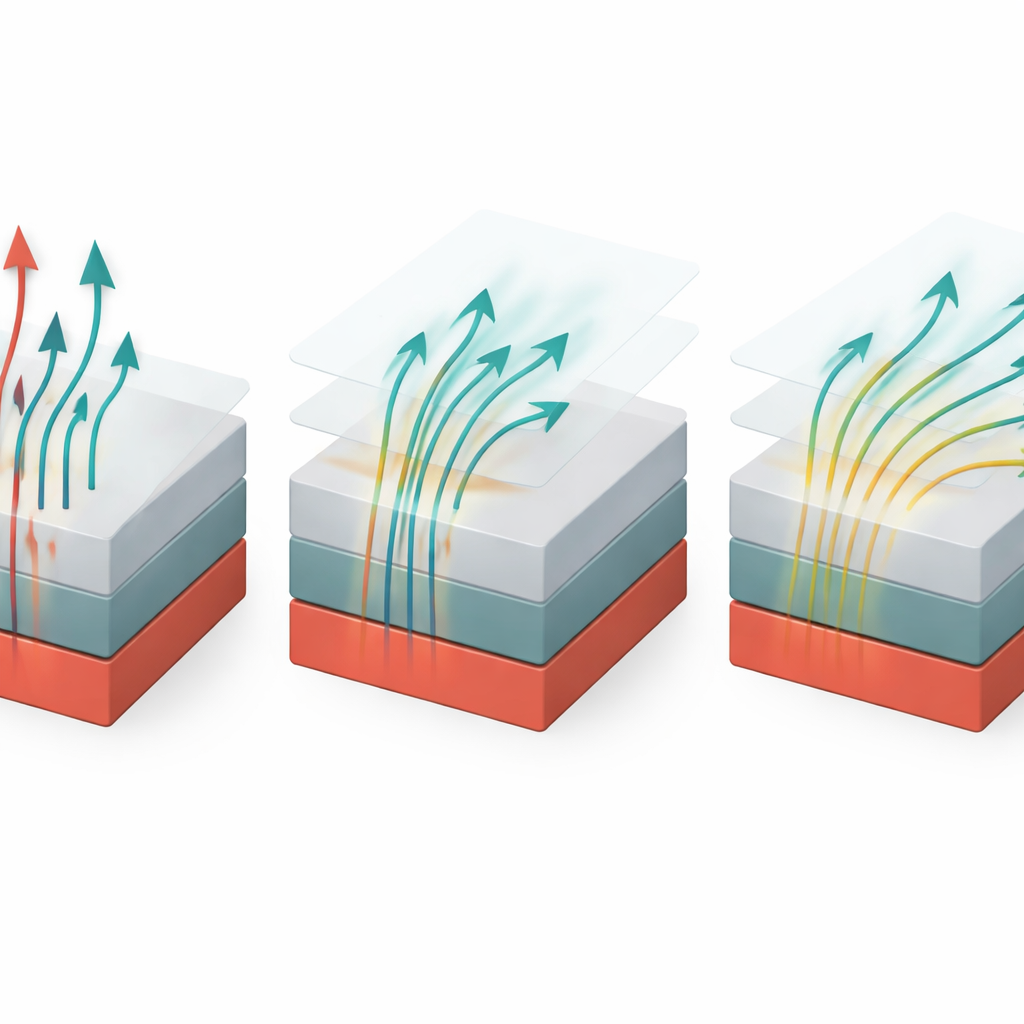
To directly examine how orbital currents propagate, the researchers vary the thickness of the platinum layer that sits between the magnetic source and the orbital-sensitive top metal. When the top layer is titanium, signals first grow and then level off as platinum thickness increases. When the top layer is gold, the signals instead dip before saturating. These opposite trends reflect the opposite signs of the orbital response in the capping layers: titanium adds to platinum’s signal, while gold subtracts from it. Additional tests using magnetic metals like cobalt and nickel confirm that these materials can also inject orbital currents into oxidized copper, especially when spin–orbit forces are moderately strong. Together, these comparisons provide a consistent picture of orbital currents diffusing, transforming, and converting into charge across different materials.
What This Means for Future Electronics
In simple terms, the study proves that electrons’ orbital motion is not just a theoretical curiosity—it is a powerful, tunable resource for carrying electrical signals. The authors provide direct experimental evidence for two key processes, the inverse orbital Hall and inverse orbital Rashba effects, across a family of metals and semiconductors. Because orbital currents can be large even in light elements, they offer a promising route to low-power memory and logic devices that go beyond conventional spintronics. By learning how to engineer interfaces and layer combinations that favor orbital motion, researchers move closer to practical orbitronic technologies where information is written, moved, and read using the swirling paths of electrons.
Citation: Santos, E., Costa, J.L., Rodríguez-Suárez, R.L. et al. Probing orbital currents through inverse orbital Hall and Rashba effects. Commun Phys 9, 98 (2026). https://doi.org/10.1038/s42005-026-02534-6
Keywords: orbitronics, orbital Hall effect, spin pumping, thin film heterostructures, spintronics